
Metal CNC machining explained
What the process is and how precision is actually achieved.
CNC Machining Guide
Metal CNC machining is computer-controlled material removal from a metal workpiece. This guide covers milling, turning, 3-, 4- and 5-axis work, tolerances, materials, design rules and cost drivers.
What the process is and how precision is actually achieved.
Seven steps from CAD review to inspected part.
Milling, turning, mill-turn, drilling and wire EDM compared.
Aluminum, stainless steel, carbon steel and engineering plastics.
Where machining wins and where it costs more.
Practical drawing rules that keep parts machinable.
Automotive, industrial, medical and aerospace parts.
Cost drivers, buyer levers and how to start a quote.
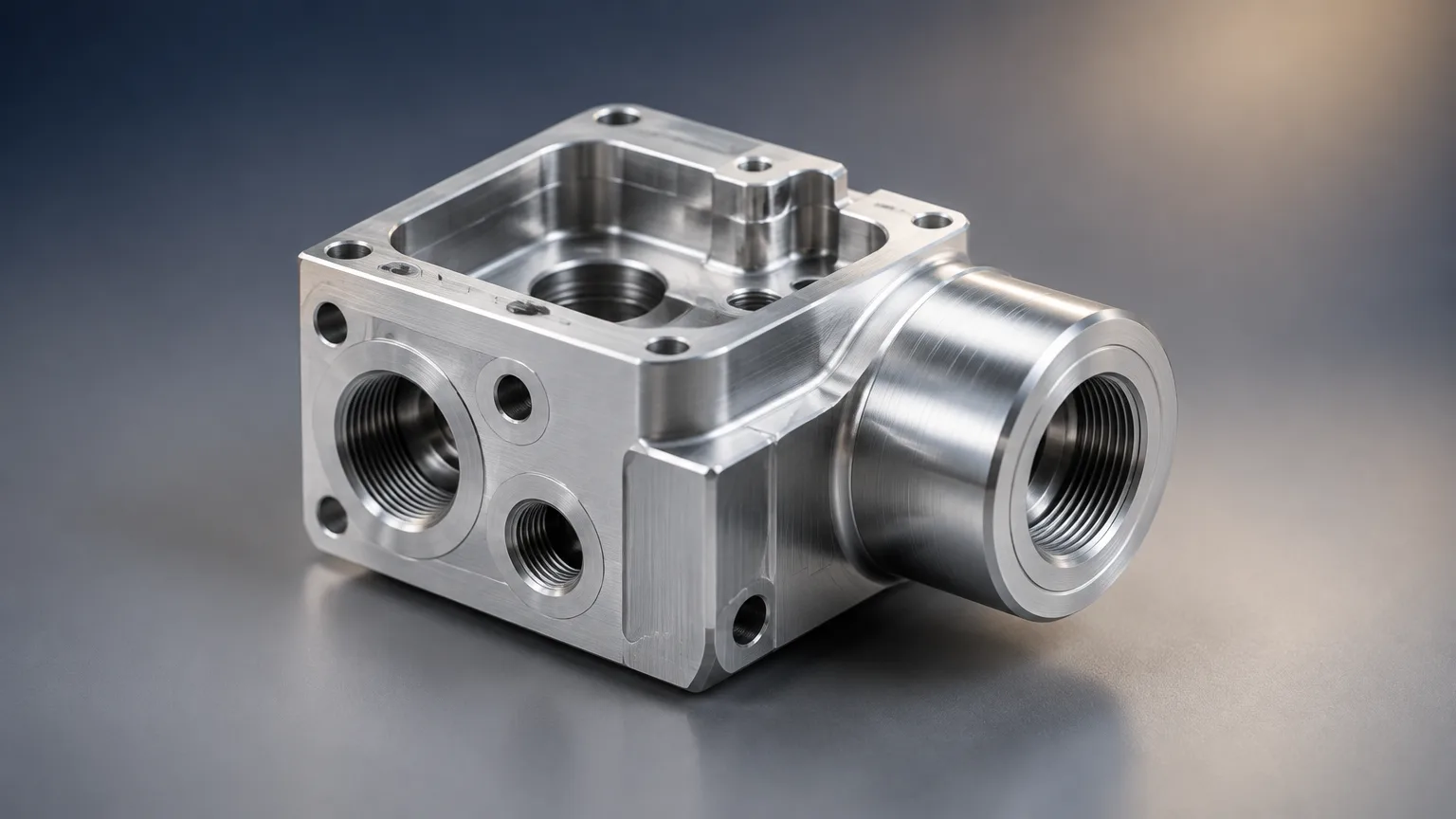
Metal CNC machining is computer-controlled removal of metal from a workpiece using milling, turning, drilling or related processes. Precision comes from controlled programming, fixturing, tooling, temperature management and inspection. A commonly reported general tolerance is ±0.005 in (±0.13 mm), but required accuracy must be defined on the drawing rather than assumed.
Metal CNC machining is a subtractive process: a computer-controlled machine moves a cutting tool through metal and removes material until the part matches the CAD model. Milling, turning, drilling and tapping are the common routes, and each suits a different part geometry.
Precision is not automatic. It is achieved through controlled programming, fixturing, tooling, temperature management and inspection. The required accuracy must be defined on the drawing rather than assumed, because capability depends on the process, material, geometry and the supplier's equipment.
Geometric tolerancing is feature-specific and has no single universal range. It is called out per ASME Y14.5 or ISO 1101 as specified by the drawing. Where a drawing is silent, the shop applies a default, and that default may not match your function.
Metal CNC machining follows a fixed sequence from drawing to inspected part. Each step feeds the next, so skipping one usually shows up as scrap or rework.
The main variations in metal CNC machining are defined by how the tool meets the workpiece and how many axes move at once. Axis count changes setup count, feature access and cost.
| Route | Strengths | Limitations |
|---|---|---|
| CNC milling | Handles prismatic parts, pockets, contours and multi-axis features. | Needs workholding access; deep cavities and thin walls add cost and distortion risk. |
| CNC turning | Efficient for shafts, bushings and threaded components. | Less suitable for non-rotational geometry; long slender parts may deflect. |
| Mill-turn machining | Combines turning and milling with fewer setups and better feature alignment. | Machine and programming costs are generally higher. |
| CNC drilling and tapping | Fast production of standardized holes and threads. | Hole location, chip evacuation and deep-hole access can limit capability. |
| Wire EDM | Can cut narrow slots and hard-material features, with reported ±0.0002–0.0004 in (±0.005–0.010 mm) capability. | Requires conductive material and is generally slower than milling. |
A 3-axis machine moves in X, Y and Z only, so undercuts need multiple setups or special fixtures. A 4-axis machine adds rotation, usually around one axis, so the part can be indexed without re-clamping. A 5-axis machine moves on two rotary axes at once, so the tool can approach from many directions in a single setup.
More axes generally mean fewer setups and access to complex contours, but higher machine rates and harder programming. Choose the lowest axis count that reaches every feature within tolerance.
| Comparison | Key differences |
|---|---|
| CNC machining vs 3D printing | Machining removes material and generally offers broad material choice and precise surfaces; 3D printing builds parts and may reduce tooling for complex prototypes. |
| CNC milling vs CNC turning | Milling suits prismatic and contoured parts; turning suits rotational parts. |
| Standard CNC vs precision CNC | Precision work uses tighter requirements, more controlled setups, specialized inspection and potentially slower feeds. |
| Prototype CNC vs production CNC | Prototypes prioritize speed and flexibility; production emphasizes repeatability, fixtures and cycle time. |
Material choice drives machinability, tool wear, achievable finish and dimensional stability. The grade and condition matter as much as the family name, so specify both on the drawing.
| Material | Grade | Properties | Typical uses |
|---|---|---|---|
| Aluminum | 6061-T6 | Lightweight, corrosion-resistant and generally machinable. | Brackets, housings, prototypes, fixtures and aerospace parts. |
| Stainless steel | 304 | Corrosion resistance, toughness and broad availability; work-hardening can increase machining difficulty. | Food, chemical, medical and general industrial components. |
| Stainless steel | 316 | Improved corrosion resistance relative to 304, especially in chloride environments. | Marine, chemical-processing, medical and sanitary hardware. |
| Carbon steel | AISI 4140 | Strength and toughness; machinability varies with heat treatment. | Shafts, tooling, fixtures and mechanically loaded parts. |
| Engineering plastic | POM/Delrin | Low friction, dimensional stability and good machinability. | Bushings, wear parts, guides and electrical-mechanical components. |
Metal and plastic differ in stiffness, thermal expansion, cutting behavior, workholding, tool selection and dimensional response. Supplier-specific limits must be verified for each material, and material properties should be checked against the applicable ASTM, EN or producer datasheet.
Metal CNC machining is strong on accuracy, material choice and repeatability, and weaker on cost at very high volumes or on parts with geometry that is hard to hold.
The practical question is not whether machining is better in general, but whether it fits the geometry, tolerance, material and quantity of a specific part. A part that is easy to mill may be expensive to turn, and the reverse is also true.
The most useful design tips for metal CNC machining are to tolerance only critical features, give the tool access and define material and finish on the drawing. Most cost and quality problems are decided at the drawing stage.
Metal CNC machining is used wherever a part must hold a defined shape and fit into an assembly. It covers both prototype and production metal parts.
The same part family can move between routes over its life. A prototype may be milled from plate for speed, while the production version is turned or mill-turn machined to cut cycle time and setups.
Cost in metal CNC machining is driven by machine time, setup count, material, tolerance and inspection. Buyers control most of these levers before the quote is issued.
| Cost driver | Why it matters | Practical lever |
|---|---|---|
| Tolerance | Tighter tolerances can need slower cutting, extra passes and more inspection; one supplier reports non-linear cost increases below about ±0.005 in (±0.13 mm). | Relax noncritical tolerances; reserve tight values for functional features. |
| Setup count | Each added setup adds labor, fixturing and alignment risk. | Consolidate compatible features; consider 4- or 5-axis access. |
| Geometry | Deep cavities, thin walls and slender parts raise distortion risk and cutting time. | Open up cavities, thicken walls and support slender sections. |
| Material | Work-hardening grades and hardened steels cut slower and wear tools faster. | Select a machinable grade that still meets the application. |
| Inspection | Specialized inspection and reporting add cost and lead time. | Define which features need documented inspection. |
When comparing CNC machining companies, check verified process capability, material traceability, inspection equipment, certifications, capacity, lead time, corrective-action practice and comparable sample work. Send a native or neutral CAD file plus a controlled drawing specifying material, grade, tolerances, datums, finish, threads, quantity and inspection requirements.
Sourcing Repository collects quotes from a vetted supplier network, manages quality and inspection, and delivers parts. Share your drawings and quantities to start a quote; typical quote turnaround is 5–7 working days.
Upload it with quantity and material to start a quote.
FAQ
Relax noncritical tolerances, simplify setups, use standard tools and threads, avoid deep cavities, select machinable materials and consolidate compatible features. Each change removes machine time, fixturing or inspection effort, and most can be made without affecting the part's function.
Compare verified process capability, material traceability, inspection equipment, certifications, capacity, lead time, corrective-action practice and comparable sample work. Ask for the specific machines and inspection methods that would run your part, not a general capability list.
Provide a native or neutral CAD file plus a controlled drawing specifying material, grade, tolerances, datums, finish, threads, quantity and inspection requirements. The drawing controls the part; the CAD model alone does not define tolerance or finish.
A commonly reported default is ±0.005 in (±0.13 mm), but actual capability depends on process, material, geometry and supplier equipment. Confirm the value for each critical feature rather than assuming the default applies.
Related resources
Ready when you are
Send your CAD files and drawings. Sourcing Repository collects quotes from a vetted supplier network, manages quality and inspection, and delivers parts. Typical quote turnaround is 5–7 working days.
Your files stay confidential. NDA available on request.