
CNC Machining Service
Plastic Machining for Custom Plastic Parts
Plastic machining removes material from plastic stock to produce custom parts with tight tolerances and clean finishes.
- CNC milling and turning
- ±0.005 in general tolerance
- Eng. plastics and more
- Inspection included
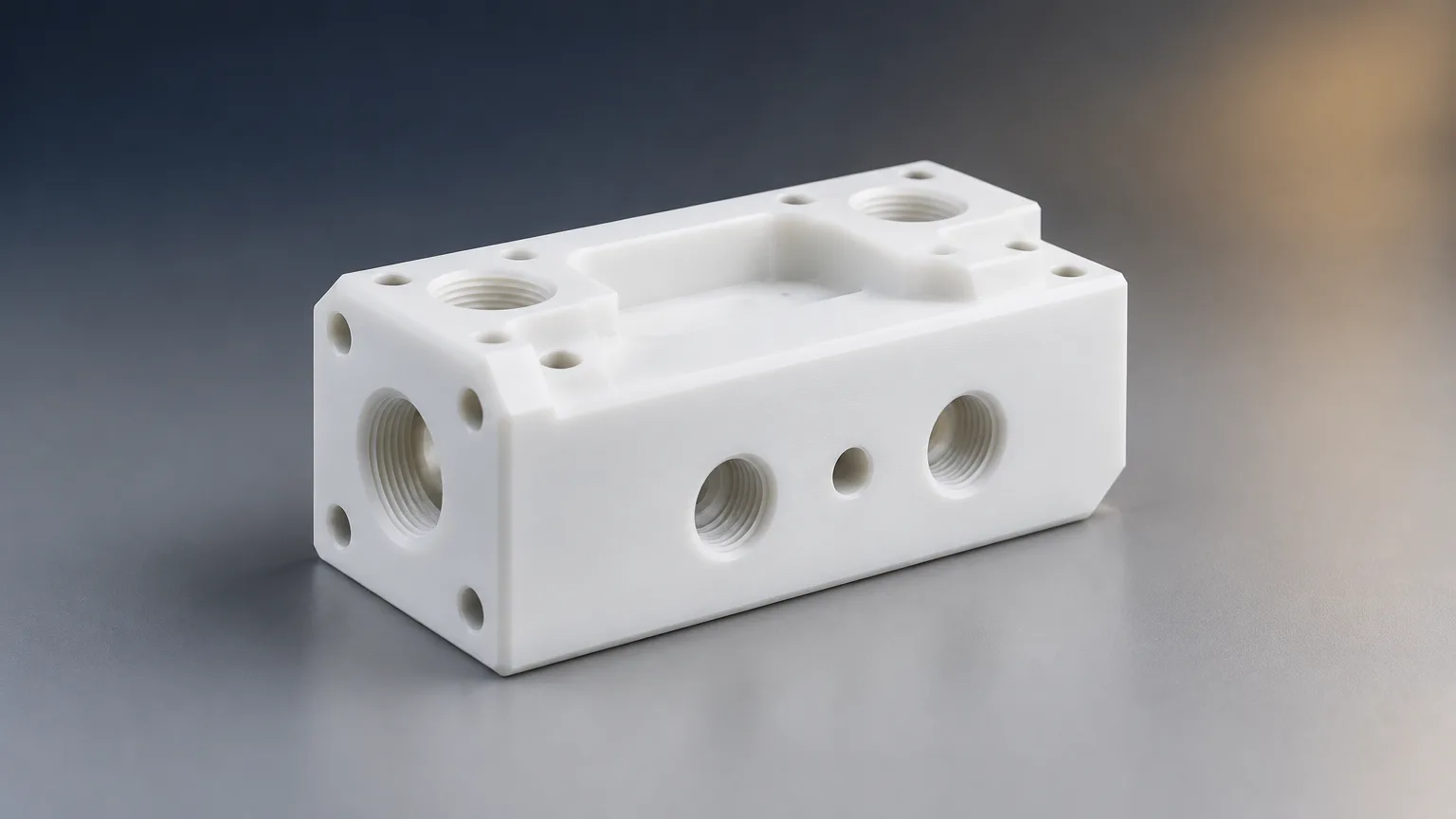
Plastic machining is the computer-controlled removal of material from plastic stock using milling, turning, drilling and related processes to make custom parts. It suits prototypes through production for housings, bushings and fixtures. Tolerances, material grade and inspection requirements must be stated on the drawing before quoting.
What plastic machining is and when to use it
Plastic machining is the computer-controlled removal of material from a plastic workpiece using milling, turning, drilling or related processes. Precision comes from controlled programming, fixturing, tooling, temperature management and inspection, and the required accuracy must be defined on the drawing rather than assumed.
It fits engineers, procurement managers and founders who need custom plastic parts without the cost of a molded tool. Choose it for prototypes, bridge production, low-to-mid volumes, design iterations and parts with undercuts or features that would be expensive to mold.
- Prototypes and functional test units in the final production material
- Low-to-mid volume runs where tooling cost is not justified
- Parts with tight flatness, bore or mating-feature requirements
- Replacement parts and one-off fixtures for existing equipment
Plastic machining process steps
The plastic machining process runs in seven steps, from drawing submission to final inspection and delivery. Plastic machining is the computer-controlled removal of material from a plastic workpiece by milling, turning, drilling or related processes, with required accuracy defined on the drawing rather than assumed.
- Send drawings and requirements Provide a CAD model plus a controlled drawing stating material grade, tolerances, datums, finish, threads, quantity and inspection needs.
- Quote routing and DFM review Your requirement goes to vetted suppliers. They confirm process capability, flag thin walls, deep pockets or workholding risks, and return pricing and lead time.
- Material and stock selection The supplier verifies material identity, grade, condition and certificates, and picks a stock size that limits waste. Confirm the grade against the producer datasheet.
- Programming and setup CAM programs, fixtures and tooling are prepared. Keeping features reachable from few orientations lowers setup count and price.
- Machining Milling, turning, mill-turn, drilling and tapping or wire EDM are applied to the features they suit best. Plastic cuts differently from metal, so feeds, speeds and cooling are adjusted.
- In-process inspection Critical dimensions are checked during the run to catch process drift early.
- Final inspection and delivery Final inspection covers drawing dimensions and finish. Inspection reports, material records and nonconformance records can be requested before parts are packed and shipped.
Plastic machining materials and finishes
Material choice drives machinability, dimensional stability and cost. The table below lists common CNC grades used across plastic and metal machining; confirm properties against the applicable ASTM, EN or producer datasheet.
| Material | Grade | Properties | Typical uses |
|---|---|---|---|
| Aluminum | 6061-T6 | Lightweight, corrosion-resistant and generally machinable. | Brackets, housings, prototypes, fixtures and aerospace parts. |
| Stainless steel | 304 | Corrosion resistance, toughness and broad availability; work-hardening can increase machining difficulty. | Food, chemical, medical and general industrial components. |
| Stainless steel | 316 | Improved corrosion resistance relative to 304, especially in chloride environments. | Marine, chemical-processing, medical and sanitary hardware. |
| Carbon steel | AISI 4140 | Strength and toughness; machinability varies with heat treatment. | Shafts, tooling, fixtures and mechanically loaded parts. |
| Engineering plastic | POM/Delrin | Low friction, dimensional stability and good machinability. | Bushings, wear parts, guides and electrical-mechanical components. |
Finishes for machined plastic parts
As-machined finishes are typical for plastics. Deburring, edge breaking, bead blasting, vapor polishing, laser marking and assembly-ready cleaning are common add-ons. Specify cosmetic zones, print location and any surface texture requirement on the drawing, because unspecified cosmetic expectations create disputes.
Plastic machining specifications and tolerances
Plastic machining tolerances are stated per feature on the drawing, and the values below are typical references rather than guaranteed capability. Actual results depend on geometry, material, inspection method and the supplier selected, so confirm each critical feature before release.
| Parameter | Typical range | Standard or source |
|---|---|---|
| General CNC dimensional tolerance | ±0.005 in (±0.13 mm) | Reported common/default range; verify with the supplier and drawing. |
| CNC milling, general features | ±0.002–0.004 in (±0.05–0.10 mm) | Supplier capability reference; not a universal standard. |
| CNC milling, tight features | ±0.0004–0.0010 in (±0.01–0.025 mm) | Supplier capability reference; depends on geometry, material and inspection. |
| CNC turning, general | ±0.001–0.002 in (±0.025–0.05 mm) | Supplier capability reference. |
| CNC turning, precision | ±0.0002–0.0004 in (±0.005–0.01 mm) | Supplier capability reference; must be confirmed for the feature. |
| General unspecified tolerances | ISO 2768-f, -m, -c or -v classes | ISO 2768 designation; class and applicable part must appear on the drawing. |
| Geometric tolerancing | Feature-specific; no single universal range | ASME Y14.5 or ISO 1101, as specified by the drawing. |
Design tips that lower plastic machining cost
Cost falls when the part is easy to hold, easy to reach and measured only where it matters. Apply these rules before you release a drawing.
- Tolerances: relax noncritical tolerances, since tight dimensional or geometric tolerances and required inspection raise cost.
- Walls and pockets: avoid very thin walls and deep cavities; plastic deflects and needs lighter cuts, and deep features need long tools.
- Setup count: design features reachable from as few orientations as possible to cut programming and setup time.
- Standard tools: use standard drill and thread sizes and avoid unusual radii that require special cutters.
- Workholding: leave a gripping surface in the stock or permit a fixture; poor access raises cost and risk.
- Quantity: low quantities carry prototype programming and setup cost, so batch similar parts together.
- Material: select a machinable, dimensionally stable grade and confirm it against the producer datasheet.
Typical plastic machining applications
Typical plastic machining applications include prismatic and rotational parts across automotive, industrial, electronics, medical and food sectors. The examples below are typical, not a limit on what suppliers can make.
| Industry | Example parts |
|---|---|
| Automotive | Sensor housings, connector bodies, jigs, fixtures, prototype trim clips, under-hood brackets |
| Industrial equipment | Wear pads, guides, bushings, manifolds, machine guards |
| Electronics | Insulator blocks, spacers, enclosures, test fixtures |
| Medical and lab | Instrument housings, fluidic manifolds, brackets and trays |
| Food and chemical | Non-metallic wetted components and handling fixtures |
What drives plastic machining cost
Plastic machining cost is driven by material, machining time and inspection, not by a fixed rate card. The same geometry in two different plastics can differ substantially because each grade cuts, chips and warms differently.
- Material: price, machinability, stock size and material certification.
- Tolerance: tight dimensional or geometric tolerances and required inspection.
- Quantity: low quantities and prototype programming or setup costs dominate.
- Geometry: deep cavities, thin walls, small tools and limited workholding access.
- Setups: each additional orientation adds programming, fixturing and handling.
- Finish and inspection: cosmetic requirements, extra passes, reports and controlled checks.
Cost does not fall linearly with tolerance. One supplier reports non-linear cost increases below the typical general default, so specify tight limits only on features that functionally need them.
Why order plastic machining through SR
Ordering plastic machining through SR gives you one point of contact while a vetted supplier network quotes, machines and inspects your parts. Sourcing Repository is a manufacturing broker, not a machine shop: it collects quotes, manages quality and inspection, and delivers parts.
- Vetted network: suppliers are screened before they are invited to quote.
- One contact: you send one drawing set and receive one consolidated response.
- Quality management: material identity, grade, condition and certificates are checked, with inspection reports and nonconformance records available on request.
- Routing decisions: the part goes to the process route and shop that fits it, whether milling, turning, mill-turn, drilling and tapping or wire EDM.
- DFM feedback: risky dimensions and features are flagged before machining starts.
Have a drawing to quote?
Upload it with quantity and material to start a quote.
FAQ
Common questions
How can buyers reduce custom CNC machining cost?
Relax noncritical tolerances, simplify setups, use standard tools and threads, avoid deep cavities, select machinable materials and consolidate compatible features. For plastic machining, add a machinable, dimensionally stable grade and keep cosmetic requirements to defined zones.
What files should a CNC machining company receive?
Provide a native or neutral CAD file plus a controlled drawing specifying material grade, tolerances, datums, finish, threads, quantity and inspection requirements. State cosmetic zones and any critical features so quotes are comparable.
What is a realistic general tolerance for plastic machining?
A commonly reported default is ±0.005 in (±0.13 mm). Plastic responds to cutting heat and clamping force, so achievable results depend on process, grade, geometry and supplier equipment. Confirm feature-level capability before release.
What distinguishes metal CNC machining from plastic machining?
Metal and plastic differ in stiffness, thermal expansion, cutting behavior, workholding, tool selection and dimensional response. Plastics deflect more and are more sensitive to clamping and cutting heat, so feeds, speeds and fixtures are adjusted accordingly.
Related resources
Keep reading
Ready when you are
Get a plastic machining quote
Send your CAD files and drawings. Sourcing Repository routes them to vetted suppliers, compares options and manages inspection through delivery.
Your files stay confidential. NDA available on request.