
Typical price ranges
Why no single published price exists and how quotes are structured.
Cost Guide
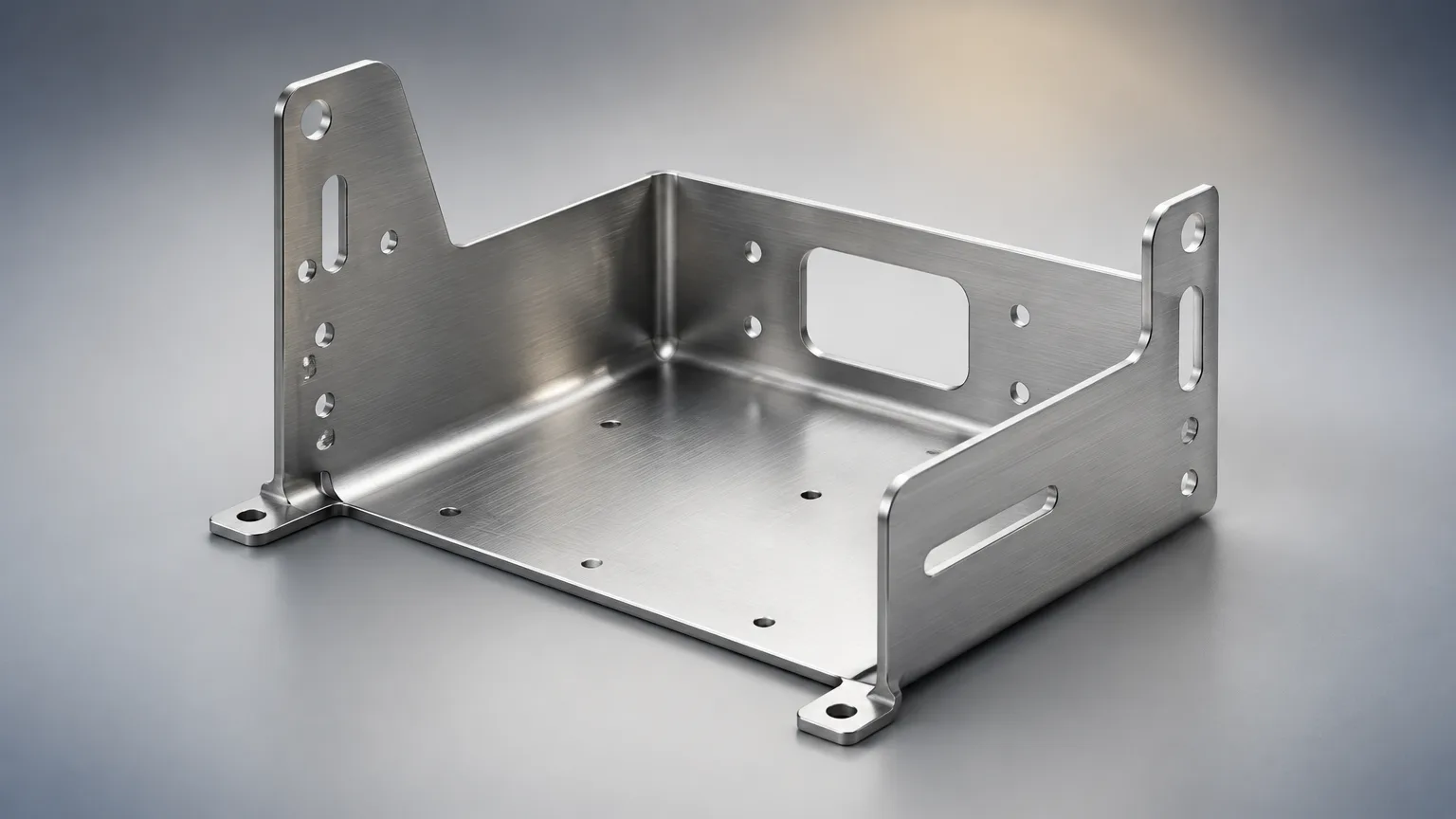
Sheet metal fabrication cost is built from material, cutting, forming, tooling, labor, finishing and inspection. This guide explains each driver and how volume changes unit price.
Why no single published price exists and how quotes are structured.
Ranked drivers from material and quantity to finishing and freight.
How grade, thickness and availability change the price.
One-time charges versus per-part costs, and process trade-offs.
How unit cost falls as quantity rises and setup is absorbed.
Design and specification actions ranked by typical impact.
A hypothetical quote built step by step, illustrative only.
What to prepare before sending your RFQ.
Sheet metal fabrication cost is the total price of converting flat sheet into finished parts: material, nesting and scrap, cutting, forming, tooling and setup, labor, joining, finishing, inspection, packaging and freight. Unit cost falls as quantity rises because one-time setup and tooling are spread across more parts. Tolerances, material grade and finish drive most of the difference between quotes.
There is no single published price for sheet metal fabrication cost. Price depends on size, material, tolerance and quantity, so treat online ranges as indicative and confirm them against your own drawing and volume.
Quotes combine a one-time charge (programming, setup, dedicated tooling) with a per-part price (material, machine time, labor, finishing, inspection). Ask suppliers to separate the two so offers compare fairly.
| Parameter | Typical range | Source |
|---|---|---|
| Flat cut feature location | ±0.005 in (±0.13 mm), process and supplier dependent | Protolabs design guidelines |
| Bend-to-hole or bend-to-feature | ±0.015 to ±0.025 in (±0.38 to ±0.64 mm) | Protolabs design guidelines |
| Dimensions across three or more bends | ±0.030 to ±0.040 in (±0.76 to ±1.02 mm) | Protolabs design guidelines |
| Forming and bending | ±0.020 in (±0.51 mm) | Brighton design guide; supplier capability must be confirmed |
| Angular tolerance | ±2° | Brighton design guide; unverified as universal default |
| Blank surface roughness | Ra 125 µin (3.2 µm) maximum | Brighton design guide; supplier-specific |
Tighter tolerances mean more inspection, slower processing and higher scrap risk, which raise price. A typical flat-cut feature tolerance is about ±0.005 in (±0.13 mm). Mark non-critical dimensions on the drawing; that can move a quote more than switching suppliers.
Material and quantity dominate sheet metal fabrication cost, followed by tolerance, finish and part count. The ranking below reflects how much each driver typically moves a quote, from largest to smallest.
Process route also matters. Laser cutting handles varied profiles without dedicated tooling, while turret punching is often faster for repeated holes and high-volume patterns. Press brakes suit low-to-medium volumes; stamping needs dedicated dies but can cut unit cost sharply at high volume.
Material is usually the largest single line in a sheet metal fabrication quote. Grade, thickness and availability all change price, and the cheapest alloy is not always the lowest total cost once forming and finishing are counted.
| Material | Grade | Properties | Typical uses |
|---|---|---|---|
| Low-carbon steel | AISI 1010 or 1018; verify mill specification | Good formability, weldability and relatively low material cost | Brackets, cabinets, machine guards, structural panels |
| Cold-rolled steel | ASTM A1008; grade must be specified | Smooth finish, consistent thickness, good forming capability | Enclosures, panels, appliance parts, precision blanks |
| Stainless steel | 304 or 316; ASTM specification required | Corrosion resistance; 316 generally offers better chloride resistance | Food, chemical, medical, outdoor and marine equipment |
| Aluminum | 5052-H32 or 6061-T6; ASTM B209 applies to sheet | Low density, corrosion resistance, good machinability; 5052 forms better | Lightweight enclosures, transportation, electronics, covers |
| Galvanized steel | ASTM A653; coating designation must be specified | Zinc coating provides corrosion protection; welding requires process controls | HVAC, outdoor enclosures, ductwork, utility hardware |
Heavier gauge needs more cutting power, bend tonnage and handling. A part that nests poorly on a purchased sheet adds scrap you still pay for.
5052-H32 aluminum generally forms better than 6061-T6, which is stronger but less bendable. For stronger chloride exposure, 316 stainless is generally preferred over 304, at higher material cost.
Tooling and setup are one-time costs, charged once per order or per design revision. Per-part costs scale with quantity. Separating the two is the fastest way to understand why a small order looks expensive per unit.
Process choice changes the split. Laser cutting needs no dedicated tooling, so it suits prototypes and varied geometries. Turret punching may need tooling but runs fast on repeated holes and louvers. Stamping requires high tooling investment and is a poor fit for frequent design changes, yet delivers very low unit cost and high repeatability at volume.
Unit cost falls as quantity rises because fixed setup and tooling are divided across more parts. The curve is steep at first and flattens once setup is fully absorbed.
| Volume band | Cost structure | Typical process fit |
|---|---|---|
| Prototype and one-off | Setup dominates; unit price is high | Laser or plasma cutting, press-brake forming, deburring |
| Low volume | Setup still significant; material and labor visible | Turret punching, forming and deburring |
| Medium volume | Setup spread thin; machine time and material dominate | Shearing, bending and welding for simple or heavy-gauge parts |
| High volume | Very low unit cost; repeatable output | Stamping with dedicated dies |
| Assembly-level orders | Adds setup, coordination and inspection requirements | Cutting, forming, PEM insertion, welding and coating from one supply chain |
Ordering assemblies rather than loose parts can reduce total cost by removing separate suppliers, freight legs and incoming inspection. It adds coordination and inspection requirements, but delivers complete assemblies from a single supply chain.
Most cost reduction comes from design and specification decisions made before quoting, not from negotiating after. The actions below are ranked by typical impact.
One caution: do not relax a tolerance that carries fit, safety or coating performance. Confirm with your engineer before loosening any callout, and confirm the fabricator's tooling before assuming a bend radius is standard.
This example is hypothetical, uses no real prices and does not represent any supplier's rates. It only shows how a quote is structured.
An accurate quote depends on complete input. Sourcing Repository collects quotes from a vetted supplier network, manages quality and inspection, and delivers parts. SR does not own factories or machines, so pricing comes from the supplier best matched to your drawing.
Send your RFQ through the quote request page and include the items above. Quote turnaround is typically 5-7 working days. If a detail is missing, the supplier has to quote with assumptions, and assumptions are where cost surprises come from.
Upload it with quantity and material to start a quote.
FAQ
Suppliers generally evaluate material, nesting, cutting, forming, tooling, labor, joining, finishing, inspection, packaging, quantity and schedule. Each element is priced separately, then one-time setup is divided across the order quantity to produce a unit price.
Use standard materials, simplify profiles, reduce setups, consolidate bend radii, relax noncritical tolerances and minimize secondary finishing. Quoting at a higher volume also spreads one-time setup across more parts, which lowers unit cost.
Precision sheet metal fabrication is work requiring controlled repeatability and tighter dimensional or geometric requirements, normally supported by defined inspection and process controls. It typically adds tighter tolerances, specialized inspection and more secondary operations compared with standard custom fabrication.
Provide a native CAD file, a drawing with datums and tolerances, material and thickness, finish, quantity, revision, inspection requirements and packaging instructions. Complete files let suppliers quote without assumptions, which keeps the final price close to the quoted price.
Related resources
Ready when you are
Share your CAD file, drawing, material, finish and quantity. SR collects quotes from a vetted supplier network, manages quality and inspection, and delivers parts. Typical quote turnaround is 5-7 working days.
Your files stay confidential. NDA available on request.