
Automotive Drivetrain Components
Transmission Housing Manufacturing for Gear and Differential Housings
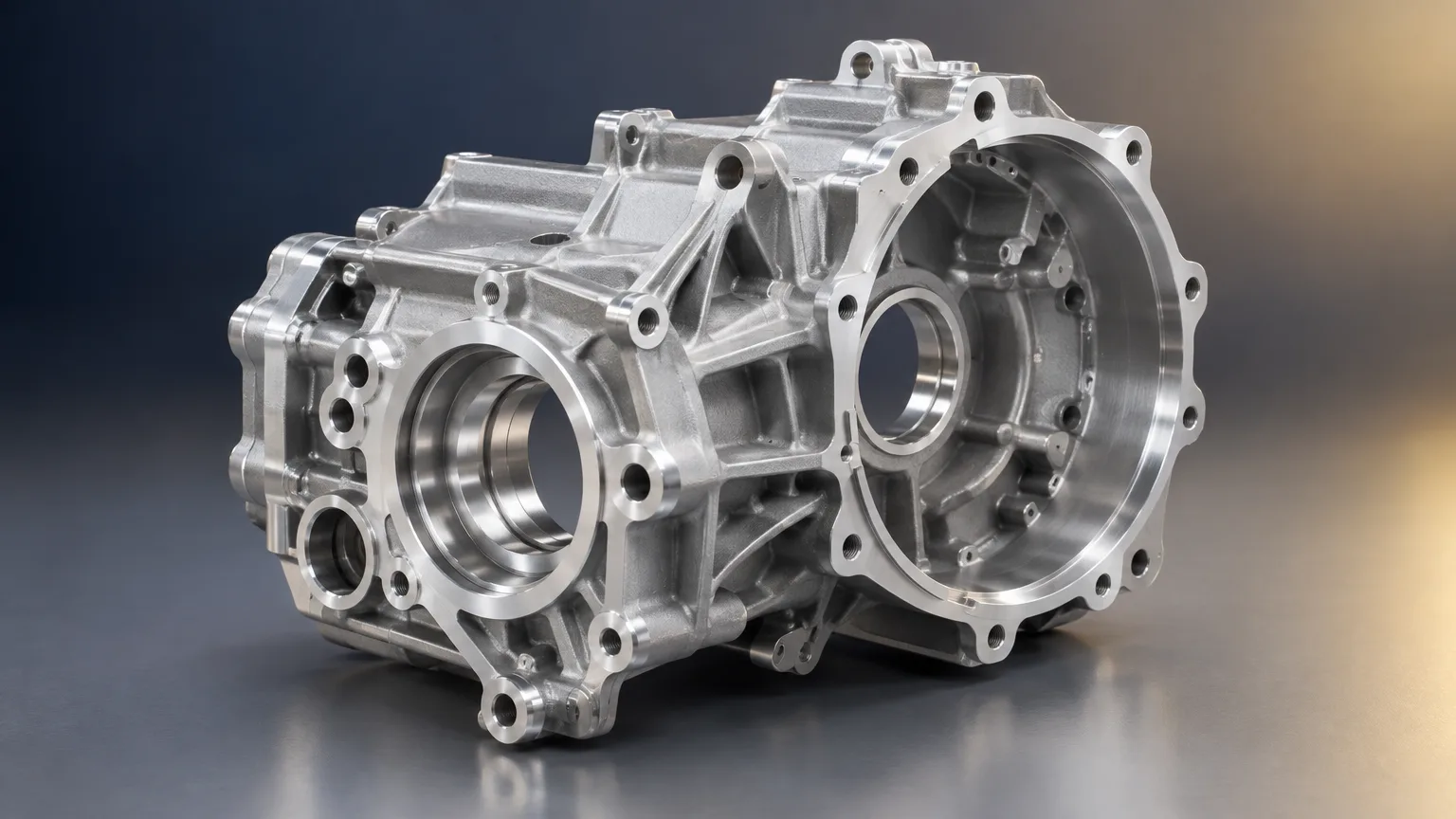
Transmission housing manufacturing covers the cast, forged and machined enclosures that carry gears, shafts and bearings.
- Gear housings
- Differential housings
- Aluminum and magnesium
- PPAP documentation
- Quote in 5-7 working daysSend CAD, drawing and volumes
- Inspection managed for youDimensional and material checks
- Approval evidence supportedSubmission level set by your customer
Transmission housing manufacturing is the production of the enclosures that hold gears, shafts and bearings in a vehicle drivetrain, including gear housings and differential housings. Typical routes are die casting or forging followed by CNC machining of bores, faces and bolt patterns, with PPAP and dimensional inspection before delivery.
What a transmission housing does in a vehicle
A transmission housing is the structural enclosure that locates gears, shafts, bearings and seals inside a vehicle drivetrain. It carries torque reaction loads, keeps lubricant contained, and holds shaft center distances so the gear mesh stays correct.
The same function applies to a differential housing, which encloses the ring and pinion set and axle bearings, and to a gear housing used on transfer cases, power take-offs or auxiliary drives. All three are load-bearing, fluid-sealing parts, so wall thickness, bore alignment and flange flatness matter as much as the external shape.
Where these housings are used
- Passenger car and light truck transmissions, including manual, automatic and dual-clutch units.
- Differential and axle assemblies on driven axles.
- Transfer cases and all-wheel-drive power transfer units.
- Electric drive units, where the housing also carries the motor and reduction gearset.
- Off-highway, agricultural and industrial drivetrains that use similar enclosure designs.
Typical transmission housing manufacturing processes
Transmission housing manufacturing usually combines a near-net shaping process with finish machining. Die casting dominates aluminum gear and differential housings; forging and casting serve higher-load or steel applications.
| Process | Best fit | Trade-offs |
|---|---|---|
| Die casting | Aluminum, zinc or magnesium housings at volume | Fast near-net shapes; porosity, tooling cost and alloy limits need control |
| Sand or gravity casting | Larger or lower-volume housings | Lower tooling cost; rougher surfaces and more machining allowance |
| Forging | High-load steel or aluminum components | Strong, fatigue-resistant parts; tooling and machining allowances raise cost |
| CNC machining | Bores, faces, bolt patterns and prototypes | Precise and flexible; material waste and cycle time can be high |
| Additive manufacturing | Prototypes and low-volume complex parts | Fast to first part; rate, finish and material qualification may limit use |
| Assembly and joining | Multi-piece housings and covers | Welding, fastening or bonding; joint strength and distortion need validation |
Machining operations on a housing
- Rough face and bore the main datum surfaces, leaving a typical finish allowance of about 0.04 in (1 mm).
- Semi-finish bearing bores and shaft center distances to drawing.
- Finish bore or line-bore bearing seats to the required tolerance and surface finish.
- Drill, tap and spot-face mounting and cover bolt patterns.
- Deburr, clean and verify flatness, bore size and position before inspection.
In automotive parts manufacturing, process selection is driven by volume, alloy, wall thickness and the number of critical features. A prototype may be machined from billet or printed, while the production part is cast and then machined on the same datums.
Materials used in gear and differential housings
Aluminum alloys are the most common choice for transmission and differential housings because they combine low density with good castability and machinability. Magnesium suits weight-critical designs, and steel appears in high-load or cost-driven ones. Car parts manufacturing and wider vehicle parts manufacturing programs choose among these by weight, load and cost.
| Material | Grade | Properties | Typical uses |
|---|---|---|---|
| Aluminum alloys | Unverified; drawing must name the alloy | Low density, corrosion resistance, machinability and castability | Brackets, housings, wheels, engine and transmission components |
| Carbon and alloy steel | Unverified; drawing must name the steel and heat treatment | High strength and fatigue resistance; hardness and weldability vary by grade | Shafts, gears, suspension, fasteners and structural parts |
| Magnesium alloys | Unverified; drawing must name the magnesium alloy | Very low density and good castability; corrosion protection often required | Lightweight housings, brackets and seat frames |
For transmission housing manufacturing, material grade, heat treatment and any coating or corrosion protection must come from the drawing or an agreed specification. If the grade is not fixed, the supplier should propose one and the buyer should confirm it in writing before tooling is cut.
Quality requirements for transmission housing manufacturing
Quality in transmission housing manufacturing is set by the drawing, customer-specific requirements and the vehicle program. Automotive component manufacturers commonly operate under IATF 16949, and PPAP shows that the production process can consistently meet approved requirements.
What is normally required
- PPAP submission at the level your customer specifies, with dimensional, material and functional evidence.
- A control plan and, where required, SPC on critical features such as bearing bores and shaft center distances.
- Material traceability from heat, lot or casting batch through to the shipped part.
- First article and in-process checks on datum faces, bores and bolt patterns.
- Leak or pressure testing where the housing seals lubricant.
- Final inspection records and, where specified, a layout inspection report.
Cp/Cpk targets are customer- and feature-specific, so state them per feature rather than as one blanket number. IATF 16949 defines a quality-management system; it does not by itself guarantee that a given part conforms.
Specifications and tolerances for housings
Housing tolerances depend on process, size, material and the drawing. The table below lists the parameters that should be defined on any transmission, gear or differential housing drawing; numerical values must be confirmed by the supplier's capability study.
| Parameter | Typical range | Standard or source |
|---|---|---|
| Dimensional tolerance | Unverified; depends on process, size, material and drawing | Part drawing and supplier capability study required |
| Geometric tolerancing | Unverified; specify datum scheme and GD&T callouts | ASME Y14.5 or applicable ISO GPS standard; exact edition unverified |
| Surface roughness | Unverified; specify Ra or other required parameter | Drawing requirement; applicable surface-texture standard unverified |
| Hardness and strength | Unverified; defined by material and heat-treatment specification | Material specification and test method required |
| Capability | Cp/Cpk targets are customer- and feature-specific | IATF 16949, control plan, SPC and customer-specific requirements |
| Part approval | Submission level and evidence vary by customer | AIAG PPAP and applicable customer-specific requirements |
Volumes and lead times from prototype to production
Prototype housings are usually machined from billet or produced by additive manufacturing to avoid tooling. Production housings move to die casting, forging or casting once volumes justify the tooling investment.
| Stage | Typical route | What drives cost and time |
|---|---|---|
| Prototype | CNC machining from billet or additive manufacturing | Programming, setup count, material removal and any design iteration |
| Pilot or bridge | Machined casting, sand casting or soft tooling | Tooling lead time and machining allowances |
| Production | Die casting or forging plus CNC machining | Tooling cost, cycle time, capability and inspection scope |
Sourcing Repository collects quotes from vetted suppliers and returns them in 5-7 working days. Actual manufacturing lead time depends on process, tooling and inspection scope, and is confirmed in each quote.
Design tips for transmission housing manufacturing
Good DFM for a housing starts with a clear datum scheme and realistic tolerances. The tips below reduce cost and risk without weakening the part.
Do
- Define datums that match how the part is machined and inspected.
- Keep wall thickness as uniform as the casting or forging process allows.
- Add draft and generous fillets on cast features.
- Specify the tightest tolerance needed for function, not the tightest possible.
- Call out surface finish only on sealing and bearing surfaces.
Avoid
- Deep, narrow pockets that need long tools and slow cycles.
- Bolt patterns or bosses that sit on a draft surface.
- Tolerance stack-ups that leave no machining allowance.
- Undefined material grade or heat treatment.
- Late changes to bore positions after tooling is cut.
- Confirm that bearing bore position and shaft center distance are called out as critical features.
- Allow access for deburring and cleaning on internal oil passages.
- Review the design with the supplier before releasing tooling, especially for cast parts.
- Plan inspection access for any feature that must be measured in production.
Ordering transmission housings through Sourcing Repository
Sourcing Repository is a manufacturing broker. It does not own factories or machines; it collects quotes from a vetted supplier network, manages quality and inspection, and delivers the finished parts.
- Send your requirement Provide CAD, drawing and revision, material, finish, tolerances, quantity, delivery location, inspection needs and the intended application.
- Receive quotes Quotes from vetted suppliers are returned in 5-7 working days, with process route, tooling and inspection scope stated.
- Approve and produce Once the route is approved, production and inspection are managed against the agreed drawing and quality requirements.
- Delivery and documentation Parts are delivered with the inspection and traceability records agreed for the program.
Send drawings and questions to killol@sourcingrepository.com, or use the quote form to start a transmission housing manufacturing RFQ.
Have a drawing to quote?
Upload it with quantity and material to start a quote.
FAQ
Common questions
What is PPAP?
PPAP is an automotive submission process used to demonstrate that a production process can consistently meet approved requirements. It covers dimensional, material and functional evidence, and the exact submission level and evidence vary by customer.
Does IATF 16949 certification guarantee part quality?
No. IATF 16949 defines a quality-management system for automotive suppliers, not the conformity of an individual part. Part quality still depends on the drawing, material specification, process controls, inspection and customer-specific requirements, so each part needs its own verification.
What information is needed for a transmission housing quote?
Provide CAD, drawing and revision, material and heat treatment, finish, tolerances, quantity, delivery location, inspection needs and the intended application. Complete information allows an accurate quote; missing details are confirmed first. Quotes typically take 5-7 working days.
What tolerance should be requested on a housing?
Request the tightest tolerance needed for function, not the tightest possible. Bearing bores and shaft center distances usually need the closest control, while non-critical features can be looser. The supplier should confirm capability for each critical feature.
Related resources
Keep reading
Ready when you are
Start a transmission housing RFQ
Send your drawing, material and volumes. Sourcing Repository collects quotes from vetted suppliers, manages inspection and delivers the parts.
Your files stay confidential. NDA available on request.