
Wire & Cable Harness Assembly
Wire Harness Assembly Services for Automotive Programs
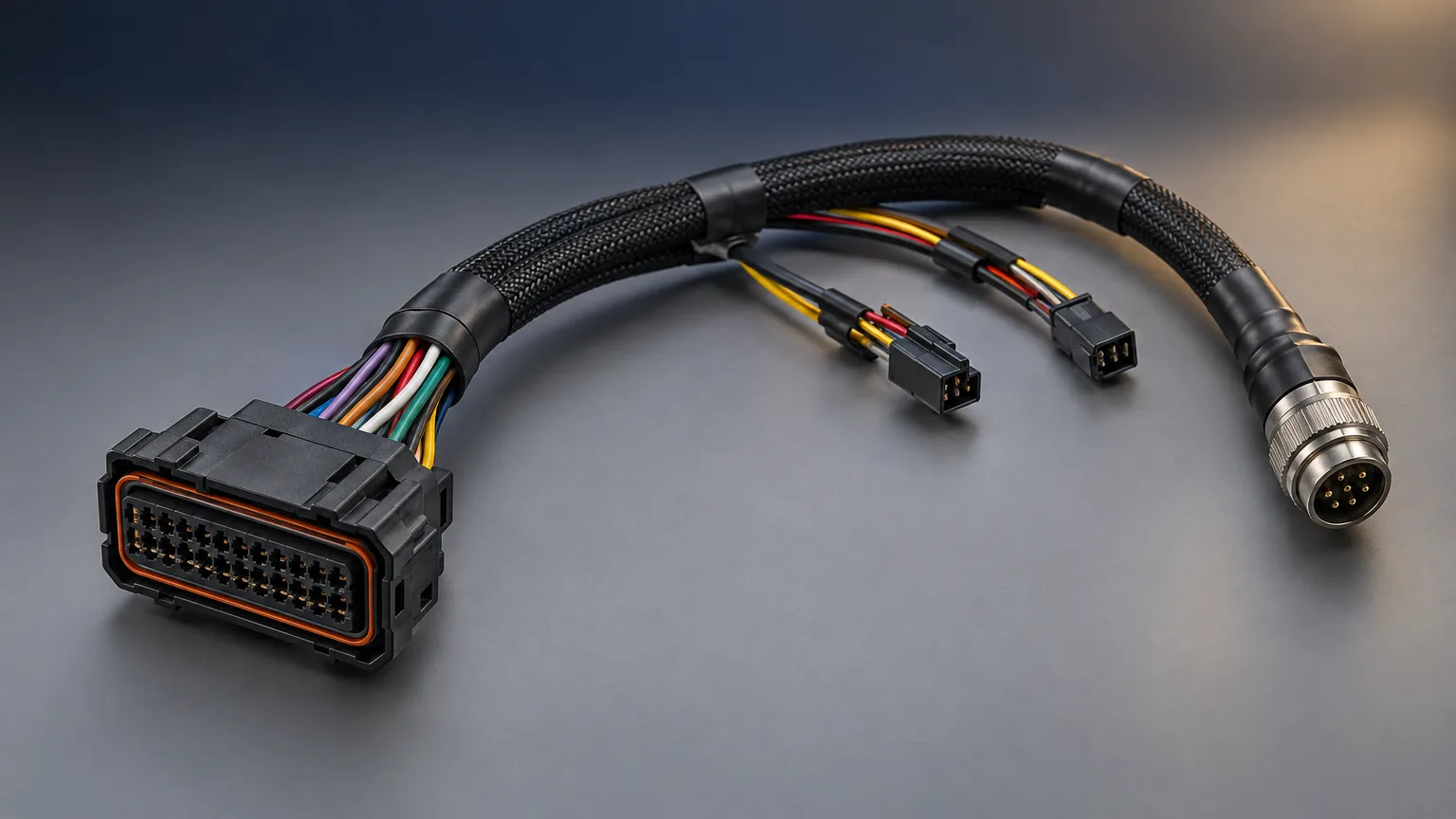
Wire harness assembly builds a tested, documented cable assembly from connectors, wire, terminals and protective sleeving. SR sources it from a vetted supplier network and manages quality and delivery.
- Cable harness assembly
- Harness cable assembly
- Prototype to production
- Inspection support
- Quote turnaround5-7 working days
- Inspection supportManaged by SR
- Drawing-led buildRevision controlled
Wire harness assembly is the build of a bundled cable assembly from wire, connectors, terminals and protective sleeving to a released drawing. Sourcing Repository collects quotes for wire harness assembly and cable harness assembly from a vetted supplier network, manages quality and inspection, and delivers finished parts without owning factories or machines.
What wire harness assembly is and when to use it
Wire harness assembly is the process of cutting wire to length, stripping and crimping terminals, inserting them into connectors, bundling the branches, and adding protection such as sleeving, tape or conduit. The finished item is a cable harness assembly that carries power and signal between vehicle systems.
It is used when a vehicle program needs a repeatable, tested interconnect rather than loose wires. Buyers are typically engineers, procurement managers and founders working on automotive builds, prototypes, low-volume specialty vehicles or aftermarket electrical products.
When to use this service
- You have a harness drawing or a defined connector and wire schedule.
- The build needs crimp validation, continuity testing and traceability.
- Quantities range from prototype sets to repeat production batches.
- Branches, breakouts or shielding make hand-built wiring unreliable.
- The program requires documented inspection evidence with each shipment.
Wire harness assembly process steps
Wire harness assembly is the process of cutting, terminating, routing and testing wires and connectors into one tested unit built to a drawing. In automotive parts manufacturing, each step produces evidence that the next step relies on.
- 1. Drawing and requirement review The harness drawing, wire schedule, connector list, branch lengths and test requirements are checked for completeness. Missing tolerances or undefined materials are raised before quoting.
- 2. Quote and supplier selection SR routes the package to suppliers matched to the wire gauges, connector types and volumes involved, then returns one consolidated quote.
- 3. Material and component verification Incoming wire, terminals, connectors and sleeving are checked against the specification, with certification review where the program requires it.
- 4. Cutting, stripping and crimping Wire is cut to length and stripped, and terminals are crimped with controlled tooling. Crimp height and pull-test checks confirm the joint.
- 5. Connector insertion and branch build Terminals are inserted into housings, secondary locks are seated, and branches are laid out on a board to the drawing geometry.
- 6. Bundling and protection Sleeving, tape, conduit, grommets and clips are applied so the harness holds its routing shape.
- 7. Electrical and dimensional test Continuity, short and point-to-point tests are run against the harness schedule, and critical branch lengths are measured.
- 8. Final inspection, packing and delivery The harness is inspected against the drawing, labelled, packed to protect connectors, and shipped with the agreed documentation.
Wire harness materials and finishes
Wire harness materials are chosen for current rating, temperature, abrasion and chemical exposure. Automotive components in a harness, such as connector bodies and clips, must have their grade specified on the drawing.
| Material | Grade | Properties | Typical uses |
|---|---|---|---|
| Aluminum alloys | Aluminum grade per drawing | Low density, corrosion resistance, machinability, and castability | Brackets, housings, clips and mounting hardware |
| Carbon and alloy steel | Steel grade per drawing | High strength, fatigue resistance, hardness, and weldability vary by grade | Terminals, fasteners, brackets and structural supports |
| Magnesium alloys | Magnesium grade per drawing | Very low density and good castability; corrosion protection is often required | Lightweight housings and instrument-panel structures |
| Zinc alloys | Zinc grade per drawing | Good die-castability, dimensional repeatability, and surface finish | Connector bodies, latches and small hardware |
| Polypropylene | Polypropylene grade per drawing | Low density, chemical resistance, and good processability | Conduit, covers and molded routing parts |
| Polyamide | Polyamide grade per drawing | Good strength, wear resistance, and temperature capability; moisture affects dimensions | Connectors, clips, brackets and under-hood parts |
| ABS | ABS grade per drawing | Impact resistance, dimensional stability, and attractive molded surfaces | Interior trim, bezels and housings |
Finishes and protection
- Tin or gold plating on terminals, set by the connector system.
- Heat-shrink tubing and boot seals at splices and connector entries.
- Braided sleeving, tape or corrugated conduit for abrasion resistance.
- Grommets and edge clips where the harness passes through panels.
- Overmolding or potting where the joint must be sealed against moisture.
Wire harness assembly specifications and tolerances
Wire harness assembly specifications and tolerances are set by the drawing, the process and the supplier's demonstrated capability. Automotive component manufacturers need these parameters defined before a harness can be quoted. State every length in both units, for example about 50 mm (2 in).
| Parameter | Typical range | Standard or source |
|---|---|---|
| Dimensional tolerance | Unverified; depends on process, size, material, and drawing | Part drawing and supplier capability study required |
| Geometric tolerancing | Unverified; specify datum scheme and GD&T callouts | ASME Y14.5 or applicable ISO GPS standard; exact edition unverified |
| Surface roughness | Unverified; specify Ra or other required parameter | Drawing requirement; applicable surface-texture standard unverified |
| Hardness and strength | Unverified; defined by material and heat-treatment specification | Material specification and test method required |
| Capability | Cp/Cpk targets are customer- and feature-specific | IATF 16949, control plan, SPC, and customer-specific requirements |
| Part approval | Submission level and evidence vary by customer | AIAG PPAP and applicable customer-specific requirements |
Design tips that lower wire harness assembly cost
Most harness cost is fixed at design release. These DFM choices reduce tooling, labour and inspection effort without weakening function.
- Request the tightest tolerance needed for function, not the tightest possible tolerance; the supplier should confirm capability for each critical feature.
- Standardise on one wire family and a small set of gauges to reduce cut, strip and crimp changeovers.
- Reuse connector families across variants so terminals and applicator tooling are shared.
- Keep branch lengths and breakouts simple; every extra breakout adds layout and test time.
- Specify protection only where abrasion, heat or moisture actually occurs.
- Define test requirements explicitly so inspection effort matches risk instead of defaulting to full point-to-point testing.
- Release a revision-controlled drawing with a clear datum scheme and connector pinout before tooling starts.
Typical wire harness assembly applications
Harness work spans body, powertrain, chassis and aftermarket electrical products. The examples below show the range of assemblies sourced through the network.
- Engine and sensor harnesses with shielded signal pairs.
- Body and interior harnesses with lighting, switch and trim connectors.
- Battery and high-current cable assemblies with heavy-gauge lugs.
- Chassis and lighting harnesses exposed to splash, salt and vibration.
- Control-panel and instrument harnesses for specialty and low-volume vehicles.
- Aftermarket and performance harnesses built to a customer drawing.
Industries served
- Automotive OEM and tier supply programs.
- Motorsport, off-road and specialty vehicle builders.
- Electric vehicle and battery system integrators.
- Industrial equipment and mobile machinery.
- Aftermarket electrical and accessory brands.
What drives wire harness assembly cost
No reliable universal price exists for a harness. Cost depends on geometry, material, process, tooling, quantity, tolerance, finishing, inspection and logistics, and it is quoted per drawing.
- Wire gauge, insulation type and total circuit count.
- Connector brand, sealing class and availability.
- Branch count, breakout complexity and overall bundle length.
- Terminal and applicator tooling, plus any test fixture required.
- Protection materials such as braided sleeving, conduit and heat-shrink.
- Inspection scope, including continuity testing and documentation level.
- Order quantity and the balance between setup cost and unit cost.
- Material type, grade, availability, and buy-to-fly ratio.
Why order wire harness assembly through SR
Ordering wire harness assembly through SR gives you one contact for quoting, build and delivery across car parts manufacturing and vehicle parts manufacturing suppliers. SR is a manufacturing broker: we do not own factories or machines. We collect quotes from a vetted supplier network, manage quality and inspection, and deliver the finished harness.
What you get
- One contact from quote to delivery.
- Quotes from suppliers matched to your harness scope.
- Quality and inspection managed against your drawing.
- Documentation reviewed before shipment.
What we do not claim
- We do not own plants, machines or tooling.
- We do not publish fixed lead times or prices before review.
Quote turnaround is 5-7 working days from a complete RFQ package. Contact killol@sourcingrepository.com or use the quote form to start.
Have a drawing to quote?
Upload it with quantity and material to start a quote.
FAQ
Common questions
What information is needed for a wire harness assembly quote?
Provide CAD or a harness drawing, revision, wire schedule, connector list, branch lengths, material and finish, tolerances, quantity, delivery location, inspection needs and the intended application. Missing items delay quoting.
Can a supplier build a harness without a drawing?
A supplier may reverse-engineer or develop a model from a sample, but requirements, ownership, tolerances, materials and approval responsibilities must be agreed in writing. A released drawing is the safer route for production.
What is PPAP and does a harness need it?
PPAP is an automotive submission process used to demonstrate that production processes can consistently meet approved requirements. Whether it applies, and at what submission level, depends on your customer-specific requirements.
What tolerance should be requested on a harness drawing?
Request the tightest tolerance needed for function, not the tightest possible tolerance. The supplier should confirm capability for each critical feature, and branch lengths should be toleranced where routing actually matters.
Related resources
Keep reading
Ready when you are
Send your harness drawing for review
Share the drawing, wire schedule and quantities. SR will route the package to matched suppliers and return a consolidated quote, typically within 5-7 working days.
Your files stay confidential. NDA available on request.