
Automotive Sourcing Hub
Auto Parts Manufacturing Sourcing for Engineers and Procurement
SR collects quotes from a vetted supplier network for custom auto parts manufacturing, manages quality and inspection, and delivers parts. No factory ownership required.
- IATF 16949 suppliers
- PPAP documentation
- Prototype to production
- Global supplier network
- Upload your drawingGet quotes from vetted automotive suppliers
- Inspection managedFAI, PPAP, and traceability support
- Parts deliveredFrom prototype to production volumes
Auto parts manufacturing is the production of components, assemblies, and service or accessory parts used in vehicles. It includes metal forming, casting, forging, machining, plastics processing, joining, finishing, and inspection. Automotive suppliers commonly operate under IATF 16949. SR collects quotes from a vetted supplier network, manages quality and inspection, and delivers parts.
Industry Challenges: Buyer Pain Points in Auto Parts Manufacturing
Buyers of auto parts manufacturing face fragmented supply bases, inconsistent documentation, and unclear capability claims. The first step is to separate real process capability from marketing language.
- Supplier capability is hard to verify without a drawing and a capability study.
- Material grades and mechanical properties are often left unspecified, shifting risk to the buyer.
- Tolerance and GD&T requirements are frequently missing or ambiguous on RFQs.
- PPAP and FAI expectations vary by customer and program, causing late-stage surprises.
- Tooling cost and lead time are difficult to compare across processes.
- Traceability from raw material to finished part is not always documented.
- Low-volume and prototype work is often deprioritized by high-volume suppliers.
- Logistics, packaging, and inspection costs are frequently omitted from initial quotes.
Parts We Source: Automotive Components and Assemblies
SR sources a broad range of automotive components and assemblies through its vetted supplier network. Typical categories include powertrain, body, chassis, thermal, and aftermarket parts.
| Category | Examples | Common processes |
|---|---|---|
| Powertrain, driveline, and transmission | Housings, shafts, gears, brackets | CNC machining, casting, forging |
| Body, chassis, and structural | Stampings, beams, mounts, frames | Stamping, welding, machining |
| Thermal-management and exhaust | Ducts, manifolds, heat shields | Stamping, casting, assembly |
| Interior and trim | Bezels, panels, clips, covers | Injection molding, finishing |
| Replacement, service, and performance | Aftermarket brackets, adapters, kits | Machining, additive, low-volume casting |
Assembly and joining services combine components through welding, riveting, fastening, bonding, or overmolding. Joint strength, distortion, and traceability require validation.
Processes and Materials for Auto Parts Manufacturing
Process selection depends on volume, geometry, material, tolerance, and program stage. The table below summarizes common automotive processes and their trade-offs.
| Process | Best fit | Trade-offs |
|---|---|---|
| CNC machining | Prototypes, low volumes, tight features | Material waste and cycle time can be high |
| Stamping | High-volume sheet-metal parts | Requires dedicated dies; less suitable for complex 3D forms |
| Injection molding | Repeatable plastic parts | Tooling cost and design lead time can be substantial |
| Die casting | Near-net-shape aluminum, zinc, or magnesium parts | Porosity, tooling cost, and alloy limits require control |
| Forging | Strong, fatigue-resistant metal parts | Tooling, material flow, and machining allowances increase cost |
| Additive manufacturing | Prototypes, tooling, complex low-volume parts | Production rate, surface finish, and material qualification may limit use |
| Assembly and joining | Combining components | Joint strength, distortion, and traceability require validation |
Materials and grades
| Material | Grade | Properties | Typical uses |
|---|---|---|---|
| Aluminum alloys | Unverified; grade must be specified by drawing | Low density, corrosion resistance, machinability, castability | Brackets, housings, wheels, engine and transmission components |
| Carbon and alloy steel | Unverified; grade must be specified by drawing | High strength, fatigue resistance, hardness, weldability vary by grade | Stampings, shafts, gears, suspension, fasteners, structural parts |
| Magnesium alloys | Unverified; grade must be specified by drawing | Very low density, good castability; corrosion protection often required | Lightweight housings, brackets, seat frames, instrument-panel structures |
| Zinc alloys | Unverified; grade must be specified by drawing | Good die-castability, dimensional repeatability, surface finish | Handles, latches, housings, small hardware |
| Polypropylene | Unverified; grade must be specified by drawing | Low density, chemical resistance, good processability | Trim, ducts, covers, containers, molded interior parts |
| Polyamide | Unverified; grade must be specified by drawing | Good strength, wear resistance, temperature capability; moisture affects dimensions | Gears, clips, brackets, connectors, under-hood parts |
| ABS | Unverified; grade must be specified by drawing | Impact resistance, dimensional stability, attractive molded surfaces | Interior trim, bezels, housings, instrument-panel parts |
For process comparisons, see related pages on CNC machining, aluminum extrusions, and die casting vs forging.
Standards and Certifications in Automotive Parts Manufacturing
Automotive parts manufacturing is governed by IATF 16949 and customer-specific requirements. SR does not claim to hold certifications; supplier certifications are verified during sourcing.
| Standard | Title | Relevance |
|---|---|---|
| IATF 16949:2016 | Automotive Quality Management System Standard | Defines automotive QMS requirements for production, service, and accessory parts, including defect prevention and process control.[1][2] |
| ISO 9001:2015 | Quality Management Systems — Requirements | Base quality-management framework incorporated by IATF 16949.[1][2] |
| AIAG APQP | Advanced Product Quality Planning | Supports structured product and process planning; exact edition unverified. |
| AIAG PPAP | Production Part Approval Process | Documents production readiness and customer approval; exact edition unverified. |
Quality and Documentation: PPAP, FAI, and Traceability
Quality documentation for auto parts manufacturing typically includes PPAP, FAI, material certs, and traceability records. The exact submission level and evidence vary by customer.
- Incoming material verification and certification review.
- First Article Inspection (FAI) report with dimensional results.
- PPAP submission per AIAG and customer-specific requirements.[1][2]
- Control plan and process flow diagram.
- Capability studies (Cp/Cpk) for specified features.
- Material and heat-treatment certificates.
- Traceability from raw material lot to finished part.
- Inspection and test reports for critical characteristics.
SR manages inspection and documentation through its supplier network. Requirements are defined in the RFQ and confirmed before production.
Volumes and Lead Times: Prototype to Production
The path from prototype to production depends on process, tooling, and validation requirements. Prototype routes minimize tooling and lead time; production routes optimize repeatability and total cost.
- Prototype CNC machining or additive manufacturing is often used for form, fit, and function testing. Tooling is minimized, but unit cost is higher.
- Pilot / bridge Low-volume production may use soft tooling or machining. Process capability and inspection plans are established.
- Production Stamping, injection molding, casting, or forging are used for high volumes. Dedicated tooling and PPAP are required.
- Validation PPAP, FAI, and capability studies confirm production readiness. Customer approval is required before full release.
Lead times and minimum order quantities are project-specific and not stated here. Provide quantities and delivery targets in your RFQ for accurate quotes.
Example Project: Custom Automotive Bracket Sourcing
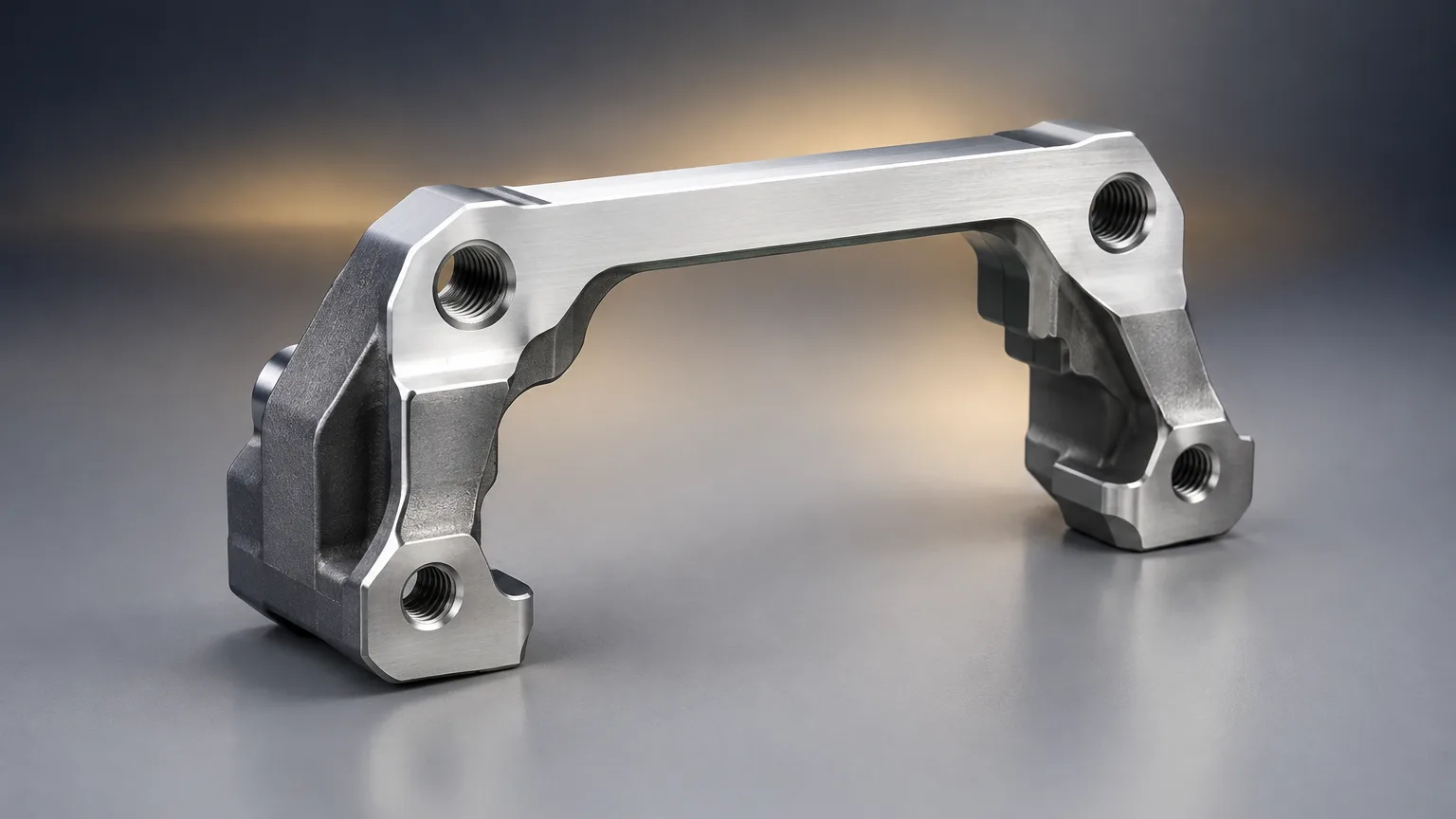
A representative example of custom automotive bracket sourcing starts with an engineer who needs an aluminum bracket for a vehicle program. The drawing specifies alloy, a 0.25 in (6.35 mm) plate thickness, a general tolerance of ±0.005 in (±0.13 mm), and finish. SR collects quotes from vetted suppliers, manages FAI and PPAP documentation, and delivers parts.
How to Get Started with Auto Parts Manufacturing Sourcing
To get started with auto parts manufacturing sourcing, prepare a complete RFQ package and submit it to SR. SR collects quotes from its vetted supplier network, manages quality and inspection, and delivers parts.
In plain terms, auto parts manufacturing means making the metal and plastic components that go into cars, trucks, and other vehicles, then machining, joining, finishing, and inspecting them to a drawing.
- Prepare CAD, drawing, revision, material, finish, tolerances, quantity, delivery location, inspection needs, and intended application.
- Submit your RFQ to SR through the RFQ link.
- SR collects quotes from vetted suppliers and returns them for review.
- Select a quote and confirm quality and documentation requirements.
- SR manages production, inspection, and delivery.
Requirements differ by where you sit in the supply chain. An OEM program usually requires validated processes, traceability, and customer approval. A Tier 1 supplier sells directly to the OEM, and a Tier 2 supplier sells to a Tier 1 supplier, so PPAP and documentation requests often flow down from the customer.
Automotive component manufacturers handle car parts manufacturing and vehicle parts manufacturing through processes such as machining, stamping, casting, forging, and molding. State the intended application in your RFQ so suppliers can match the process to the part.
For related sourcing, see Aftermarket & Replacement Parts, Automotive Aluminum Extrusions, and Automotive CNC Machined Parts.
Have a drawing to quote?
Upload it with quantity and material to start a quote.
FAQ
Common questions
How much do custom auto parts cost?
No reliable universal price exists for custom auto parts. Cost depends on geometry, material, process, tooling, quantity, tolerance, finishing, inspection, and logistics. A machined prototype and a stamped production part are priced very differently. Send a complete RFQ package with drawing and quantity so suppliers can quote accurately.
Does IATF 16949 certification guarantee part quality?
No. IATF 16949 is a quality-management system standard for automotive production, service, and accessory parts. Certification shows a supplier has defined process controls, but part conformity still depends on the specification, control plan, inspection, and customer requirements.[1][2]
What is PPAP?
PPAP, the Production Part Approval Process, is an automotive submission process used to show that a supplier's production processes can consistently meet approved requirements. Submission level and required evidence vary by customer, so confirm the requested PPAP level before quoting and production start.
What information is needed for a quote?
A complete RFQ includes CAD, a drawing with revision, material, finish, tolerances, quantity, delivery location, inspection needs, and the intended application. Missing details force suppliers to make assumptions, which leads to inconsistent quotes. State any PPAP or FAI documentation requirements up front.
Related resources
Keep reading
Ready when you are
Ready to source custom auto parts?
Submit your RFQ to SR. We collect quotes from vetted suppliers, manage quality and inspection, and deliver parts.
Your files stay confidential. NDA available on request.