
Automotive Stamping
Automotive Stamping for Custom Metal Parts
SR sources automotive stamping parts from a vetted supplier network, manages quality and inspection, and delivers production-ready components to your drawing.
- High-volume sheet metal
- IATF 16949 suppliers
- PPAP support
- One point of contact
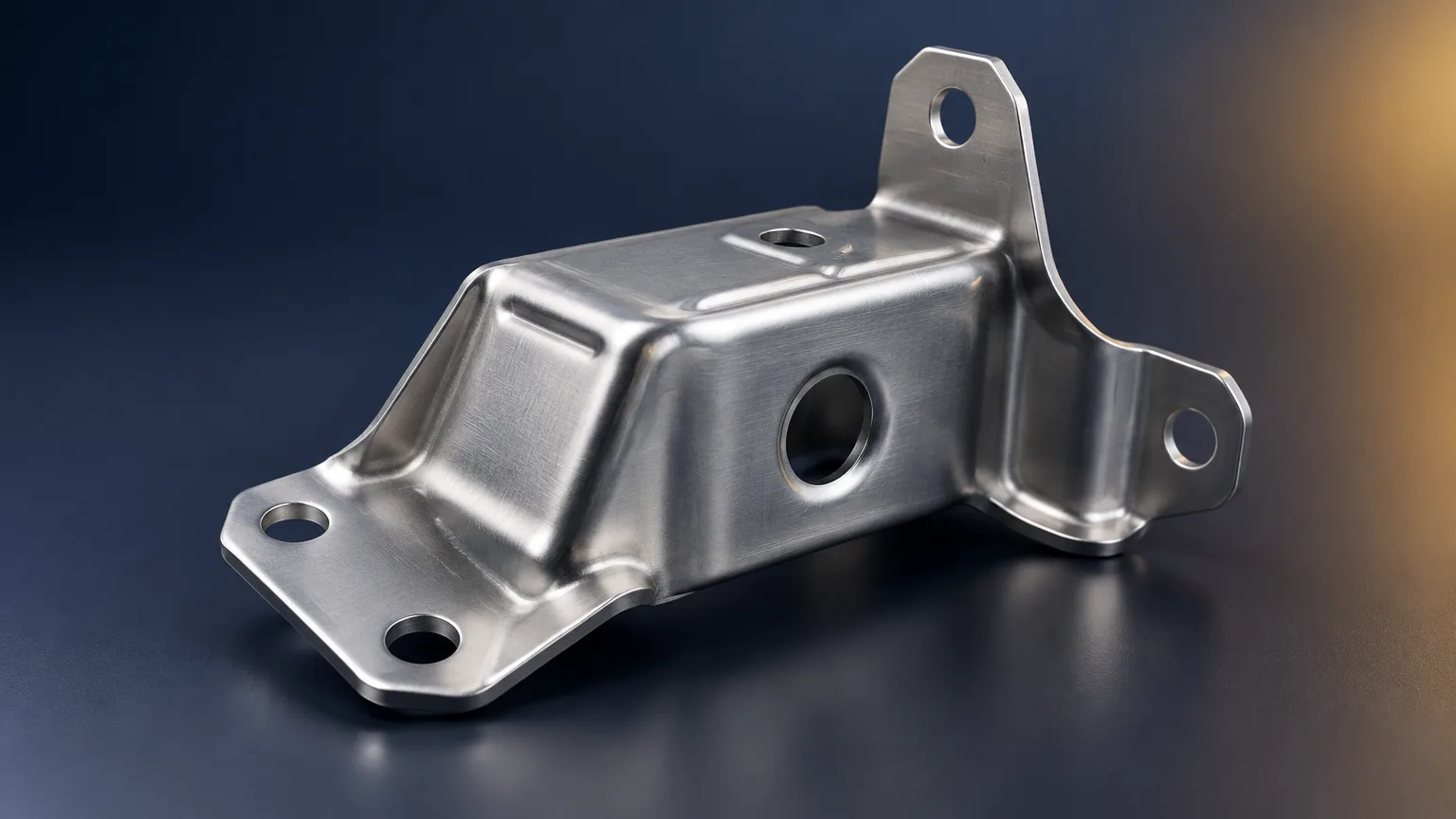
- Die design reviewFormability and tolerance check before tooling
- Inspection managedDimensional and material evidence per drawing
- Quote in 5-7 daysMultiple vetted suppliers compared
Automotive stamping is the high-volume forming of sheet metal into vehicle parts using dedicated dies. It suits brackets, structural and chassis components where repeatability and cycle time matter. SR collects quotes from vetted stamping suppliers, manages inspection and PPAP documentation, and delivers parts to your drawing.
What automotive stamping is and when to use it
Automotive stamping is a sheet-metal forming process that cuts and shapes flat stock into vehicle components using a press and a dedicated die. It is one route in auto parts manufacturing, also called car parts manufacturing or vehicle parts manufacturing, alongside machining, casting, forging, molding and additive processes.
Automotive stamping is economical for high-volume sheet-metal automotive components because the dedicated dies are paid back over many parts. It suits flat or shallow-formed geometry better than complex 3D forms, so low-volume or still-changing designs may cost less through machining or another route.
Who this service is for
- Tier 1 supplier and OEM program teams needing repeatable sheet-metal components.
- Automotive component manufacturers and procurement managers moving a part from prototype to production.
- Founders, aftermarket and performance brands sourcing brackets, mounts, panels or service stampings.
When to use stamping
- Annual volumes justify dedicated tooling.
- The part is flat or shallow-formed sheet metal with consistent thickness.
- Cycle time and unit cost matter more than design flexibility.
- The drawing and revision are stable enough to freeze.
Automotive stamping process steps
The automotive stamping process runs from drawing review to approved production parts. Each step produces evidence that feeds the next.
- 1. Requirements and drawing review Confirm geometry, material, thickness (for example, about 0.06 in (1.5 mm)), tolerances, finish, quantity and delivery location. Flag any feature that cannot be produced or verified as drawn.
- 2. DFM and die concept The supplier reviews formability, bend radii, hole placement and strip layout, then proposes a die concept. This is where most cost is designed in or out.
- 3. Tooling build and first article Dies are built or sourced, then first-article parts are measured against the drawing before approval.
- 4. Process validation and PPAP Control plans, capability studies and inspection methods are established. PPAP submission level and evidence vary by customer and applicable customer-specific requirements.
- 5. Production stamping Parts run on the approved process with in-process checks. SPC monitors critical features where the control plan requires it.
- 6. Finishing and secondary operations Deburring, plating, coating, welding, riveting or assembly are applied as specified. Joint strength, distortion and traceability require validation.
- 7. Inspection and delivery Final inspection confirms drawing conformity, then parts ship with the agreed documentation.
Materials and finishes for automotive stamping parts
Materials for automotive stamping parts are mainly sheet steel and aluminum, and the grade must be specified on the drawing. Material choice drives strength, weight, corrosion behavior and formability.
| Material | Grade | Properties | Typical uses |
|---|---|---|---|
| Aluminum alloys | Specify on drawing | Low density, corrosion resistance, machinability, and castability | Brackets, housings, wheels, engine and transmission components |
| Carbon and alloy steel | Specify on drawing | High strength, fatigue resistance, hardness, and weldability vary by grade | Stampings, shafts, gears, suspension, fasteners, and structural parts |
Finishes and secondary operations
- Deburring and edge conditioning for handling and fit.
- Plating or coating for corrosion protection, where specified.
- Welding, riveting, fastening or bonding to combine components.
- Heat treatment where hardness and strength are defined by specification.
Automotive stamping specifications and tolerances
Tolerances, size limits and lead times depend on process, size, material and drawing. The values below are the parameters that must be defined; numerical limits are confirmed per part by the supplier's capability study.
| Parameter | Typical range | Standard or source |
|---|---|---|
| Dimensional tolerance | Unverified; depends on process, size, material, and drawing | Part drawing and supplier capability study required |
| Geometric tolerancing | Unverified; specify datum scheme and GD&T callouts | ASME Y14.5 or applicable ISO GPS standard; exact edition unverified |
| Surface roughness | Unverified; specify Ra or other required parameter | Drawing requirement; applicable surface-texture standard unverified |
| Hardness and strength | Unverified; defined by material and heat-treatment specification | Material specification and test method required |
| Capability | Cp/Cpk targets are customer- and feature-specific | IATF 16949, control plan, SPC, and customer-specific requirements |
| Part approval | Submission level and evidence vary by customer | AIAG PPAP and applicable customer-specific requirements |
Design tips that lower automotive stamping cost
Most stamping cost is fixed at design. These DFM points reduce tooling complexity, scrap and inspection burden without weakening the part.
- Keep wall thickness uniform. Thickness steps force extra operations and can cause tearing or thinning.
- Use bend radii at least equal to material thickness. Tight radii crack high-strength steel and shorten die life.
- Place holes and slots away from bend lines. Distance of at least 1.5 times thickness plus the bend radius avoids distortion.
- Request the tightest tolerance needed for function, not the tightest possible. Over-tolerancing raises cost and inspection time.
- Design for one strip layout. Parts that nest efficiently use less material and fewer die stations.
- Avoid sharp internal corners and narrow tabs. They concentrate stress and drive punch maintenance.
- Standardize material grades and finishes across a part family to consolidate purchasing and tooling.
Typical automotive stamping applications
Automotive stamping parts appear across body, chassis and structural systems, plus service and performance applications. The examples below are typical, not exhaustive.
- Body and structural: reinforcement panels, seat frames, cross members, mounting plates.
- Chassis and suspension: brackets, control-arm components, subframe plates, heat shields.
- Powertrain and under-hood: covers, clips, retainers, connector housings, small hardware.
- Interior and trim: bezels, brackets, latches, handles and instrument-panel supports.
- Service and performance: replacement panels, adapter plates and aftermarket mounts.
Industries served
- Passenger vehicle and light truck programs.
- Commercial and off-highway vehicle builders.
- EV and hybrid platforms needing lightweight brackets and housings.
- Aftermarket, motorsport and specialty vehicle brands.
What drives automotive stamping cost
Automotive stamping cost is driven by tooling, material, volume, tolerance, finishing, inspection and logistics, and no reliable universal price exists for a stamped part. Each element scales differently with volume.
- Tooling: die complexity, number of stations and expected die life.
- Material: grade, thickness and scrap rate from the strip layout.
- Volume: annual quantity amortizes tooling and sets press size.
- Tolerance and GD&T: tighter features add operations, gauges and inspection time.
- Finishing: plating, coating, heat treatment and joining.
- Inspection and documentation: capability studies, PPAP evidence and traceability.
- Logistics: packaging, delivery location and schedule stability.
Why order automotive stamping through SR
Ordering automotive stamping through SR gives you one point of contact for quoting, quality and delivery. SR is a manufacturing broker: it does not own factories or machines, but collects quotes from a vetted supplier network, manages quality and inspection, and delivers parts to your drawing.
What SR does
- Matches your part to suppliers with the right press and die capability.
- Collects and compares quotes so you see the trade-offs.
- Manages inspection and documentation against the drawing.
What SR does not do
- Own plants, presses or dies.
- Guarantee a part without an approved drawing and specification.
- Quote without a complete RFQ package.
Quote turnaround is typically 5-7 working days from a complete package. Send drawings and requirements to killol@sourcingrepository.com, or reach the team at 201 SG Mall, Ahmedabad.
Have a drawing to quote?
Upload it with quantity and material to start a quote.
FAQ
Common questions
How much do custom auto parts cost?
No reliable universal price exists. Cost depends on geometry, material, process, tooling, quantity, tolerance, finishing, inspection and logistics. Ask for pricing at two or three annual volumes so tooling amortization is visible.
What information is needed for a quote?
Provide the CAD model, controlled drawing and revision, material, finish, tolerances, quantity, delivery location, inspection needs and intended application. A complete package lets a supplier quote the stamping without assumptions and shortens the back-and-forth before pricing.
Can a supplier make a part without a drawing?
A supplier may reverse-engineer or develop a model, but requirements, ownership, tolerances, materials and approval responsibilities must be agreed in writing. For automotive stamping, a controlled drawing is the normal basis for tooling and inspection.
What tolerance should be requested?
Request the tightest tolerance needed for function, not the tightest possible tolerance. The supplier should confirm capability for each critical feature, and GD&T should be applied only where it reflects how the part is located and used.
Related resources
Keep reading
Ready when you are
Get automotive stamping quotes from vetted suppliers
Send your drawing, material, finish, tolerances and annual volume. SR collects quotes from its vetted network, manages inspection and delivers parts to specification.
Your files stay confidential. NDA available on request.