What is die casting?
Definition, context and key process facts.
Manufacturing guide
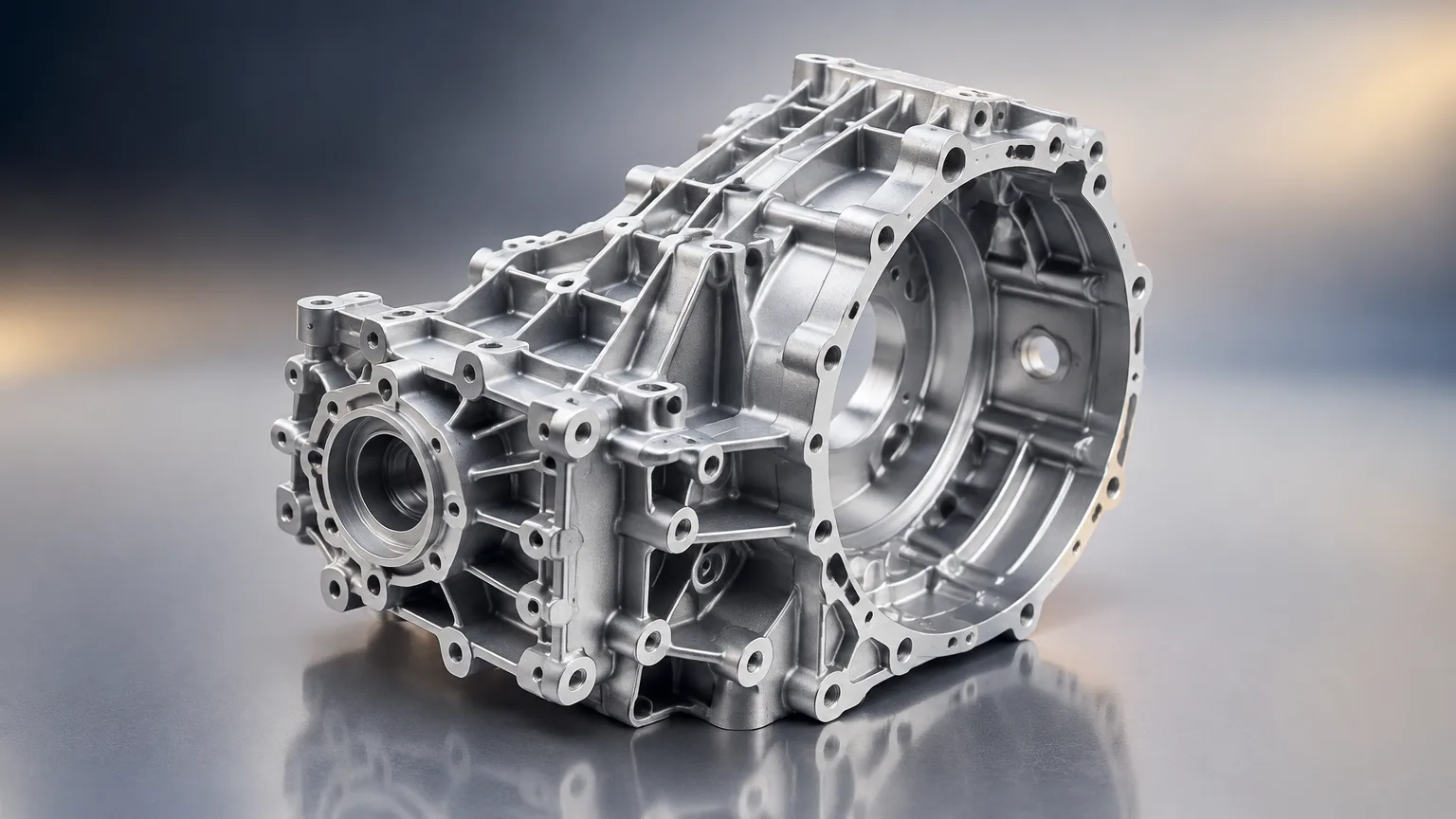
Die casting is a metal casting process that injects molten or semi-molten alloy into a reusable steel die under pressure, producing near-net-shape parts.
Definition, context and key process facts.
Step-by-step from melt to inspection.
Cold-chamber, hot-chamber, vacuum, squeeze and semi-solid.
Aluminum, zinc, magnesium and copper alloys.
Balanced pros and cons for sourcing decisions.
Practical rules for walls, draft, tolerances and die steel.
Automotive, electronics, industrial and consumer parts.
Cost drivers and how to request a quote.
What is die casting? Die casting is a metal casting process that injects molten or semi-molten alloy into a reusable steel die under pressure to make near-net-shape parts. High-pressure die casting is commonly used for repeatable, high-volume aluminum, zinc, magnesium and selected copper-alloy components.
What is die casting? Die casting refers to forcing molten or semi-molten metal into a hardened, reusable steel die under pressure, so the part leaves the tool close to final shape. Because one die serves thousands of cycles, the process suits repeatable, high-volume production.
High-pressure die casting (HPDC) is the most common form, used for aluminum, zinc, magnesium and selected copper-alloy parts. Cold-chamber die casting handles higher-melting alloys such as aluminum and magnesium, while hot-chamber die casting suits compatible zinc and selected magnesium alloys. The die is a hardened steel tool with a machined cavity that defines the part geometry, so parts need less machining than many other casting routes.
People asking what is diecast or what is die cast are asking about the same thing. “Diecast” and “die cast” are common variants of “die casting,” which technical documents generally use. The process differs from sand and investment casting because it uses permanent metal tooling rather than expendable molds or patterns.
The die casting process works by melting alloy, injecting it into a closed steel die under pressure, letting it solidify, and ejecting the finished part. This repeatable cycle is the practical answer to what is die casting for production buyers, and it explains the process's productivity and dimensional repeatability.
| Parameter | Typical range | Standard or source |
|---|---|---|
| Typical production cycle | 15–90 seconds | DFMA process comparison; application and geometry dependent.[10] |
| Typical tolerance | ±0.002–0.005 in [±0.05–0.13 mm] | DFMA comparison; confirm against NADCA alloy, size and feature tables.[10][1] |
| Miniature casting tolerance | ±0.0008 in [±0.020 mm] up to 1 in [25.4 mm]; ±0.001 in [±0.025 mm] per additional inch | NADCA miniature die-casting engineering reference.[9] |
| Minimum wall thickness | Approximately 0.04–0.08 in [1–2 mm], application dependent | DFMA comparison; verify with the selected alloy, die design and NADCA guidance.[10] |
| Die steel | H-10, H-11, H-13; premium or superior H-13 for demanding aluminum, magnesium and ZA tooling | NADCA tooling guidance and NADCA No. 229 recommendations.[8] |
Die casting types differ mainly in how metal enters the die and how air and porosity are managed. For anyone asking what is die casting beyond the basics, the main variations are cold-chamber, hot-chamber, vacuum, squeeze and semi-solid die casting, and HPDC covers the first two.
| Route | Pros | Cons |
|---|---|---|
| Cold-chamber high-pressure die casting | Suitable for aluminum, magnesium and some copper alloys; high productivity and dimensional repeatability. | Tooling investment, trapped air, porosity and limited weldability can be significant. |
| Hot-chamber high-pressure die casting | Fast cycles and efficient metal delivery for compatible zinc and selected magnesium alloys. | Generally unsuitable for alloys whose melting temperature or chemistry attacks the injection system. |
| Vacuum die casting | Reduces entrained gas and can improve structural integrity, heat treatment and welding potential. | Requires vacuum-capable dies, sealing, controls and process validation. |
| Squeeze casting | Applies pressure during solidification, reducing porosity and improving mechanical properties. | Usually slower and less suitable for highly intricate thin-wall geometry than conventional high-pressure casting.[15] |
| Semi-solid die casting | Can reduce turbulence and porosity while producing complex parts. | Requires controlled feedstock, specialized equipment and tighter process management.[15] |
| Compared with | Key differences |
|---|---|
| Sand casting | Die casting uses reusable metal tooling, higher production rates, thinner walls and tighter repeatability; sand casting generally has lower tooling cost and broader size flexibility. |
| Investment casting | Die casting is better suited to high volume and short cycles; investment casting supports complex small parts and broader alloy selection but uses expendable patterns. |
| Permanent-mold casting | Die casting injects metal under substantially higher pressure and usually provides faster cycles and thinner sections. |
| Forging | Die casting produces complex near-net shapes with less machining; forging generally offers stronger wrought grain structure but less geometric freedom. |
| Plastic injection molding | Die casting produces metal parts with higher temperature and strength capability, but requires metal dies, melting equipment and greater process energy. |
Aluminum, zinc, magnesium and selected copper alloys are the most common die casting materials. Each alloy family balances density, thermal properties, castability and tooling demands differently.
| Material | Grade | Properties | Typical uses |
|---|---|---|---|
| Aluminum | Common die-casting aluminum alloys; specify the applicable NADCA or regional alloy designation | Low density, good thermal conductivity, corrosion resistance and castability | Automotive housings, structural parts, heat sinks and equipment enclosures.[1][4] |
| Zinc | Zamak and ZA alloy families | Good fluidity, surface finish, dimensional stability and wear resistance | Small precision hardware, consumer products, locks, fittings and housings.[4] |
| Magnesium | Commercial magnesium die-casting alloy families | Very low density, good stiffness-to-weight ratio and electromagnetic shielding potential | Lightweight automotive, electronics and portable-equipment parts.[4] |
| Copper alloys | Commercial brass and bronze die-casting families | High thermal and electrical conductivity; higher density and tooling demands than aluminum | Electrical, plumbing, thermal and industrial components.[4] |
Die casting offers high productivity, thin walls and repeatable dimensions, but it also brings tooling cost, porosity risk and limited weldability. The balance depends on volume, geometry and alloy.
Porosity is the most common quality concern. Vacuum die casting reduces entrained gas and can improve structural integrity, heat treatment and welding potential, but it requires vacuum-capable dies, sealing, controls and process validation. Validate hardness, tensile properties or density when the application specifies them.
Good die casting design keeps walls uniform, avoids sharp corners and plans for draft, ejection and machining, which reduces porosity, tooling wear and cost. These rules follow from what is die casting at its core: molten metal filling a steel die under pressure.
Die casting is used where repeatable metal parts are needed at moderate-to-high volume. Automotive is a major application, along with electronics, industrial equipment and consumer products.
The process fits parts that would otherwise need extensive machining from billet or assembly from multiple pieces. It is less suitable for very low volumes, very large parts, or alloys that attack the injection system.
Die casting cost is driven by tooling, alloy, part geometry, annual volume, cycle time, secondary operations, tolerances and inspection requirements. No universal price applies, so a quotation is needed for each part.
Sourcing Repository collects quotes from a vetted supplier network, manages quality and inspection, and delivers parts. It does not own factories or machines. To start, share your drawings, alloy, annual volume and inspection requirements through the die casting service page or request a quote. Quote turnaround is typically 5–7 working days.
Upload it with quantity and material to start a quote.
FAQ
“Diecast” and “die cast” are common variants of “die casting”; technical documents generally use “die casting.” All three refer to injecting molten or semi-molten metal into a reusable steel die under pressure to make near-net-shape parts.
It is usually most economical at moderate-to-high volume because tooling and process-development costs are spread across many parts.[13] At low volume, tooling can dominate the piece price, so alternative processes may be more cost-effective.
No universal price applies. Obtain a quotation using geometry, alloy, annual volume, tooling, cycle time, secondary operations, tolerances and inspection requirements. Cost is driven by tooling, material, cycle time and post-casting operations.
Some vacuum or specially controlled castings may support welding, but gas porosity and alloy condition must be qualified for the specific process. Standard high-pressure die castings often have limited weldability due to trapped gas.
Related resources
Ready when you are
Share your drawings, alloy, annual volume and inspection requirements. Sourcing Repository collects quotes from a vetted supplier network, manages quality and inspection, and delivers parts.
Your files stay confidential. NDA available on request.