
What 80/20 T-slot extrusion is
System designation, not a material spec: how the term is used in practice.
Sourcing guide
80/20 is a brand-based name for modular T-slotted aluminum framing, commonly used for machine guards, workstations, and material-handling carts. This guide covers series, sizes, alloys, and sourcing.
80/20 branded T-slot framingvsGeneric T-slot or welded framing
System designation, not a material spec: how the term is used in practice.
Extrusion, cutting and finishing, then weld-free mechanical assembly.
Nominal size differences and why catalog geometry must be verified.
6105-T5 and 6063-T6, and why the material certificate controls.
Slot geometry, cut length, squareness, and burr control.
Yield, tooling, and secondary operations that drive price.
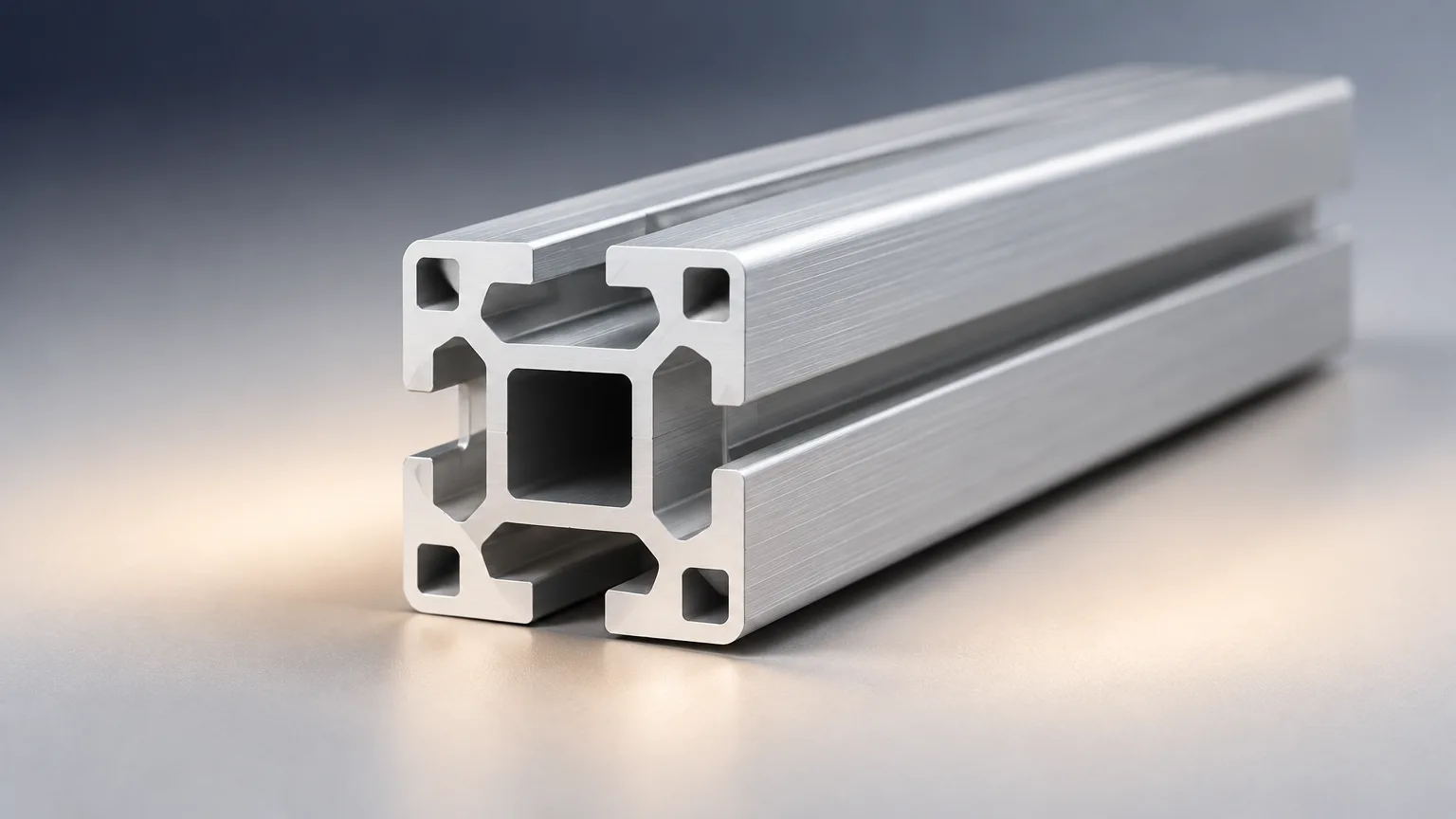
80/20 is a proprietary family of T-slotted aluminum framing profiles and matching fasteners, also used generically for T-slot framing. A typical 10 Series 1010 profile measures about 1.00 by 1.00 in [25.4 by 25.4 mm] with four open slots. Verify slot geometry, alloy, and interchangeability by manufacturer part number.
80/20 is a proprietary family of modular, T-slotted aluminum framing profiles and compatible fasteners. The term is also used generically for T-slot framing, but dimensions, alloys, slot geometry, and compatibility must be verified against the specified manufacturer.
That dual meaning matters in procurement. A drawing that says "8020 aluminum" may mean a branded catalog line, an equivalent profile from another mill, or the general category of slotted extrusion.
Treat 80/20 as a system designation, not a material specification. State the profile series, cross-section, slot geometry, and alloy or temper on every print so each supplier quotes the same target.
T-slot framing works because each profile carries continuous slots along its length, letting fasteners lock anywhere on the member. Profiles are extruded, cut and finished to length, then joined mechanically.
The weld-free joint is the defining feature: you can build, test, and change a frame without cutting or repainting. The trade-off is that joint stiffness depends on fastener preload and bracket choice.
| Parameter | Typical range | Source |
|---|---|---|
| 10 Series 1010 profile | Typically 1.00 by 1.00 in [25.4 by 25.4 mm]; four open slots | 80/20 product listings and distributor technical data |
| 10 Series slot width | Approximately 0.26 in [6.6 mm] | 80/20 product listings |
| 10 Series bore diameter | Approximately 0.21 in [5.3 mm] | 80/20 product listings |
| 10 Series rectangular profiles | Typical examples include 1 by 2 in [25.4 by 50.8 mm] and 1 by 3 in [25.4 by 76.2 mm] | 80/20 product listings |
| Stock lengths | Typical examples: about 48, 72, and 97 in [1,219, 1,829, and 2,464 mm] | 80/20 distributor listings |
| Profile dimensional tolerance | Unverified for specific 80/20 profiles | Obtain the manufacturer drawing and applicable ASTM B221 tolerance table |
Series designation indicates nominal profile size, which is the fastest way to separate T-slot options. A 10 Series profile is typically about 1 in [25.4 mm] on a side. An 80 Series profile belongs to a larger family in some catalogs, typically about 3.15 in [80 mm]; exact geometry and material are unverified here and need the manufacturer catalog.
In catalog shorthand, 10S refers to the 80/20 10 Series. A representative 1010 profile is typically about 1.00 by 1.00 in [25.4 by 25.4 mm] with four open T-slots, a slot width near 0.26 in [6.6 mm], and a bore diameter near 0.21 in [5.3 mm].
| Option | Key differences | Best fit |
|---|---|---|
| 80/20 branded profiles | Catalog-driven system with documented profiles, slots, and matching fasteners | Projects that follow an existing 80/20 bill of materials |
| Bosch Rexroth profile systems | Also modular T-slots, but geometry, fasteners, and compatibility are manufacturer-specific | Projects already standardized on that catalog |
| Generic T-slot extrusion | May cost less but can differ in alloy, slot geometry, tolerances, and accessory compatibility | Cost-driven frames with specified, inspected geometry |
| Welded steel framing | 80/20 is lighter and reconfigurable; welded steel can give higher stiffness or lower cost | Permanent, heavy, high-stiffness structures |
| Welded aluminum framing | T-slot avoids welding and finishing; welded aluminum can reduce joint hardware | Custom shapes with continuous load paths |
Most T-slot framing profiles are made from heat-treatable aluminum extrusion alloys. 80/20 profile listings identify 6105-T5 for many framing extrusions, and at least one component lists 6063-T6.
| Material | Grade | Properties | Typical uses |
|---|---|---|---|
| Aluminum | 6105-T5 | Common 80/20 profile alloy; precipitation-hardened extrusion temper. Specific strength, conductivity, and corrosion data require the applicable material certificate. | Structural T-slot profiles and framing members |
| Aluminum | 6063-T6 | Listed for at least one 80/20 extrusion component; often selected for finish quality and general framing. | Certain proprietary profiles or accessories; verify by part number |
The part number controls the alloy. Two profiles with the same cross-section can be produced in different alloys with different mechanical properties, so a material certificate is the only reliable confirmation for a structural application.
Finishes are separate from alloy. Anodizing is common on framing profiles because it protects the surface and gives a consistent appearance, but it does not change the underlying alloy or temper.
The main advantage of 80/20 framing is speed of change; the main limitation is joint stiffness compared with welded construction. Both matter when you select a framing method.
Nothing in this list rules the system out for demanding work; it defines where engineering attention is required. Rigid frames need bracket selection, preload control, and sometimes diagonal bracing rather than bigger profiles.
Good T-slot design starts with the drawing, not the catalog. Specify measurable features so any qualified supplier can quote and inspect against the same requirements.
Two tolerances drive most fit problems: slot geometry and cut length. Slot width and bore diameter control hardware engagement, while cut length and squareness control whether a frame closes square.
Applications for 80/20 aluminum extrusion center on structures that must be built quickly and changed later, with material-handling carts and racks among the most common.
Sourcing Repository collects quotes from a vetted supplier network, manages quality and inspection, and delivers parts. We do not own factories or machines; our value is supplier selection, quote comparison, and inspection follow-through.
Cost is driven mainly by cut length and material yield, plus tooling for custom cross-sections and any secondary operations. Cutting optimization, finish requirements, and tolerances all move the price.
The cheapest path is usually to use a catalog profile with a cut plan that minimizes scrap, and to keep secondary operations to a defined list.
Upload it with quantity and material to start a quote.
FAQ
10S generally means 80/20's 10 Series. A representative 1010 profile is 1.00 by 1.00 in [25.4 by 25.4 mm] with four open T-slots, a slot width near 0.26 in [6.6 mm], and a bore diameter near 0.21 in [5.3 mm].
No. 80/20 is primarily a brand and framing-system designation. The material itself is typically an aluminum extrusion alloy such as 6105-T5, and some components list 6063-T6, so the part number controls.
80/20 profile listings identify 6105-T5 for many framing extrusions, a precipitation-hardened extrusion temper. Some components list 6063-T6 instead. Specific strength and corrosion data require the applicable material certificate.
Only after confirming slot opening, slot depth, T-nut dimensions, centerline, and fastener compatibility. Brand names alone do not establish interchangeability, and mixing unspecified profiles is a common cause of loose or misaligned joints.
Related resources
Ready when you are
Send your profile drawing, alloy, cut list, and finish requirements. Sourcing Repository collects quotes from a vetted supplier network, manages quality and inspection, and delivers parts.
Your files stay confidential. NDA available on request.