
Automotive electronics sourcing
Automotive Electronics Manufacturing
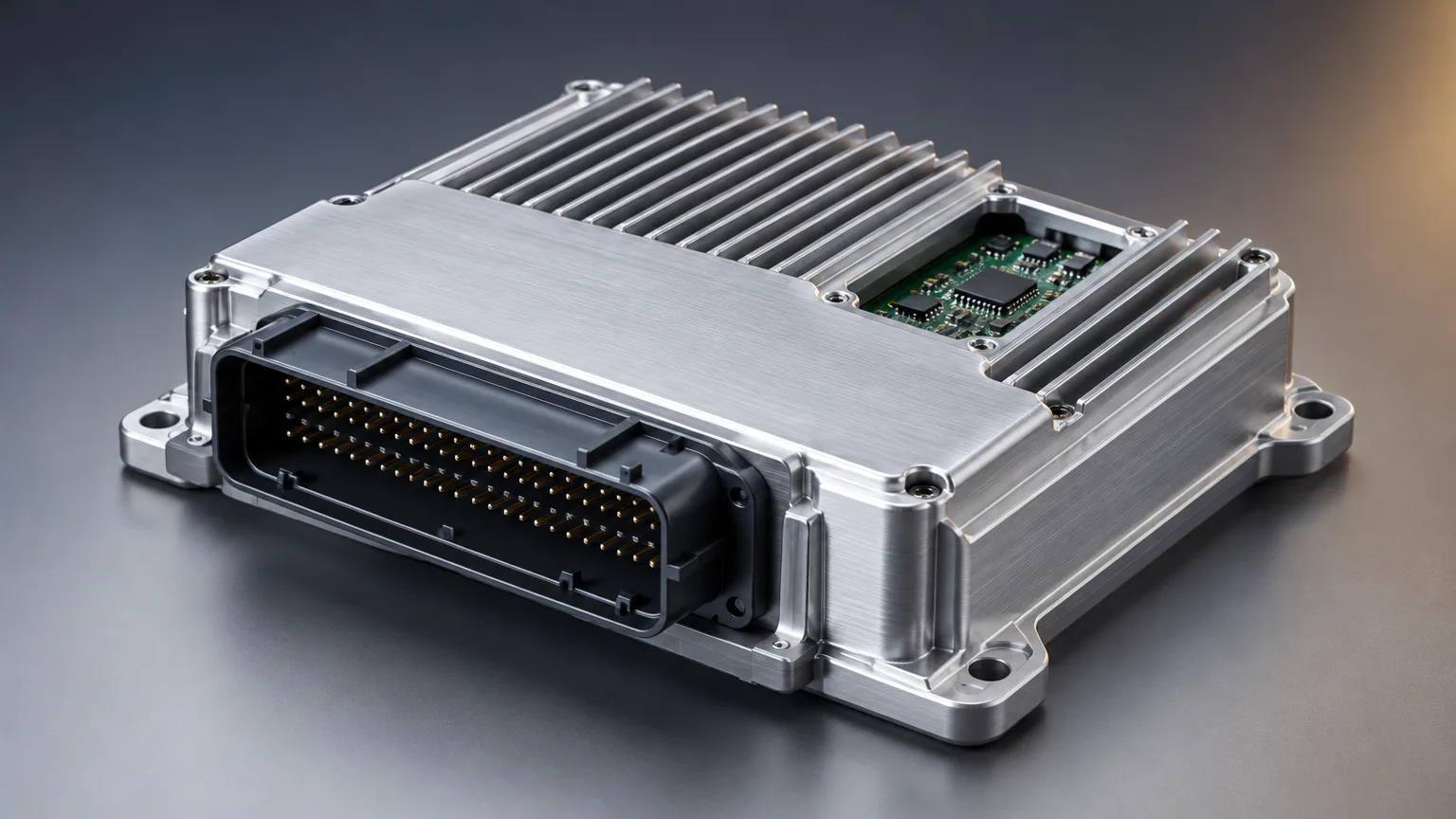
SR sources automotive electronics parts — housings, connectors, brackets and sensor components — from a vetted supplier network, with inspection and one point of contact from quote to delivery.
- Housings and enclosures
- Connectors and terminals
- Sensor brackets
- ECU mounting hardware
- Quote in 5-7 working daysSend CAD, drawing and quantities
- Inspection before shipmentDimensional and visual checks
- One contact, many suppliersSR manages the supplier network
Automotive electronics manufacturing is the production of electronic car parts such as control-unit housings, connectors, sensor bodies and mounting brackets. SR is a manufacturing broker: it collects quotes from a vetted supplier network, manages quality and inspection, and delivers finished automotive electronic components without owning factories or machines.
What automotive electronics manufacturing covers
Automotive electronics manufacturing is the production of electronic car parts — enclosures, connectors, terminals, brackets and sensor bodies — using processes such as CNC machining, die casting, injection molding, stamping, forging and assembly. It is the manufacturing side of automotive electronic components, not the design of the circuits inside them.
This service fits engineers, procurement managers and founders who need custom automotive electronics parts made to a drawing. It suits prototype and low-volume builds, aftermarket and service parts, and production programs where a validated process, traceability and part approval are required.
When to use this service
- You have a CAD model or drawing for an electronic car part and need it manufactured.
- You need several process routes compared — machining, casting, molding or stamping — before committing to tooling.
- You want supplier quotes collected and compared without contacting factories yourself.
- You need inspection evidence and part approval documentation alongside the parts.
- Your program follows automotive quality expectations such as IATF 16949 and PPAP.
Automotive electronics manufacturing process steps
The process runs from requirement review to delivered parts in seven steps. Each step produces a document or decision that the next step depends on, so nothing moves forward on assumptions.
- 1. Requirement review Send CAD, drawing, revision, material, finish, tolerances, quantity, delivery location and inspection needs. SR reviews the package for gaps before quoting.
- 2. Process route selection SR matches the part to suitable routes — CNC machining, die casting, injection molding, stamping, forging, additive or assembly — based on geometry, volume and tolerance.
- 3. Supplier quoting Vetted suppliers in the network quote the same package so quotes are comparable. Quote turnaround is typically 5-7 working days.
- 4. DFM and clarification Suppliers flag features that raise cost or risk: thin walls, tight tolerances on non-critical features, deep pockets, undercuts and datum schemes that are hard to hold.
- 5. Tooling and first article Where tooling is needed, the supplier builds it and produces a first article. Dimensions, material and finish are checked against the drawing before volume work starts.
- 6. Production and in-process control Production runs under a control plan with SPC where the customer requires it. Capability targets are feature-specific and agreed in advance.
- 7. Inspection and delivery SR manages final inspection — dimensional and visual — and coordinates shipping to the delivery location on the drawing package.
Part approval follows AIAG PPAP where the customer requires it. The submission level and evidence vary by customer, so confirm the required level before production begins.
Materials and finishes for automotive electronic components
Material choice for automotive electronics parts is driven by weight, thermal load, electrical insulation, corrosion exposure and cost. Grades must be specified on the drawing; the table below lists the material families SR sources most often.
| Material | Grade | Properties | Typical uses |
|---|---|---|---|
| Aluminum alloys | Unverified; grade must be specified by drawing | Low density, corrosion resistance, machinability, and castability | Brackets, housings, wheels, engine and transmission components |
| Carbon and alloy steel | Unverified; grade must be specified by drawing | High strength, fatigue resistance, hardness, and weldability vary by grade | Stampings, shafts, gears, suspension, fasteners, and structural parts |
| Magnesium alloys | Unverified; grade must be specified by drawing | Very low density and good castability; corrosion protection is often required | Lightweight housings, brackets, seat frames, and instrument-panel structures |
| Zinc alloys | Unverified; grade must be specified by drawing | Good die-castability, dimensional repeatability, and surface finish | Handles, latches, housings, and small hardware |
| Polypropylene | Unverified; grade must be specified by drawing | Low density, chemical resistance, and good processability | Trim, ducts, covers, containers, and molded interior parts |
| Polyamide | Unverified; grade must be specified by drawing | Good strength, wear resistance, and temperature capability; moisture affects dimensions | Gears, clips, brackets, connectors, and under-hood parts |
| ABS | Unverified; grade must be specified by drawing | Impact resistance, dimensional stability, and attractive molded surfaces | Interior trim, bezels, housings, and instrument-panel parts |
Finishes and protection
Finishes are specified on the drawing along with the surface requirement. Typical finishes for electronic car parts include anodizing and conversion coating on aluminum, zinc or nickel plating on steel hardware, powder coating and e-coat on brackets, and molded-in color or texture on plastic housings. Magnesium parts usually need corrosion protection because the base metal corrodes readily.
Specs and tolerances for automotive electronics parts
Tolerances, size limits and lead times depend on the process, material, size and drawing. The table below lists the parameters that must be defined before a supplier can confirm capability.
| Parameter | Typical range | Standard or source |
|---|---|---|
| Dimensional tolerance | Unverified; depends on process, size, material, and drawing | Part drawing and supplier capability study required |
| Geometric tolerancing | Unverified; specify datum scheme and GD&T callouts | ASME Y14.5 or applicable ISO GPS standard; exact edition unverified |
| Surface roughness | Unverified; specify Ra or other required parameter | Drawing requirement; applicable surface-texture standard unverified |
| Hardness and strength | Unverified; defined by material and heat-treatment specification | Material specification and test method required |
| Capability | Cp/Cpk targets are customer- and feature-specific | IATF 16949, control plan, SPC, and customer-specific requirements |
| Part approval | Submission level and evidence vary by customer | AIAG PPAP and applicable customer-specific requirements |
Lead time is not a fixed number. It depends on whether tooling is required, material availability, finishing steps and inspection scope. Prototype routes that avoid tooling are usually faster than production routes that require first-article approval.
Design tips that lower automotive electronics part cost
Most cost in automotive electronics manufacturing is set at the design stage, before a single quote is issued. These DFM rules reduce cost without weakening the part.
- Tolerance only what functions. Request the tightest tolerance needed for function, not the tightest possible tolerance; every extra decimal adds cost and inspection time.
- Keep walls uniform. Sudden wall-thickness changes cause sink, warp and porosity in molded and cast housings. Gradual transitions are cheaper to produce and easier to hold.
- Design for the process you chose. Undercuts, deep thin pockets and sharp internal corners raise tooling cost in molding and casting; add draft and radii where the function allows.
- Use a clear datum scheme. A defined datum scheme with GD&T callouts lets the supplier build a repeatable fixture instead of measuring every feature from scratch.
- Specify standard material grades. Exotic or single-source grades extend lead time and limit which suppliers can quote.
- Consolidate parts. Combining brackets, fasteners or housings into one machined or cast part often costs less than assembling several pieces.
- Match finish to exposure. Do not over-specify plating or coating on parts that never see moisture or road salt; specify only the protection the location requires.
Typical automotive electronics applications
Automotive electronic components appear across the vehicle, from under-hood control units to interior interfaces. The examples below show the part types and industries SR sources most often.
| Area | Example parts | Common process |
|---|---|---|
| Powertrain and driveline | Sensor housings, transmission components, mounting brackets | Die casting, CNC machining |
| Body, chassis and structure | Module brackets, structural mounts, reinforcement plates | Stamping, forging, machining |
| Electrical, electronic and sensor housings | ECU enclosures, connector bodies, terminal hardware, sensor caps | Injection molding, die casting, stamping |
| Thermal management and exhaust | Heat-sink bodies, ducting, shield components | Die casting, stamping, molding |
| Interior and interface | Bezels, switch housings, trim panels, instrument-panel parts | Injection molding |
| Replacement, service and performance | Aftermarket housings, retrofit brackets, low-volume assemblies | CNC machining, additive, molding |
Industries served include passenger and commercial vehicle OEM programs, Tier 1 and Tier 2 suppliers, motorsport and performance builders, EV and hybrid platforms, and aftermarket distributors. OEM production programs usually require validated processes, traceability and customer approval; custom aftermarket work often prioritizes flexibility and low-volume economics.
What drives the cost of automotive electronics manufacturing
No reliable universal price exists for custom auto parts. Cost is built from the factors below, and the same part can price very differently depending on volume and approval scope.
- Part geometry, size, wall thickness and tolerance requirements — the largest single driver.
- Material family and grade, including whether the grade is standard or single-source.
- Process route: CNC machining is flexible for prototypes and low volumes but wastes material and cycle time; injection molding is efficient at volume but carries tooling cost and design lead time; die casting is fast for near-net shapes but porosity and alloy limits need control; forging gives strong fatigue-resistant parts at the cost of tooling, material flow and machining allowances.
- Tooling and fixturing, amortized over the order quantity.
- Finishing steps such as plating, anodizing, coating or molded-in texture.
- Inspection scope: first article, in-process SPC, final dimensional reports and PPAP evidence.
- Quantity, packaging and delivery location.
- Program requirements such as traceability, control plans and customer-specific rules.
The cheapest quote is not always the lowest total cost. A route that avoids tooling may win on 50 parts and lose badly on 50,000. Compare quotes on the same drawing, revision, quantity and inspection scope.
Why order automotive electronics parts through SR
SR is a manufacturing broker. It does not own factories or machines; it collects quotes from a vetted supplier network, manages quality and inspection, and delivers the parts. That model gives buyers one contact instead of a list of factories to manage.
What SR does
- Reviews the drawing package and flags missing requirements before quoting
- Collects comparable quotes from vetted suppliers in the network
- Coordinates DFM feedback, tooling, first article and production
- Manages quality and inspection, including dimensional and visual checks
- Handles delivery coordination to the stated location
What SR does not do
- SR does not own factories, machines or certifications
- SR does not design the electronic circuit inside the part
- SR does not guarantee a supplier's process without agreed specifications and controls
- SR does not quote without a defined drawing, revision and quantity
Deposit and payment terms are agreed per order and confirmed in writing before production starts. Quote turnaround is typically 5-7 working days from a complete package. Send drawings and quantities to killol@sourcingrepository.com or through the quote form.
Have a drawing to quote?
Upload it with quantity and material to start a quote.
FAQ
Common questions
How much do custom auto parts cost?
No reliable universal price exists. Cost depends on geometry, material, process, tooling, quantity, tolerance, finishing, inspection and logistics. Compare quotes on the same drawing, revision and quantity so the differences you see are real.
What information is needed for a quote?
Provide CAD, drawing, revision, material, finish, tolerances, quantity, delivery location, inspection needs and the intended application. Missing any of these usually means the quote comes back with assumptions instead of a firm number.
What is PPAP?
PPAP is an automotive submission process used to demonstrate that production processes can consistently meet approved requirements. The submission level and evidence vary by customer, so confirm the required level before production begins.
What tolerance should be requested?
Request the tightest tolerance needed for function, not the tightest possible tolerance. The supplier should confirm capability for each critical feature, and capability targets are customer- and feature-specific rather than a single default value.
Related resources
Keep reading
Ready when you are
Send your automotive electronics drawing for quoting
Share CAD, drawing, revision, material, finish, tolerances and quantity. SR reviews the package, collects vetted supplier quotes and manages inspection through delivery.
Your files stay confidential. NDA available on request.