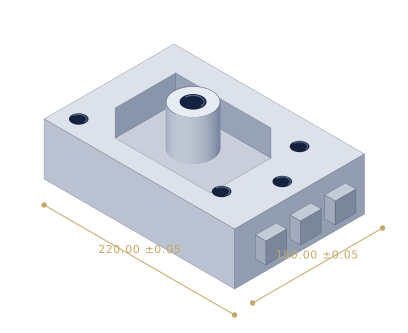
Aluminum vs zinc vs magnesium die casting alloys
Compares density, castability, finish and typical applications across the main alloy families.
Manufacturing guide
This die casting guide explains how high-pressure die casting works, which alloys fit which parts, and the design, tolerance and cost factors that decide a program.
Compares density, castability, finish and typical applications across the main alloy families.
Explains machine routes, compatible alloys and when each process is selected.
Covers as-cast finish, trimming, machining, coating and other post-casting steps.
Breaks down tooling investment and how volume affects program economics.
Details minimum wall, draft angles, radii and feature rules for castable parts.
Die casting is a metal casting process that injects molten or semi-molten alloy into a reusable steel die under pressure to produce near-net-shape parts. This die casting guide covers cold-chamber and hot-chamber routes, vacuum and semi-solid variants, aluminum, zinc, magnesium and copper alloys, tolerances, design rules, cost drivers and supplier selection.
Die casting is a metal casting process that injects molten or semi-metall alloy into a reusable steel die under pressure, producing near-net-shape parts. High-pressure die casting is commonly used for repeatable, high-volume aluminum, zinc, magnesium and selected copper-alloy components.
This die casting guide is written for engineers, procurement managers and founders sourcing custom parts, with automotive applications first. It moves from process selection through alloy choice, design rules, tolerances, cost drivers and supplier evaluation, so a buyer can brief a supplier and read a quotation with confidence.
Sourcing Repository (SR) is a manufacturing broker. SR does not own factories or machines; it collects quotes from a vetted supplier network, manages quality and inspection, and delivers parts. Technical statements here follow published die-casting references, chiefly NADCA guidance and DFMA process comparisons.
The chapter map below lists each chapter of this die casting guide with a one-line summary, so you can jump to the decision you are facing now.
| Chapter | One-line summary | Link |
|---|---|---|
| Aluminum vs zinc vs magnesium die casting alloys | Compares density, castability, finish and typical applications across the main alloy families. | /resources/guides/die-casting-guide/aluminum-vs-zinc-vs-magnesium-die-casting-alloys/ |
| Die casting process: hot chamber vs cold chamber | Explains machine routes, compatible alloys and when each process is selected. | /resources/guides/die-casting-guide/die-casting-process-hot-chamber-vs-cold-chamber/ |
| Die casting surface finish and secondary operations | Covers as-cast finish, trimming, machining, coating and other post-casting steps. | /resources/guides/die-casting-guide/die-casting-surface-finish-and-secondary-operations/ |
| Die casting tooling cost and MOQ | Breaks down tooling investment and how volume affects program economics. | /resources/guides/die-casting-guide/die-casting-tooling-cost-and-moq/ |
| Wall thickness and draft design rules | Details minimum wall, draft angles, radii and feature rules for castable parts. | /resources/guides/die-casting-guide/wall-thickness-and-draft-design-rules/ |
| Guides hub | Index of SR manufacturing guides for sourcing and process selection. | /resources/guides/ |
| Request a quote | Submit drawings and volumes to SR for supplier quotes and delivery. | /get-a-quote/ |
High-pressure die casting is the default route for high-volume, repeatable parts; the choice between cold-chamber, hot-chamber, vacuum, squeeze and semi-solid variants follows the alloy and the required internal quality.
| Route | Pros | Cons |
|---|---|---|
| Cold-chamber high-pressure die casting | Suitable for aluminum, magnesium and some copper alloys; high productivity and dimensional repeatability. | Tooling investment, trapped air, porosity and limited weldability can be significant. |
| Hot-chamber high-pressure die casting | Fast cycles and efficient metal delivery for compatible zinc and selected magnesium alloys. | Generally unsuitable for alloys whose melting temperature or chemistry attacks the injection system. |
| Vacuum die casting | Reduces entrained gas and can improve structural integrity, heat treatment and welding potential. | Requires vacuum-capable dies, sealing, controls and process validation. |
| Squeeze casting | Applies pressure during solidification, reducing porosity and improving mechanical properties. | Usually slower and less suitable for highly intricate thin-wall geometry than conventional high-pressure casting. |
| Semi-solid die casting | Can reduce turbulence and porosity while producing complex parts. | Requires controlled feedstock, specialized equipment and tighter process management. |
| Compared with | Key differences |
|---|---|
| Sand casting | Die casting uses reusable metal tooling, higher production rates, thinner walls and tighter repeatability; sand casting generally has lower tooling cost and broader size flexibility. |
| Investment casting | Die casting is better suited to high volume and short cycles; investment casting supports complex small parts and broader alloy selection but uses expendable patterns. |
| Permanent-mold casting | Die casting injects metal under substantially higher pressure and usually provides faster cycles and thinner sections. |
| Forging | Die casting produces complex near-net shapes with less machining; forging generally offers stronger wrought grain structure but less geometric freedom. |
| Plastic injection molding | Die casting produces metal parts with higher temperature and strength capability, but requires metal dies, melting equipment and greater process energy. |
Aluminum, zinc, magnesium and copper alloys cover most die-casting demand; the alloy decision sets density, castability, finish, tooling demands and the achievable tolerance band.
| Alloy | Grade family | Properties | Typical uses |
|---|---|---|---|
| Aluminum | Common die-casting aluminum alloys; specify the applicable NADCA or regional alloy designation | Low density, good thermal conductivity, corrosion resistance and castability | Automotive housings, structural parts, heat sinks and equipment enclosures. |
| Zinc | Zamak and ZA alloy families | Good fluidity, surface finish, dimensional stability and wear resistance | Small precision hardware, consumer products, locks, fittings and housings. |
| Magnesium | Commercial magnesium die-casting alloy families | Very low density, good stiffness-to-weight ratio and electromagnetic shielding potential | Lightweight automotive, electronics and portable-equipment parts. |
| Copper alloys | Commercial brass and bronze die-casting families | High thermal and electrical conductivity; higher density and tooling demands than aluminum | Electrical, plumbing, thermal and industrial components. |
Design for die casting means designing for a steel die: uniform walls, adequate draft, generous radii and tolerances that match what the process can hold repeatably.
| Parameter | Typical range | Standard or source |
|---|---|---|
| Typical production cycle | 15–90 seconds | DFMA process comparison; application and geometry dependent. |
| Typical tolerance | ±0.002–0.005 in [±0.05–0.13 mm] | DFMA comparison; confirm against NADCA alloy, size and feature tables. |
| Miniature casting tolerance | ±0.0008 in [±0.020 mm] up to 1 in [25.4 mm]; ±0.001 in [±0.025 mm] per additional inch | NADCA miniature die-casting engineering reference. |
| Minimum wall thickness | Approximately 0.04–0.08 in [1–2 mm], application dependent | DFMA comparison; verify with the selected alloy, die design and NADCA guidance. |
| Die steel | H-10, H-11, H-13; premium or superior H-13 for demanding aluminum, magnesium and ZA tooling | NADCA tooling guidance and NADCA No. 229 recommendations. |
Die casting cost is driven by tooling, cycle time, alloy, secondary operations and inspection; volume determines how much of the fixed tooling and process-development cost each part carries.
No universal tooling price, unit price or minimum order quantity can be stated without a supplier quotation. The practical approach is to quote the same drawing at two or three annual volumes and compare the total program cost, not the piece price alone.
A capable die casting supplier matches machine and alloy capability to your part, controls the process with evidence, and communicates deviations before they become scrap.
SR collects quotes from a vetted supplier network, manages quality and inspection, and delivers parts. SR does not own factories or machines, so supplier capability is verified rather than assumed.
Upload it with quantity and material to start a quote.
FAQ
Die casting is a metal casting process that injects molten or semi-molten alloy into a reusable steel die under pressure to make near-net-shape parts. High-pressure die casting is the common route for repeatable, high-volume aluminum, zinc, magnesium and selected copper-alloy components.
Die casting is usually most economical at moderate-to-high volume, because tooling and process-development costs are spread across many parts. At low volume the fixed tooling investment dominates, and sand or investment casting may be the better economic choice.
Die casting services may include design review, die manufacture, casting, trimming, machining, finishing, inspection, assembly and logistics. Scope varies by supplier, so confirm exactly which steps are included before comparing quotations.
Some vacuum or specially controlled castings may support welding, but gas porosity and alloy condition must be qualified for the specific process. Conventional high-pressure die castings often have limited weldability, so confirm the requirement with the supplier early.
Related resources
Ready when you are
Send drawings, alloy and annual volumes to SR. SR collects quotes from a vetted supplier network, manages quality and inspection, and delivers parts. Typical quote turnaround is 5–7 working days.
Your files stay confidential. NDA available on request.