
Automotive Casting Sourcing
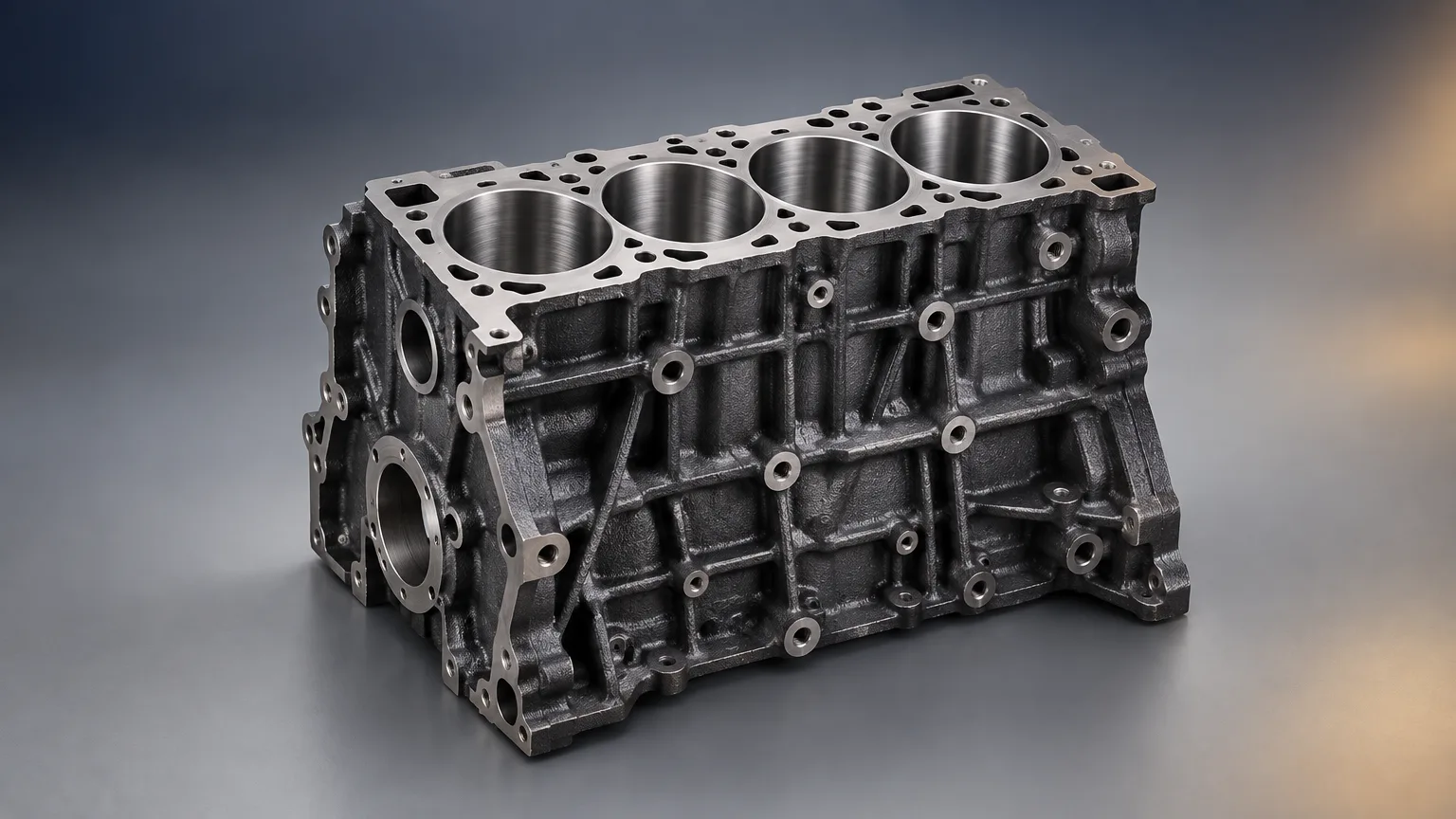
Cast Iron Engine Block Casting and Machining
SR sources cast iron engine blocks and related castings from a vetted supplier network, manages quality and inspection, and delivers finished parts to your drawing.
- Grey and ductile iron
- Sand casting routes
- Machined to drawing
- Inspection managed
- Quote in 5-7 working daysSend drawing, material, quantity and delivery location
- Inspection managed by SRIncoming material review and dimensional checks
- PPAP-ready documentationSubmission level set by your customer requirements
A cast iron engine block is a cylinder block produced by pouring molten iron into a mold, then machining critical faces, bores and holes. SR sources cast iron engine blocks from a vetted supplier network, manages inspection and documentation, and delivers parts to your drawing without owning factories or machines.
What cast iron engine block sourcing through SR is
Cast iron engine block sourcing is the process of obtaining a cylinder block cast from iron and machined to a defined drawing. SR is a manufacturing broker: it collects quotes from a vetted supplier network, manages quality and inspection, and delivers finished parts. SR does not own factories or machines.
This service fits engineers, procurement managers and founders who need cast iron block engines for production, replacement, service or performance programs. It suits automotive work first, and also applies to industrial engines, compressors and pump housings where a cast iron block engine structure is required.
When to use this service
- You have a drawing or CAD model for an engine block casting and need production quotes.
- You need a cast iron block engine for a low-volume or aftermarket program where tooling economics matter.
- You want one contact managing multiple casting and machining suppliers.
- You need incoming material verification, dimensional inspection and traceability documented.
- You are preparing an automotive submission and need PPAP evidence from the supply chain.
Engine block casting process steps
Engine block casting is the process of pouring molten iron into a sand mold to form a rough block that is then machined. It is a core step in automotive parts manufacturing, and critical features are verified before shipment.
- 1. Requirements review SR reviews your drawing, material specification, tolerances, quantity and delivery location, and flags missing details before quoting.
- 2. Supplier selection and quoting The requirement goes to vetted suppliers with casting and machining capability. Quotes are compared on process route, tooling, inspection and lead time.
- 3. Pattern and tooling The supplier produces or qualifies the pattern and core boxes. Tooling design affects draft, wall thickness, core placement and machining allowance.
- 4. Mold and core making Sand molds and cores are formed. Gating, risering and chill placement control solidification and reduce shrinkage porosity.
- 5. Melting and pouring Iron is melted to the specified grade and poured at a controlled temperature, typically about 2,550 °F (1,400 °C) for grey iron. Chemistry and pouring practice are recorded for traceability.
- 6. Cooling, shakeout and cleaning Castings cool under controlled conditions, then are shaken out and cleaned, and gates, risers and flash are removed.
- 7. Heat treatment and stress relief Where the drawing requires it, castings are heat treated or stress relieved to meet hardness and strength requirements.
- 8. Machining Cylinder bores, main bearing bores, deck surfaces and bolt holes are machined to the drawing. Datum schemes and GD&T callouts govern setup.
- 9. Inspection and documentation Material verification, dimensional checks and required tests are performed, and traceability records are compiled for review.
- 10. Packing and delivery Parts are protected, packed and shipped with the documentation package.
Engine block cast iron materials and finishes
Engine block cast iron is commonly grey iron or ductile iron, with the exact grade specified on the drawing. Finishes and surface treatments depend on the application and customer requirement.
| Material | Grade | Properties | Typical uses |
|---|---|---|---|
| Grey iron | Unverified; grade must be specified by drawing | Good castability, vibration damping, thermal conductivity and machinability | Engine blocks, cylinder heads, housings and machine bases |
| Ductile iron | Unverified; grade must be specified by drawing | Higher strength and ductility than grey iron; nodular graphite structure | Blocks, crankshafts, brackets and structural castings |
| Carbon and alloy steel | Unverified; grade must be specified by drawing | High strength, fatigue resistance and hardness vary by grade | Shafts, gears, suspension and structural parts |
| Aluminum alloys | Unverified; grade must be specified by drawing | Low density, corrosion resistance and good machinability | Brackets, housings and lightweight engine components |
Finishes and surface treatments
- As-cast finish on non-critical surfaces, cleaned of sand and flash.
- Machined finish on deck faces, bores, bearing journals and sealing surfaces.
- Shot blasting or tumbling to even out surface appearance.
- Primer or paint where corrosion protection is required; the specification must be on the drawing.
- Oil, coolant and sealing surfaces protected for shipment.
Cast iron engine block specs and tolerances
Tolerances, size limits and lead time for a cast iron engine block depend on process route, part size, material and drawing. The table lists the parameters SR manages across vehicle parts manufacturing and the source that governs each one.
| Parameter | Typical range | Standard or source |
|---|---|---|
| Dimensional tolerance | Unverified; depends on process, size, material and drawing | Part drawing and supplier capability study required |
| Geometric tolerancing | Unverified; specify datum scheme and GD&T callouts | ASME Y14.5 or applicable ISO GPS standard; exact edition unverified |
| Surface roughness | Unverified; specify Ra or other required parameter. Machined sealing faces are typically called out near Ra 63 µin (1.6 µm) | Drawing requirement; applicable surface-texture standard unverified |
| Hardness and strength | Unverified; defined by material and heat-treatment specification | Material specification and test method required |
| Capability | Cp/Cpk targets are customer- and feature-specific | IATF 16949, control plan, SPC and customer-specific requirements |
| Part approval | Submission level and evidence vary by customer | AIAG PPAP and applicable customer-specific requirements |
Request the tightest tolerance needed for function, not the tightest possible. The supplier should confirm capability for each critical feature before production.
Design tips that lower cast iron engine block cost
Design decisions made before tooling are cut have the largest effect on cast iron engine block cost. These DFM practices reduce tooling complexity, scrap and machining time.
- Use uniform wall thickness where possible. Thick-to-thin transitions create hot spots, shrinkage porosity and extra inspection.
- Add draft to all vertical faces so the pattern can be withdrawn without damaging the mold.
- Keep cores simple and well supported. Complex core assemblies raise tooling cost and increase core shift risk.
- Specify machining allowance only where it is needed. Excess stock increases machining time and tool wear.
- Define datums and GD&T that reflect function. Over-constrained datum schemes force tighter process control than the part needs.
- Avoid deep, narrow pockets and undercuts that require special tooling or additional operations.
- Standardize bolt holes, thread sizes and sealing features across variants to reduce setup changes.
- Confirm the material grade early. Grade changes after tooling can require process revalidation.
Typical cast iron engine block applications
Cast iron block engines appear in automotive, motorsport, industrial and agricultural equipment. The same casting and machining route supports replacement, service and performance parts.
| Part or component | Industry | Notes |
|---|---|---|
| Engine block casting | Automotive OEM and aftermarket | Grey or ductile iron; machined deck, bores and bearing journals |
| Cylinder head casting | Automotive and performance | Complex core work; valve guide and seat features |
| Transmission and clutch housing | Automotive and off-highway | Bearing bores and mounting faces machined to drawing |
| Compressor and pump housings | Industrial equipment | Pressure-tightness and machined sealing faces |
| Machine bases and frames | Industrial machinery | Vibration damping and flat mounting surfaces |
| Manifolds and adapters | Automotive and marine | Thermal cycling and flange flatness requirements |
OEM programs usually require validated processes, traceability and customer approval. Custom aftermarket work often prioritizes flexibility and low-volume economics. SR routes each program to suppliers suited to that balance.
What drives cast iron engine block casting cost
Cast iron engine block casting cost is driven by geometry, material, tooling, quantity, tolerance, finishing, inspection and logistics. No reliable universal price exists, so SR quotes each requirement against the actual drawing and scope.
- Part geometry, size, wall thickness and tolerance requirements.
- Material type, grade, availability and buy-to-fly ratio.
- Tooling: pattern, core boxes, fixtures and any dedicated gauges.
- Machining time, number of setups and required surface finishes.
- Heat treatment, stress relief and coating requirements.
- Inspection scope: dimensional layout, material testing and capability studies.
- Documentation level, including PPAP submission and traceability records.
- Quantity, order pattern and delivery location.
Why source cast iron engine blocks through SR
Sourcing cast iron engine blocks through SR gives you one contact for casting, machining, finishing and documentation. SR is a manufacturing broker for car parts manufacturing and other automotive components. It collects quotes from vetted automotive component manufacturers, manages quality and inspection, and delivers parts.
What SR does
- Reviews your drawing and RFQ package before quoting
- Collects and compares quotes from vetted suppliers
- Manages quality, inspection and documentation
- Provides one point of contact through delivery
- Returns quotes in 5-7 working days
What SR does not do
- Operate its own plants or machines
- Perform casting or machining in-house
- Set supplier prices
Inspection and documentation
Inspection scope is agreed at RFQ. It can include material verification and certification review, dimensional checks, process audits, control plans and traceability. Where an automotive submission is required, the supplier provides PPAP evidence at the level your customer defines.
Have a drawing to quote?
Upload it with quantity and material to start a quote.
FAQ
Common questions
How much do custom auto parts cost?
No reliable universal price exists. Cost depends on geometry, material, process, tooling, quantity, tolerance, finishing, inspection and logistics. SR quotes each cast iron engine block against the actual drawing and scope.
What information is needed for a quote?
Provide CAD, drawing, revision, material, finish, tolerances, quantity, delivery location, inspection needs and intended application for the cast iron engine block. A complete package lets SR collect comparable supplier quotes and return them in 5-7 working days.
Can a supplier make a part without a drawing?
A supplier may reverse-engineer or develop a model, but requirements, ownership, tolerances, materials and approval responsibilities must be agreed in writing. A controlled drawing is strongly preferred for engine block castings.
What is PPAP?
PPAP, the Production Part Approval Process, is an automotive submission used to show that a supplier's production process can consistently meet approved requirements. The supplier provides the evidence package, and submission level and rules vary by customer, so confirm them at RFQ.
Related resources
Keep reading
Ready when you are
Request a cast iron engine block quote
Send your drawing, material grade, quantity and delivery location. SR reviews the package and returns supplier quotes in 5-7 working days.
Your files stay confidential. NDA available on request.