
Automotive Sourcing Service
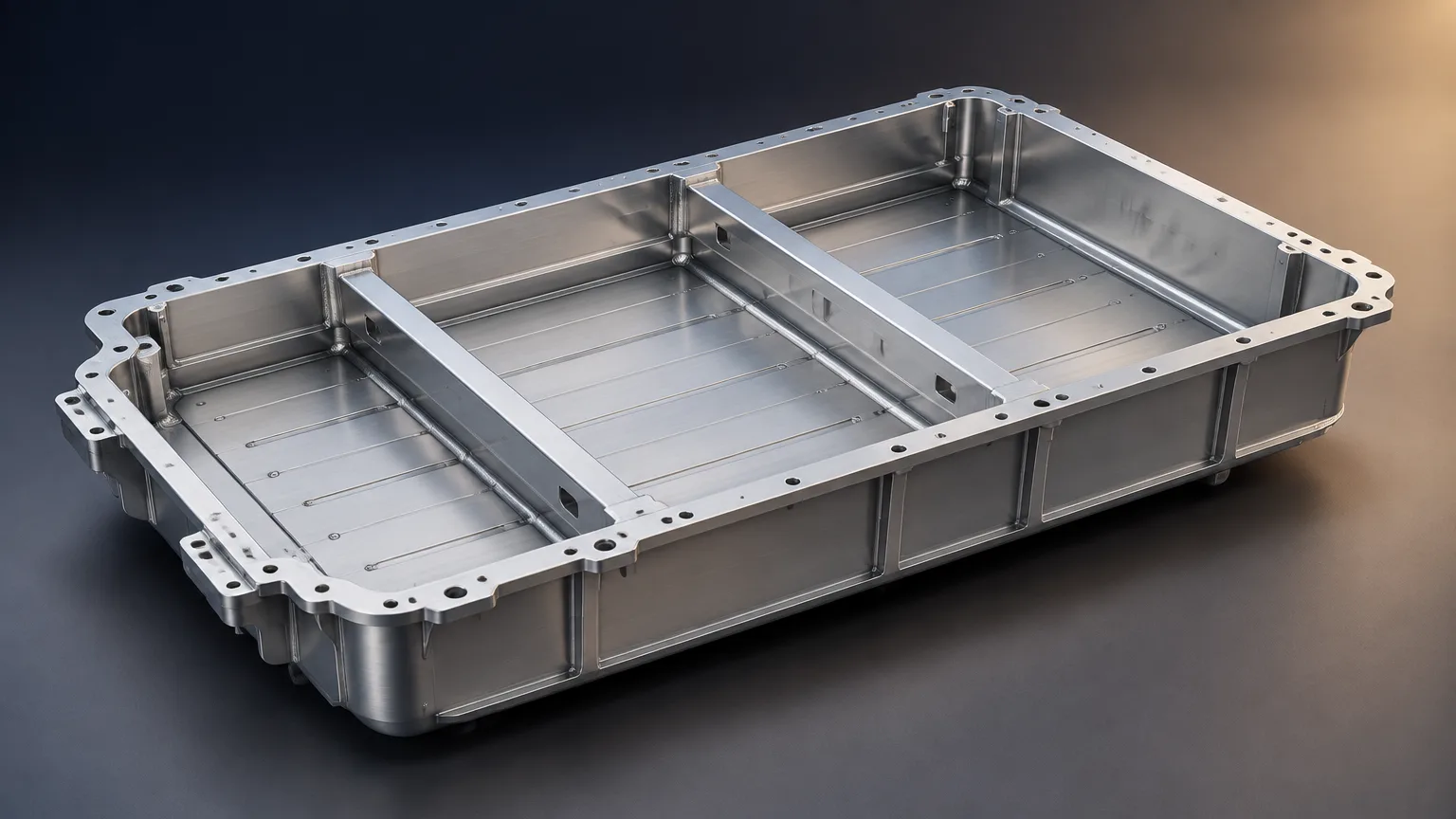
EV Battery Enclosure Manufacturing & Sourcing
SR sources EV battery enclosures and cooling plates from a vetted supplier network, managing quotes, quality and inspection so you get production-ready parts.
- Aluminum & steel
- Cooling plates
- IATF 16949 suppliers
- Inspection support
- Quote in 5-7 daysSend drawings and volumes for a supplier quote.
- Inspection managedIncoming material and dimensional checks.
- One point of contactSR coordinates every supplier on the job.
An EV battery enclosure is the structural housing that protects battery modules and integrates cooling plates in an electric vehicle. SR sources these parts from vetted suppliers using processes such as die casting, CNC machining, stamping, forging and injection molding, then manages quality and inspection.
What EV Battery Enclosure Sourcing Covers
An EV battery enclosure is the structural housing that contains battery modules, protects them from impact and contamination, and often integrates cooling plates or channels. Battery enclosure manufacturing combines metal forming, casting, machining, joining, finishing and inspection into one qualified assembly.
An EV battery enclosure is an automotive component that SR sources through a vetted supplier network: SR collects quotes, coordinates production, and manages quality and inspection until parts are delivered.
Enclosure work sits within auto parts manufacturing, also called car parts, automotive parts or vehicle parts manufacturing. Use this service when you have a drawing or CAD model and need production parts, a prototype-to-production transition or a second source among automotive component manufacturers. It also fits programs that require IATF 16949 suppliers, PPAP documentation or traceability a general machine shop cannot provide.
EV Battery Enclosure Manufacturing Process Steps
The process moves from requirements review to inspected delivery, with quality gates at material receipt, in-process operations and final inspection. SR manages each step across the selected supplier.
- 1. Requirements and drawing review SR reviews your CAD, drawing, revision, material, finish, tolerances, quantity and delivery location, and flags missing or ambiguous requirements before quoting.
- 2. Supplier selection and quoting The job is matched to vetted suppliers with the right process, capacity and quality framework. Quotes are consolidated into one response, typically within 5-7 working days.
- 3. DFM and process planning The supplier reviews wall thickness, draft, radii, datum scheme and joining method, then proposes a process route and control plan for critical features.
- 4. Tooling and first article Where tooling is required, it is built and sampled. First-article inspection verifies dimensions, material and finish against the drawing before volume release.
- 5. Production and in-process control Parts are made under the agreed control plan, with incoming material verification, process audits and traceability records kept by the supplier.
- 6. Inspection and documentation Final dimensional and visual inspection is performed, and inspection records, material certificates and PPAP evidence are compiled as required.
- 7. Delivery Parts are packed to protect sealing surfaces and cooling channels, then shipped with documentation to the agreed location.
Materials and Finishes for Battery Enclosures
Material choice drives weight, stiffness, cooling performance and cost. Aluminum is common for enclosures and cooling plates because of its low density and thermal conductivity, while steels and plastics suit specific structural or insulating roles.
| Material | Properties | Typical uses |
|---|---|---|
| Aluminum alloys | Low density, corrosion resistance, machinability, castability | Brackets, housings, cooling plates, structural enclosures |
| Carbon and alloy steel | High strength, fatigue resistance; hardness and weldability vary by grade | Stampings, suspension, fasteners, structural parts |
| Magnesium alloys | Very low density, good castability; corrosion protection often required | Lightweight housings, brackets, seat frames |
| Zinc alloys | Good die-castability, dimensional repeatability, surface finish | Handles, latches, housings, small hardware |
| Polypropylene | Low density, chemical resistance, good processability | Trim, ducts, covers, containers |
| Polyamide | Good strength, wear resistance, temperature capability; moisture affects dimensions | Clips, brackets, connectors, under-hood parts |
| ABS | Impact resistance, dimensional stability, molded surface quality | Interior trim, bezels, housings |
Finishes and surface treatments
- Anodizing for aluminum corrosion resistance and wear.
- Conversion coating to prepare surfaces for bonding or painting.
- Powder coating or e-coat for steel and aluminum structures.
- Machined sealing faces and O-ring grooves for cooling plate interfaces.
- Leak and pressure testing for liquid-cooled assemblies.
- Cleaning and passivation before assembly or bonding.
Specs and Tolerances for EV Battery Enclosures
Tolerances, size limits and lead times depend on process, material, geometry and supplier capability. The table below lists the parameters to define on your drawing; numerical values must be confirmed by the supplier's capability study.
| Parameter | Typical range | Standard or source |
|---|---|---|
| Dimensional tolerance | Unverified; depends on process, size, material and drawing | Part drawing and supplier capability study required |
| Geometric tolerancing | Unverified; specify datum scheme and GD&T callouts | ASME Y14.5 or applicable ISO GPS standard; exact edition unverified |
| Surface roughness | Unverified; specify Ra or other required parameter | Drawing requirement; applicable surface-texture standard unverified |
| Hardness and strength | Unverified; defined by material and heat-treatment specification | Material specification and test method required |
| Capability | Cp/Cpk targets are customer- and feature-specific | IATF 16949, control plan, SPC and customer-specific requirements |
| Part approval | Submission level and evidence vary by customer | AIAG PPAP and applicable customer-specific requirements |
Design Tips That Lower Battery Enclosure Cost
Most cost is locked in at design. These DFM choices reduce tooling, cycle time, scrap and inspection burden without compromising function.
- Specify the loosest tolerance that still meets function; tight tolerances on non-critical features add cost with no benefit.
- Use uniform wall thickness and generous radii to reduce distortion and porosity in castings and moldings.
- Design cooling channels with simple, accessible geometry so they can be machined, sealed and leak tested reliably.
- Standardize fasteners, seals and interface features across variants to reduce tooling and part count.
- Choose a material grade that is readily available in the required form and thickness to avoid long material lead times.
- Define a clear datum scheme and GD&T so inspection is repeatable and first-article approval is faster.
- Plan joining and sealing early; welding, bonding and overmolding each add validation and distortion risk.
Typical EV Battery Enclosure Applications
These parts appear across electric vehicle platforms, battery systems and adjacent industries that need sealed, structural housings.
- Battery pack enclosures and lower trays for passenger EVs.
- Cooling plates and cold plates for module and pack thermal management.
- Enclosure covers, lids and sealing frames.
- Module housings, busbar supports and internal brackets.
- Structural mounts and crash-relevant reinforcement brackets.
- Charging equipment housings and power electronics enclosures.
- Energy storage cabinets and industrial battery housings.
Industries served include automotive OEM and tier supply, electric commercial vehicles, energy storage, and industrial equipment. Each application carries its own validation and traceability expectations.
What Drives EV Battery Enclosure Cost
No universal price exists for a custom enclosure. Cost is built from material, process, tooling, quality and logistics, and it changes with volume and specification.
- Material type, grade, availability and buy-to-fly ratio.
- Part geometry, size, wall thickness and tolerance requirements.
- Process route: casting, machining, stamping, forging, molding or assembly.
- Tooling, fixtures and first-article inspection effort.
- Finishing, sealing, leak testing and surface treatment.
- Inspection level, documentation and PPAP evidence required.
- Order quantity, packaging and delivery location.
Early supplier involvement usually reduces cost more than later negotiation. A DFM review before tooling can remove features that drive cycle time or scrap.
Why Source EV Battery Enclosures Through SR
Sourcing EV battery enclosures through SR gives you one point of contact for quotes, quality and delivery. SR is a manufacturing broker: it does not own factories or machines, but collects quotes from a vetted supplier network, manages quality and inspection, and delivers parts.
What SR does
- Matches your drawing to suppliers with the right process and capacity.
- Consolidates quotes into one response, typically in 5-7 working days.
- Coordinates DFM, tooling, production and delivery.
- Manages quality and inspection, including documentation review.
- Gives you one point of contact across the job.
What SR does not do
- SR does not own plants, machines or tooling.
- SR does not replace your engineering approval.
- SR does not set supplier prices; suppliers quote the work.
To discuss your drawing, contact SR at killol@sourcingrepository.com or 201 SG Mall, Ahmedabad.
Have a drawing to quote?
Upload it with quantity and material to start a quote.
FAQ
Common questions
How much do custom EV battery enclosures cost?
No reliable universal price exists. Cost depends on geometry, material, process, tooling, quantity, tolerance, finishing, inspection and logistics. SR collects supplier quotes against your drawing and volume so you can compare real numbers.
What information is needed for a quote?
Provide the CAD model, drawing and revision, plus material, finish, tolerances, quantity, delivery location, inspection needs and intended application. Complete information shortens quoting, reduces assumptions and lets suppliers confirm capability for critical features before pricing.
Can a supplier make a battery enclosure without a drawing?
Sometimes. A supplier may reverse-engineer a part or develop a CAD model, but requirements, ownership, tolerances, materials and approval responsibilities must be agreed in writing before work starts. A drawing still gives the clearest basis for quotes and inspection.
What is PPAP and when is it required?
PPAP, the Production Part Approval Process, is an automotive submission process that demonstrates production processes can consistently meet approved requirements. Submission level and evidence vary by customer and program, so confirm requirements before the RFQ so suppliers can quote documentation correctly.
Related resources
Keep reading
Ready when you are
Get a Quote for EV Battery Enclosures
Send your drawing, material, tolerances and volume. SR will return consolidated supplier quotes, typically within 5-7 working days.
Your files stay confidential. NDA available on request.