
Welding & Assembly
Welding Fabrication Services for Steel and Sheet Metal
Sourcing Repository collects quotes for welded and assembled metal parts from a vetted supplier network, then manages inspection and delivery. Send one drawing set and get comparable offers.
- One drawing set
- Quote in 5-7 working days
- Inspection managed
- Design reviewDrawn feature tolerances checked before tooling
- First-article inspectionDimensional report on critical features
- Vetted suppliersProcess capability confirmed per part family
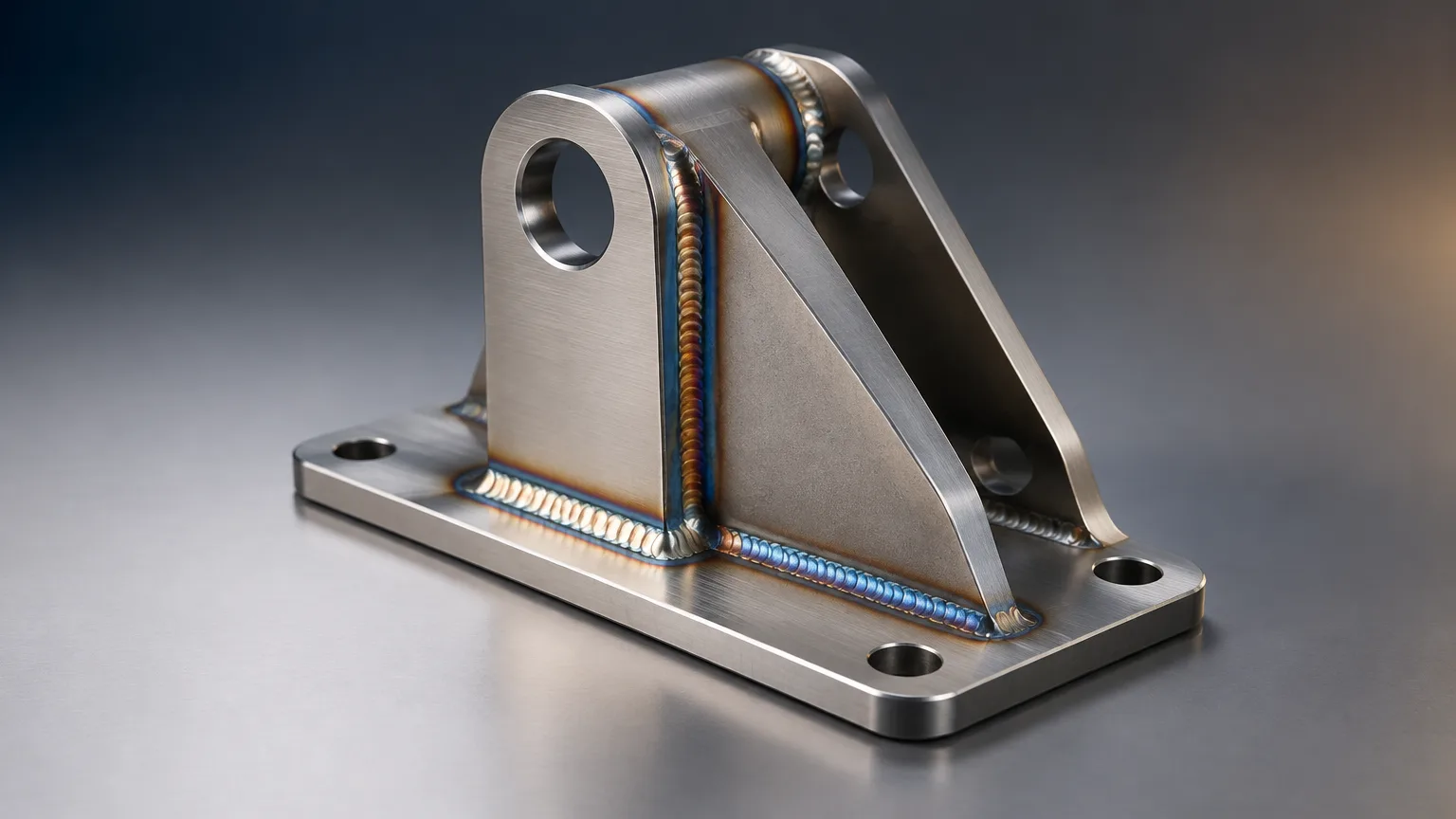
Welding fabrication services convert cut and formed metal into joined parts or assemblies using arc, MIG or TIG welding, plus hardware insertion and finishing. Sourcing Repository is a manufacturing broker: it collects quotes for welded steel and sheet metal work from a vetted supplier network, then manages inspection and delivery.
What welding fabrication services cover
Welding fabrication services turn cut and formed metal into a single joined part or a complete assembly. Steel fabricating and welding typically combines cutting, press-brake forming, welding, hardware insertion and coating into one supply route, so the buyer receives a finished item rather than loose components.
Who this service is for
- Engineers who need a welded frame, bracket or enclosure rather than individual blanks.
- Procurement managers consolidating several cut, formed and joined parts under one purchase order.
- Founders and product teams taking a fabricated structure from prototype to repeat production.
- Automotive and industrial buyers who need weld workmanship and inspection defined before the first article is built.
When to use it
Use welding fabrication when a part cannot be formed from one blank, when a structure needs stiffness or load capacity, or when several sheet metal parts must arrive as one assembly. Heavy fabrication welding suits simple geometry in heavier gauges; thinner work is usually laser or turret processed first and then joined.
Welding fabrication process steps
Welding fabrication services join cut and formed metal details into finished assemblies using fixtures, controlled welds and inspection. The process follows six steps, and each step adds its own tolerance, so the tightest requirement is normally worked last.
- 1. Drawing and DFM review The print is checked for gauge, weld symbols, datums, hardware and finish. Weld access and distortion risk are flagged before quoting, and tolerances beyond normal process capability are raised with the buyer.
- 2. Cutting Sheet is cut by laser or plasma, or by shearing and punching. Laser handles varied profiles without dedicated tooling; punching is often faster for repeated holes and forms.
- 3. Forming Press-brake forming applies bend compensation for material and thickness. Formed details are checked against the flat pattern before welding, since a mis-formed detail is hard to correct after joining.
- 4. Fit-up and fixturing Details are tacked in a fixture or jig that holds assembly geometry. Fit-up controls gap, alignment and squareness, and is the main defense against weld distortion.
- 5. Welding and hardware insertion Welds are made to the specified process and size, following AWS D9.1/D9.1M where the drawing invokes it. PEM inserts and studs are installed before or after welding, depending on heat sensitivity and coating plan.
- 6. Finishing and inspection Spatter and sharp edges are removed, then the part is coated or passivated as specified. Inspection covers weld size, critical dimensions and hardware presence, and is reported before shipment.
Materials and finishes for steel welding fabrication
Welding fabrication services start with material choice, which sets weldability, corrosion resistance and cost. State the mill specification and thickness on the drawing, since grade substitution changes both welding procedure and forming behavior.
| Material | Grade | Properties | Typical uses |
|---|---|---|---|
| Low-carbon steel | AISI 1010 or 1018; verify mill specification | Good formability, weldability and relatively low material cost | Brackets, cabinets, machine guards and structural panels |
| Cold-rolled steel | ASTM A1008; grade must be specified | Smooth finish, consistent thickness, good forming capability | Enclosures, panels, appliance parts and precision blanks |
| Stainless steel | 304 or 316; ASTM specification required | Corrosion resistance; 316 generally offers better chloride resistance | Food, chemical, medical, outdoor and marine equipment |
| Aluminum | 5052-H32 or 6061-T6; ASTM B209 applies to sheet | Low density, corrosion resistance and good machinability; 5052 forms better | Lightweight enclosures, transportation, electronics and covers |
| Galvanized steel | ASTM A653; coating designation must be specified | Zinc coating provides corrosion protection; welding requires process controls | HVAC, outdoor enclosures, ductwork and utility hardware |
Finishes applied after welding
- Powder coating and liquid paint for appearance and outdoor durability.
- Zinc-rich or primer coatings over cleaned welds for corrosion protection.
- Passivation for stainless assemblies after weld cleaning.
- Deburring and weld dressing, with threaded hardware masked before coating.
Specs and tolerances for welding fabrication services
Welding fabrication services typically hold flat-cut features to about ±0.005 in (±0.13 mm), but welded-part tolerances accumulate from cutting, forming and welding. The ranges below are typical references; ISO 2768 defaults apply only when the drawing states the class.
| Parameter | Typical range | Standard or source |
|---|---|---|
| Flat cut feature location | ±0.005 in (±0.13 mm), process and supplier dependent | Protolabs design guidelines |
| Bend-to-hole or bend-to-feature | ±0.015 to ±0.025 in (±0.38 to ±0.64 mm) | Protolabs design guidelines |
| Dimensions across three or more bends | ±0.030 to ±0.040 in (±0.76 to ±1.02 mm) | Protolabs design guidelines |
| Forming and bending | ±0.020 in (±0.51 mm) | Brighton design guide; supplier capability must be confirmed |
| Angular tolerance | ±2° | Brighton design guide; unverified as universal default |
| General tolerance | Specify individually; ISO 2768 may provide defaults | ISO 2768; class and applicability must be stated |
| Blank surface roughness | Ra 125 µin (3.2 µm) maximum | Brighton design guide; supplier-specific |
Design tips that lower welding fabrication cost
Most cost is fixed by the drawing, long before a supplier quotes. These seven changes reduce setups, handling and inspection without weakening the part.
- Use standard sheet thicknesses and common grades so material can be bought at normal availability rather than cut from special stock.
- Consolidate bend radii to one or two values that match available press-brake tooling, which removes extra setups.
- Avoid bend features too close to each other or to a hole; keep bend-to-hole distance generous enough for the stated tolerance band.
- Design self-locating features such as tabs and slots so parts sit correctly in the fixture before welding.
- Specify the smallest weld that carries the load, and place welds where the torch can reach without repositioning.
- Relax tolerances on nonfunctional dimensions and identify only critical features individually.
- Minimize secondary operations: fewer weld-dressing and finishing steps means less handling and less rework risk.
Typical welded parts and industries
Welded sheet metal work is used wherever a part must be stiff, sealed or load-bearing. Automotive and industrial machinery remain the largest categories, with material-handling equipment and enclosures close behind.
- Chassis brackets, battery trays and mounting plates for automotive programs.
- Machine frames, base plates and guards for industrial machinery.
- Material-handling equipment such as conveyor supports, chutes and racks.
- Electrical and control enclosures, panels and cabinets.
- HVAC housings, ductwork and outdoor utility hardware.
- Food, chemical and medical equipment in 304 or 316 stainless steel.
| Route | Pros | Cons |
|---|---|---|
| Laser or plasma cutting, press-brake forming, deburring | Flexible, economical for prototypes and varied geometries | Heat-affected edges; forming requires bend compensation |
| Turret punching, forming and deburring | Fast repetitive production; efficient holes and louvers | Tooling constraints; punch marks and distortion may occur |
| Shearing, bending and welding | Suitable for simple parts and heavy-gauge work | Lower geometric flexibility; weld distortion requires control |
| Cutting, forming, PEM insertion, welding and coating | Delivers complete assemblies from a single supply chain | Additional setup, coordination and inspection requirements |
| Stamping with dedicated dies | Very low unit cost at high volumes; repeatable | High tooling investment; poor fit for frequent design changes |
What drives welding fabrication cost
Welding fabrication cost is driven by material, process time and the inspection and finishing burden the drawing creates. Suppliers of welding fabrication services also weigh nesting, tooling, labor, quantity and schedule.
Cost drivers
- Material grade, thickness and current market price.
- Tight tolerances, inspection effort and process capability.
- Welding, hardware insertion, assembly and rework time.
- Fixture and tooling requirements for repeat production.
- Quantity and nesting efficiency on the sheet.
- Finishing type and the amount of weld dressing.
Cost reducers
- Standard grades and thicknesses.
- Fewer bends, welds and setups.
- Self-fixturing tab-and-slot details.
- Generous tolerances on nonfunctional dimensions.
Each joint needs fit-up, tacking, welding and inspection, and heat input can distort the assembly enough to require straightening. A drawing review before quoting is the cheapest way to control price.
Why order welding fabrication through Sourcing Repository
Sourcing Repository is a manufacturing broker, not a factory. It collects quotes from a vetted supplier network on your drawings, manages quality and inspection, and delivers the finished parts.
- One contact for the whole job, including cutting, forming, welding, hardware and coating.
- Quotes gathered from multiple suppliers so you can compare capability, not just price.
- Supplier vetting against the process, material and gauge your part actually needs.
- Inspection managed on your behalf, with a dimensional report on critical features before shipment.
- Deposit and balance terms confirmed in writing before production starts.
Have a drawing to quote?
Upload it with quantity and material to start a quote.
FAQ
Common questions
How is welding fabrication priced compared with cutting alone?
Welding and assembly add fit-up, tacking, welding, dressing and inspection to the cutting and forming steps, so unit cost is higher than for flat or formed parts. Suppliers weigh material, setups, joint count, finishing and quantity when quoting a weldment.
Should I specify the welding process on the drawing?
Specify a process when the joint demands it, for example TIG for thin stainless or appearance welds. Otherwise state the material, thickness, joint type and load requirement, and let the supplier choose the process that meets the drawing.
What files should a buyer provide for a welded assembly?
Welding fabrication services quote most accurately from a native CAD file and a drawing with datums and tolerances. Also provide material and thickness, weld symbols and sizes, finish, hardware callouts, quantity, revision and any inspection or packaging requirements.
Should the buyer specify a weld size or a bend radius?
Yes, when either one affects fit, strength, coating or appearance. Otherwise state the material, thickness and functional requirement, then confirm the fabricator's tooling and welding procedure before release so the part is built as intended.
Related resources
Keep reading
Ready when you are
Send your drawings for a welding fabrication quote
Upload CAD files and a toleranced drawing. Sourcing Repository collects comparable quotes from vetted suppliers, manages inspection and delivers the finished welded parts.
Your files stay confidential. NDA available on request.