
Material reference
6061-T6 Aluminum Alloy: Properties and Sourcing
6061-T6 is a precipitation-hardened aluminum alloy used for machined parts, structural sections and transport components. This reference covers typical properties, processes, finishes and sourcing.
- AA96061
- 45 ksi tensile
- Weldable
- Corrosion resistant
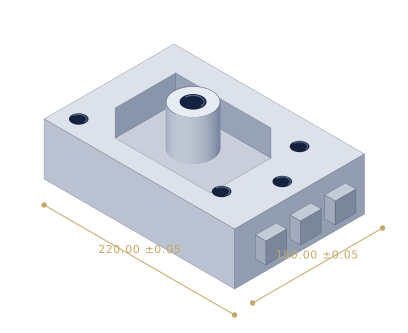
6061-T6 is a precipitation-hardened aluminum alloy in the 6000 series, alloyed mainly with magnesium and silicon. The T6 temper means solution heat treatment followed by artificial aging. Typical values are 45 ksi (310 MPa) ultimate tensile strength and 40 ksi (276 MPa) yield strength. It is machined, extruded, rolled and forged for structural and transport parts.
6061-T6 aluminum alloy: what it is and key traits
6061-T6 is a precipitation-hardened aluminum alloy in the 6000 series, principally alloyed with magnesium and silicon. T6 indicates solution heat treatment followed by artificial aging; the UNS designation is AA96061. It balances moderate-to-high strength, good corrosion resistance and good weldability, which is why it is a default choice for machined and structural parts.
The alloy is supplied in several product forms, including extruded bar, rod, profile and tube, rolled sheet and plate, and forged stock. Each form has its own ASTM product specification, so buyers should specify the standard that matches the form they are ordering.
6061-T6 properties: mechanical, thermal and physical values
The table below lists typical values for 6061-T6. Exact minimums depend on product form and the governing ASTM specification, so treat these as reference values for early design work rather than acceptance criteria.
| Property | Typical value | Source or note |
|---|---|---|
| Ultimate tensile strength | 45 ksi (310 MPa) | Product-form data; ASTM B308/B308M applies to structural shapes |
| Yield strength | 40 ksi (276 MPa) | Product-form data; exact minimum varies by product form |
| Elongation | 10–12% | Sheet and product data; thickness-dependent |
| Brinell hardness | 95 HB | Product data |
| Elastic modulus | 10,000 ksi (68.9 GPa) | Product data |
| Poisson ratio | 0.33 | Product data |
| Magnesium content | 0.80–1.20 wt% | ASTM B221 composition table; manufacturer data |
| Silicon content | 0.40–0.80 wt% | ASTM B221; manufacturer data |
| Copper content | 0.15–0.40 wt% | ASTM B221; manufacturer data |
| Dimensional tolerance | Product-form and size-dependent | Applicable ASTM product specification; numeric tolerance unverified |
| Grade | Designation | Typical properties | Typical uses |
|---|---|---|---|
| 6061-T6 aluminum | AA 6061-T6; UNS AA96061 | Typical UTS 45 ksi (310 MPa), yield 40 ksi (276 MPa), Brinell 95, elastic modulus 10,000 ksi (68.9 GPa), Poisson 0.33 | Machined parts, structural sections, pipe, fittings, transport components, marine hardware |
| 6061-T651 | AA 6061-T651 | Solution-treated, stress-relieved and artificially aged; exact properties depend on product form and governing specification. Numeric values: unverified. | Plate and machined components where reduced residual stress is required |
Best processes for 6061-T6 aluminum parts
6061-T6 suits most common metalworking routes. CNC machining is the usual choice for precise parts, while extrusion, rolling and forging are used to produce the stock itself. Welding is possible but reduces strength in the heat-affected zone.
- CNC machining: stock is cut to final geometry. Pros: precise prototypes and production parts; cons: material waste and residual-stress risk.
- Extrusion: heated billet is forced through a die. Pros: efficient constant profiles; cons: directional properties and die costs.
- Rolling: slab is reduced into sheet or plate. Pros: broad flat products; cons: rolling direction can affect properties.
- Forging: heated stock is shaped under compressive load. Pros: strong, refined components; cons: tooling and machining costs.
- T6 treatment: solution heat treatment, quenching, then artificial aging. Pros: high strength; cons: distortion and reduced weld-zone strength.
- Welding: commonly performed by TIG, MIG or other standard methods. Pros: good weldability; cons: heat-affected zones lose temper strength.
For machined parts, T651 or T6511 stock is often preferred over generic T6 because stress relieving reduces distortion during material removal. Confirm the temper and product form before quoting.
Typical applications of 6061-T6 aluminum
6061-T6 is used where moderate-to-high strength, low weight and good corrosion resistance matter more than maximum hardness. Common uses include machined parts, structural sections, pipe, fittings, transport components and marine hardware.
- Automotive and transport: brackets, mounts, structural sections and chassis components where weight reduction is a priority.
- Industrial equipment: machined housings, frames, manifolds and fixtures.
- Marine: hardware, fittings and structural parts exposed to moisture, with attention to galvanic isolation.
- Aerospace and defense: non-critical structural parts and brackets where 7075 strength is not required.
- Consumer and electronics: enclosures, heat sinks and frames that need machinability and clean anodized finishes.
For pressure-retaining parts, design-code and product-form requirements must be verified before the alloy is selected.
6061-T6 machining and fabrication notes
6061-T6 machines well at high spindle speeds with sharp tooling and good chip evacuation. The main risks are residual stress, distortion in thin walls and strength loss near welds.
- Use sharp, polished carbide tooling with positive rake and generous chip clearance to avoid built-up edge.
- Expect good surface finish from standard milling and turning; plan finishing passes for tight tolerances.
- For thin walls and long parts, start from stress-relieved T651 or T6511 stock to limit movement after machining.
- Control heat input when welding; the heat-affected zone loses temper strength, so avoid welding in high-stress regions or plan post-weld review.
- Anodizing and other coatings change dimensions slightly; account for coating thickness in the drawing tolerance.
- Review material test certificates and heat or lot traceability before production.
Compatible finishes for 6061-T6 aluminum
6061-T6 accepts most common aluminum finishes. Anodizing is the most widely used because it builds a hard, corrosion-resistant surface that takes dye well, though the alloy's copper content can affect color consistency compared with 6063.
- Anodizing (Type II and Type III): hard, corrosion-resistant surface; color consistency varies with alloy and temper.
- Chemical conversion coating (chromate or non-chromate): good base for paint and a low-cost corrosion barrier.
- Powder coating and liquid painting: durable color and protection; requires proper pretreatment.
- Passivation and cleaning: removes surface contamination before assembly or coating.
- Mechanical finishes: bead blasting, brushing and polishing for appearance or surface preparation.
- Plating: possible but less common than anodizing; confirm adhesion and process compatibility with the finisher.
Specify the finish, color and any masking requirements on the drawing, and note that coating thickness affects final dimensions.
6061-T6 alternatives and comparison
Choose 6061-T6 when you need a balance of strength, weldability, corrosion resistance and machinability at moderate cost. Move to another alloy or temper when the application demands higher strength, better extrusion appearance or lower residual stress.
| Alternative | Key differences | When to choose it |
|---|---|---|
| 6061-T4 | T4 is solution-treated and naturally aged; T6 is artificially aged and generally stronger. Exact values depend on product form. | When higher formability is needed and lower strength is acceptable. |
| 6061-T651 | T651 includes stress relieving, commonly by stretching, after solution treatment; preferred where machining distortion matters. | For plate and machined components with tight flatness or stability requirements. |
| 6061-T6511 | T6511 is a stress-relieved extrusion temper; it should not be treated as interchangeable with T6 without specification review. | For extruded profiles that need stress relief and tighter straightness. |
| 6063-T6 | 6063 is commonly selected for architectural extrusion and surface appearance; 6061 generally provides higher structural strength. | For visible architectural profiles and complex extrusion shapes. |
| 7075-T6 | 7075-T6 is substantially stronger but generally less weldable and more costly; 6061 offers better weldability and corrosion resistance. | For high-strength aerospace or structural parts where welding is not required. |
Temper and product form matter as much as alloy. A T6511 extrusion is not automatically interchangeable with a T6 plate, so review the governing specification before substituting.
Sourcing 6061-T6 aluminum parts through SR
Sourcing Repository is a manufacturing broker. We do not own factories or machines. We collect quotes from a vetted supplier network, manage quality and inspection, and deliver parts made to your drawing.
- Send your drawing and specification Include the alloy and temper (for example, 6061-T6 or 6061-T651), product form, dimensions, tolerances, finish and the governing ASTM standard. Note any certification or traceability requirements.
- Quote collection We route the requirement to suppliers in our vetted network and return quotes, typically within 5–7 working days.
- Supplier selection and quality planning We help compare quotes on process fit, lead time and quality approach, then agree the inspection plan and documentation.
- Production and inspection Parts are produced by the selected supplier. We manage quality and inspection, including review of material test certificates and heat or lot traceability.
- Delivery Finished parts are delivered to your specification, with inspection records as agreed.
Cost drivers for 6061-T6 parts include raw aluminum and alloy surcharge, machining cycle time and material removal, finish and inspection requirements. Send your drawing to start a quote.
Have a drawing to quote?
Upload it with quantity and material to start a quote.
FAQ
Common questions
Is 6061-T6 weldable?
Yes. Common welding processes such as TIG and MIG can be used, but the heat-affected zone loses temper strength. Avoid welding in high-stress regions or plan a post-weld review of the design.
What is the typical strength of 6061-T6?
A commonly listed value is 45 ksi (310 MPa) ultimate tensile strength and 40 ksi (276 MPa) yield strength. Exact minimums vary by product form and the governing ASTM specification, so confirm the mill certificate.
Is 6061-T6 corrosion resistant?
It has good general corrosion resistance, which suits marine and outdoor parts. Galvanic corrosion when joined to dissimilar metals and localized corrosion remain design risks, so specify isolation and coatings where needed.
Which standard should a buyer specify for 6061-T6?
Use the ASTM standard matching the product form, such as ASTM B221/B221M for extrusions or ASTM B308/B308M for structural profiles. Add alloy, temper, dimensions, finish and certification requirements to the purchase order.
Related resources
Keep reading
Ready when you are
Need 6061-T6 parts quoted?
Send your drawing and specification. We collect quotes from a vetted supplier network, manage quality and inspection, and deliver parts made to your requirements.
Your files stay confidential. NDA available on request.