
Typical cost ranges
Why universal dollar ranges do not apply.
Cost Guide
CNC machining cost is driven by material, tolerance, setup, tooling and order quantity. This guide explains each driver and how to prepare an RFQ that returns usable prices.
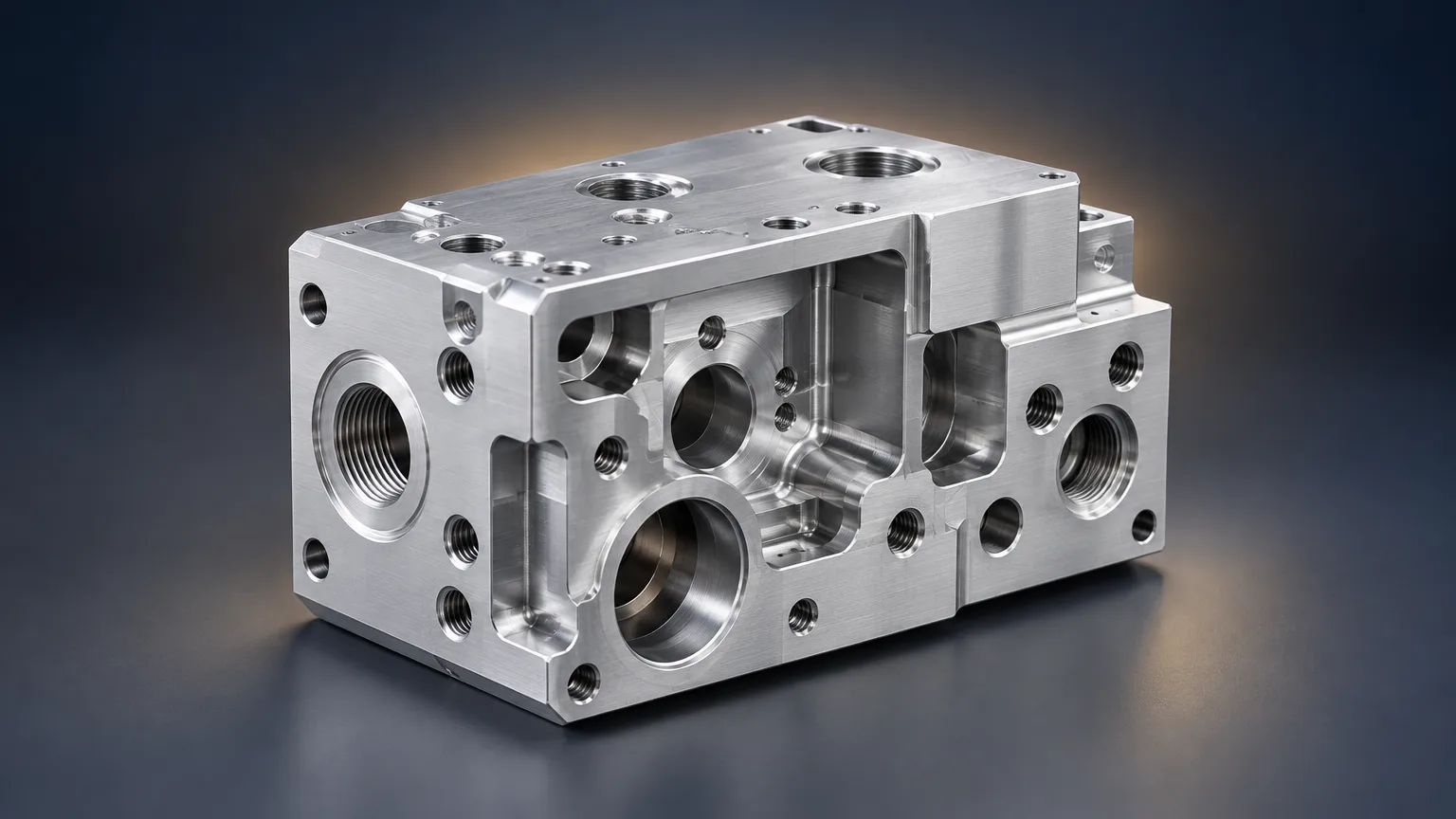
Why universal dollar ranges do not apply.
Material, geometry, tolerance, setup, tooling, quantity.
Grade, machinability, stock size and certification.
One-time versus per-part cost separation.
How unit price falls as quantity rises.
Design and specification actions before the RFQ.
Hypothetical cost breakdown for an aluminum bracket.
What to prepare for an accurate quotation.
CNC machining cost is the sum of material, programming and setup, machining time, tooling, finishing and inspection. Tolerance, geometry, quantity and material grade move the price most: tighter tolerances need slower cutting and more inspection, and low quantities spread one-time setup over few parts. Send a controlled drawing with material, tolerances, finish and quantity for an accurate quote.
CNC machining cost is the total price a supplier charges to cut a part, built from material, setup, machine time, tooling and inspection. Tighter tolerances, harder materials and low quantities typically raise it, while a typical default tolerance of ±0.005 in (±0.13 mm) keeps it lower.
Published price ranges depend on the specific part, so this guide does not quote universal dollar figures. It describes the cost drivers every quote reflects instead.
Cost scales with two things: how much material must be removed and how tightly that removal must be controlled. A simple bracket and a thin-walled housing of the same size can differ several times over in price. For part-specific pricing, send the drawing and quantity for a supplier quote; typical turnaround is 5-7 working days.
Material choice and geometry are the two largest cost drivers in CNC machining, followed by tolerance, setup and inspection. The list below ranks drivers from highest to lowest typical impact.
Material affects price through stock cost, machinability and certification. A free-machining aluminum cuts faster than a work-hardening stainless, so two parts of identical geometry rarely cost the same.
| Material | Grade | Properties | Typical uses |
|---|---|---|---|
| Aluminum | 6061-T6 | Lightweight, corrosion-resistant, generally machinable | Brackets, housings, prototypes, fixtures |
| Stainless steel | 304 | Corrosion resistance and toughness; work-hardening can increase machining difficulty[3] | Food, chemical, medical, industrial components |
| Stainless steel | 316 | Improved corrosion resistance versus 304 in chloride environments | Marine, chemical-processing, sanitary hardware |
| Carbon steel | AISI 4140 | Strength and toughness; machinability varies with heat treatment | Shafts, tooling, fixtures, loaded parts |
| Engineering plastic | POM/Delrin | Low friction, dimensional stability, good machinability | Bushings, wear parts, guides, electro-mechanical parts |
Material properties and grades should be confirmed against the applicable ASTM, EN or producer datasheet before release. Stock size also matters: a part hogged out of a solid block costs more than one machined from near-net bar.
CNC machining cost splits into one-time charges paid once per order and per-part charges that scale with quantity. One-time costs cover programming, workholding, first-article inspection and setup. Per-part costs cover cycle time, material, tool wear and in-process inspection.
| Cost element | One-time or per-part | Main drivers |
|---|---|---|
| CAM programming | One-time | Feature count, tolerances, multi-axis work, drawing completeness |
| Workholding and fixture design | One-time | Part geometry, workholding access, number of setups |
| Machine setup and first-article inspection | One-time | Number of operations, datum strategy, inspection requirements |
| Material | Per-part | Material price, machinability, stock size, material certification[1][3] |
| Machine cycle time | Per-part | Feature complexity, tolerances, surface finish, tool paths |
| Tooling and tool wear | Per-part | Material hardness, feature depth, tool life, standard versus custom cutters |
| In-process inspection | Per-part | Tolerance class, sampling plan, geometric tolerancing on the drawing[7][10] |
Low quantities and prototype programming or setup costs are a recognized cost driver in CNC machining. On a one-off part, the full setup burden lands on a single unit. On a run of hundreds, the same cost is spread across every part, so unit price falls even though cycle time per part is unchanged.
To reduce the one-time burden, relax noncritical tolerances, simplify setups, use standard tools and threads, avoid deep cavities, select machinable materials and consolidate compatible features.[3][6][8]
Unit price falls as quantity rises because fixed costs are spread over more parts. The drop is steep from 1 to 100 pieces and flattens as material and machine time — the truly variable costs — take over.
Standard CNC and precision CNC behave differently at volume. Precision work holds tighter feature requirements with more controlled setups and inspection, so it benefits less from simple quantity breaks.[3]
Most CNC machining cost reductions come from design decisions made before the RFQ, not from squeezing the supplier. The actions below are the highest-leverage changes.
This hypothetical illustration is not a quote, a market average or a real customer order. It shows how the cost drivers combine.
| Cost element | One-time or per-part | Relative share of unit price |
|---|---|---|
| Programming and CAM | One-time | Low per unit at 100 pieces |
| Fixture and first-article inspection | One-time | Small share once spread over the 100-piece run |
| 6061-T6 aluminum stock | Per part | Moderate |
| Machine cycle time | Per part | Highest single share |
| Tooling and tool wear | Per part | Low to moderate |
| Deburr and finish | Per part | Moderate |
If the drawing called for a precision feature at a typical ±0.0004–0.0010 in (±0.01–0.025 mm), the supplier would report extra cutting passes and inspection, raising the per-part share. If quantity dropped to about 5 pieces, the one-time rows would dominate unit price. Actual values require supplier quotes.
An accurate quote depends on a complete, controlled drawing. Sourcing Repository collects quotes from a vetted supplier network, manages quality and inspection, and delivers parts; quote turnaround is typically 5-7 working days.
To start, use the Sourcing Repository request-a-quote form and attach your drawing set. Questions can go to killol@sourcingrepository.com or 201 SG Mall, Ahmedabad.
Upload it with quantity and material to start a quote.
FAQ
Tighter tolerances can require slower cutting, extra finishing passes, controlled environments and more inspection. One supplier reports non-linear cost increases below ±0.005 in (±0.13 mm), so tolerance should be specified per feature rather than applied globally.[3]
A commonly reported default is ±0.005 in (±0.13 mm). Actual capability depends on process, material, geometry and supplier equipment, so confirm the tolerance on the drawing rather than assuming it. Milling and turning have different typical capability ranges.[12][14]
Compare verified process capability, material traceability, inspection equipment, certifications, capacity, lead time and corrective-action practice against comparable sample work. A low unit price that requires rework or late delivery costs more than a slightly higher quoted price.
Metals and plastics differ in stiffness, thermal expansion, cutting behavior, workholding and tool selection, so cycle time and scrap rates change. Dimensional response after machining also differs. Supplier-specific limits for each material must be verified rather than assumed.
Related resources
Ready when you are
Send your CAD file, controlled drawing and quantities. Sourcing Repository collects quotes from a vetted supplier network, manages quality and inspection, and delivers parts, with quote turnaround typically 5-7 workin.
Your files stay confidential. NDA available on request.