
Automotive engine components
Engine Components Manufacturing
Crankshafts, connecting rods, camshafts and cylinder heads produced by vetted suppliers through casting, forging, machining and assembly. We collect quotes, manage quality records and deliver inspected parts.
- Crankshafts
- Connecting rods
- Camshafts
- Cylinder heads
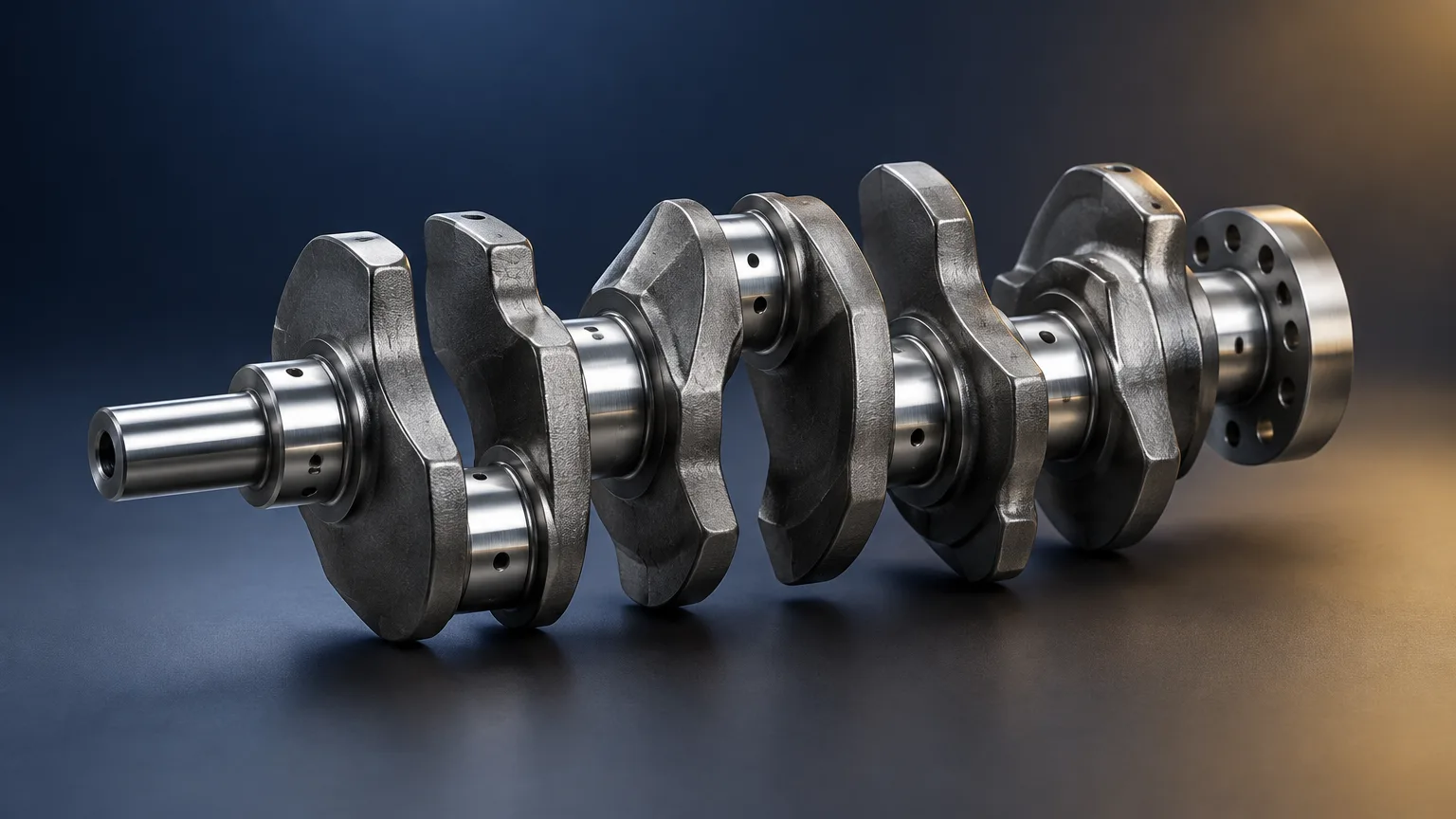
Engine components manufacturing is the production of parts such as crankshafts, connecting rods, camshafts and cylinder heads through casting, forging, machining, joining and inspection. Sourcing Repository collects quotes from a vetted supplier network, manages quality and inspection, and delivers finished parts; it does not own factories or machines.
What engine components do in a vehicle
Engine components convert combustion energy into rotation and keep the process controlled. The cylinder head seals the combustion chamber and carries the ports. The camshaft opens and closes valves. The connecting rod carries piston force to the crankshaft, and the crankshaft turns that force into torque.
These automotive components sit in the powertrain, driveline and transmission group of automotive parts manufacturing, also called car parts manufacturing or vehicle parts manufacturing. Engine components manufacturing must control material grade, heat treatment, dimensions and surface finish. Together they set fatigue life, fit and oil control.
- Crankshaft: converts piston motion into rotary output; journal dimensions, fillet radii and balance are critical.
- Connecting rod: links piston to crankshaft; weight matching and bore roundness affect vibration and bearing life.
- Camshaft: controls valve timing; lobe profile, journal diameter and hardness drive wear.
- Cylinder head: seals combustion and routes air, fuel and coolant; deck flatness and valve-seat concentricity matter.
Typical engine component manufacturing processes
Engine components manufacturing combines a shaping route with a finishing route. Shaping forms the near-final geometry. Finishing brings critical features to drawing tolerance and surface finish.
- Casting or forging the blank Cylinder heads are commonly cast in aluminum. Crankshafts and connecting rods are often forged for fatigue resistance. Die casting makes near-net-shape parts quickly but needs porosity and tooling control. Forging adds tooling and machining allowance cost.
- CNC machining CNC machining is precise and flexible for prototypes or low volumes, though waste and cycle time can be high. It covers journal turning, bore honing, deck milling and port work.
- Heat treatment and surface finishing Hardness, strength and wear resistance come from the material and heat-treatment specification. Grinding, honing, shot peening and coating follow, with the test method agreed on the drawing.
- Assembly and joining Welding, fastening or bonding combine components, so joint strength, distortion and traceability need validation. Cylinder heads may receive valve guides and seats before final inspection.
- Inspection and documentation Dimensions, surface roughness, hardness and capability studies are recorded against the drawing and control plan before shipment.
| Component | Usual shaping route | Finishing route | Typical quantity fit |
|---|---|---|---|
| Crankshaft | Forging (or casting) | Turning, grinding, fillet rolling, balancing | Low to high |
| Connecting rod | Forging | Machining, honing, weight matching | Low to high |
| Camshaft | Forging or casting | Turning, lobe grinding, heat treatment | Low to high |
| Cylinder head | Casting | CNC machining, seat and guide work, pressure test | Low to medium |
Additive manufacturing can support prototypes and tooling. Production rate, surface finish and material qualification may limit its use for running engine parts.
Materials used in engine component manufacturing
Engine components manufacturing uses aluminum alloys, carbon and alloy steel, magnesium and zinc alloys, chosen by load path, thermal environment and process route. Each serves a different function.
| Material | Grade | Properties | Typical uses |
|---|---|---|---|
| Aluminum alloys | Unverified; grade must be specified by drawing | Low density, corrosion resistance, machinability and castability | Brackets, housings, wheels, engine and transmission components |
| Carbon and alloy steel | Set by drawing callout | High strength, fatigue resistance, hardness and weldability vary by grade | Stampings, shafts, gears, suspension, fasteners and structural parts |
| Magnesium alloys | Drawing-specified | Very low density and good castability; corrosion protection often required | Lightweight housings, brackets and seat frames |
| Zinc alloys | Per drawing | Good die-castability, dimensional repeatability and surface finish | Handles, latches, housings and small hardware |
For crankshafts, connecting rods and camshafts, steel grade plus heat treatment usually decides fatigue life. For cylinder heads, aluminum alloy and casting quality usually decide thermal behavior and porosity risk.
Quality requirements for engine components
Quality for engine components manufacturing is defined by the drawing, the control plan and the customer-specific requirements. Suppliers in this sector commonly operate under IATF 16949, which defines a quality-management system; part conformity still depends on specifications, controls, inspection and customer requirements.
- Part approval: PPAP submission level and evidence vary by customer; the supplier submits samples, dimensional results and process evidence for approval.
- Traceability: raw material lot, heat number, process route, operator records and inspection results should be linked to each production batch.
- Inspection: first-article, in-process and final inspection against the drawing; critical features such as journals, bores, seats and deck flatness are measured on calibrated equipment.
- Capability: Cp/Cpk targets are customer- and feature-specific and are tracked through SPC on the control plan.
- Nonconformance control: containment, root-cause analysis and corrective action are documented before parts return to the line.
- Change control: material, process, supplier or site changes are reviewed and approved before production shipment.
Specifications and tolerances for engine parts
Engine part specifications and tolerances are parameters to define on the drawing, not fixed values. Automotive component manufacturers typically confirm each critical feature through a supplier capability study.
| Parameter | Typical range | Standard or source |
|---|---|---|
| Dimensional tolerance | Unverified; depends on process, size, material and drawing | Part drawing and supplier capability study required |
| Geometric tolerancing | Unverified; specify datum scheme and GD&T callouts | ASME Y14.5 or applicable ISO GPS standard; exact edition unverified |
| Surface roughness | Unverified; specify Ra or other required parameter | Drawing requirement; applicable surface-texture standard unverified |
| Hardness and strength | Unverified; defined by material and heat-treatment specification | Material specification and test method required |
| Capability | Cp/Cpk targets are customer- and feature-specific | IATF 16949, control plan, SPC and customer-specific requirements |
| Part approval | Submission level and evidence vary by customer | AIAG PPAP and applicable customer-specific requirements |
Precision bore and journal tolerances and surface roughness (Ra) are typical features to define. Confirm each value against the drawing and the supplier's measured capability.
Volumes and lead times from prototype to production
Prototype engine components are usually machined or additively built to prove fit and function; production parts move to casting or forging plus dedicated fixturing once geometry and demand are stable. Sourcing Repository returns quotes in 5-7 working days.
Prototype and low volume
- CNC machining from billet or near-net blank avoids tooling investment.
- Additive manufacturing suits complex low-volume shapes and tooling aids.
- Lead time is driven by programming, material availability and inspection.
- Tolerances should match the function to be proven, not the final drawing limit.
Production volume
- Casting and forging reduce per-part cost but add tooling and validation time.
- Stamping or molding becomes economical at high sheet-metal or plastic volume.
- Cycle time, capability and inspection frequency are optimized on the control plan.
- Approved PPAP evidence is normally required before regular shipment.
The fact pack does not verify numerical lead times or order quantities for engine components, so schedule and volume commitments are confirmed per project during quoting.
Design tips for engine component manufacturing
Design for manufacturability means giving the supplier a drawing that a stable process can hold. Most cost and quality problems in engine components come from tolerance stack-up, inaccessible features and undefined datums.
- Define a datum scheme early and apply GD&T consistently; ambiguity forces conservative machining.
- Request the tightest tolerance needed for function, not the tightest possible tolerance.
- Allow machining allowance on forged or cast blanks and state it on the drawing.
- Keep fillet radii, draft and wall thickness compatible with the chosen process; casting and forging cannot reproduce every sharp corner.
- Specify surface roughness by parameter rather than by feel, and only on surfaces that need it.
- State material grade, heat treatment and test method explicitly; unverified grades cannot be quoted accurately.
- Design for the inspection method you expect, including access for gauges and fixtures.
- Review prototype findings before releasing tooling for casting, forging or stamping.
Ordering engine components through SR
Ordering engine components through SR means sending your drawing to Sourcing Repository, a manufacturing broker that does not own factories or machines. We collect quotes from a vetted supplier network, manage quality and inspection, and deliver parts. Quotes typically come back in 5-7 working days.
- Send CAD, drawing and revision for each engine component.
- State material, heat treatment, finish, tolerances and inspection needs.
- Give quantity, delivery location and the intended application.
- Include any customer-specific requirements for the program.
Custom auto parts cost depends on geometry, material, process, tooling, quantity, tolerance, finishing and inspection. No universal price exists, so a drawing-based quote is the reliable route.
Questions can be sent to killol@sourcingrepository.com or by post to 201 SG Mall, Ahmedabad. Use the quote request page to start a crankshaft, connecting rod, camshaft or cylinder head project.
Have a drawing to quote?
Upload it with quantity and material to start a quote.
FAQ
Common questions
What is PPAP?
PPAP, the Production Part Approval Process, is an automotive submission process that shows production processes can consistently meet approved requirements. The customer reviews the evidence before approving production. Submission levels and required evidence vary by customer, so confirm the exact rules before you request quotes.
Does IATF 16949 certification guarantee part quality?
No. IATF 16949 defines a quality-management system for automotive suppliers. It does not guarantee any single part. Part conformity still depends on the specifications, process controls, inspection plan and customer requirements agreed for that part.
Can a supplier make a part without a drawing?
A supplier may reverse-engineer a part or develop a model from a sample. Before work starts, agree in writing on requirements, ownership, tolerances, materials and approval responsibilities. A released drawing still gives the clearest basis for quoting and inspection.
What information is needed for a quote?
Provide CAD, a drawing with revision, material, finish, tolerances, quantity, delivery location, inspection needs and the intended application. Add any customer-specific requirements. Complete information lets suppliers quote accurately and reduces back-and-forth before production starts.
Related resources
Keep reading
Ready when you are
Send your engine component drawing for quoting
Share CAD, drawing revision, material, tolerances, quantity and delivery location. SR collects supplier quotes, manages quality and inspection, and delivers inspected engine components.
Your files stay confidential. NDA available on request.