
Automotive Parts Manufacturing
Intake Manifold Manufacturing and Turbo Exhaust Components
Sourcing Repository collects quotes for intake manifold manufacturing, turbocharger housings and exhaust components from a vetted supplier network, then manages quality and inspection through to delivery.
- Intake manifolds
- Turbocharger housings
- Exhaust components
- PPAP support
- Quote in 5-7 working daysSend CAD, drawing and quantity
- Inspection managed for youDimensional and documentation checks
- Approval evidence coordinatedSubmission level set by your customer
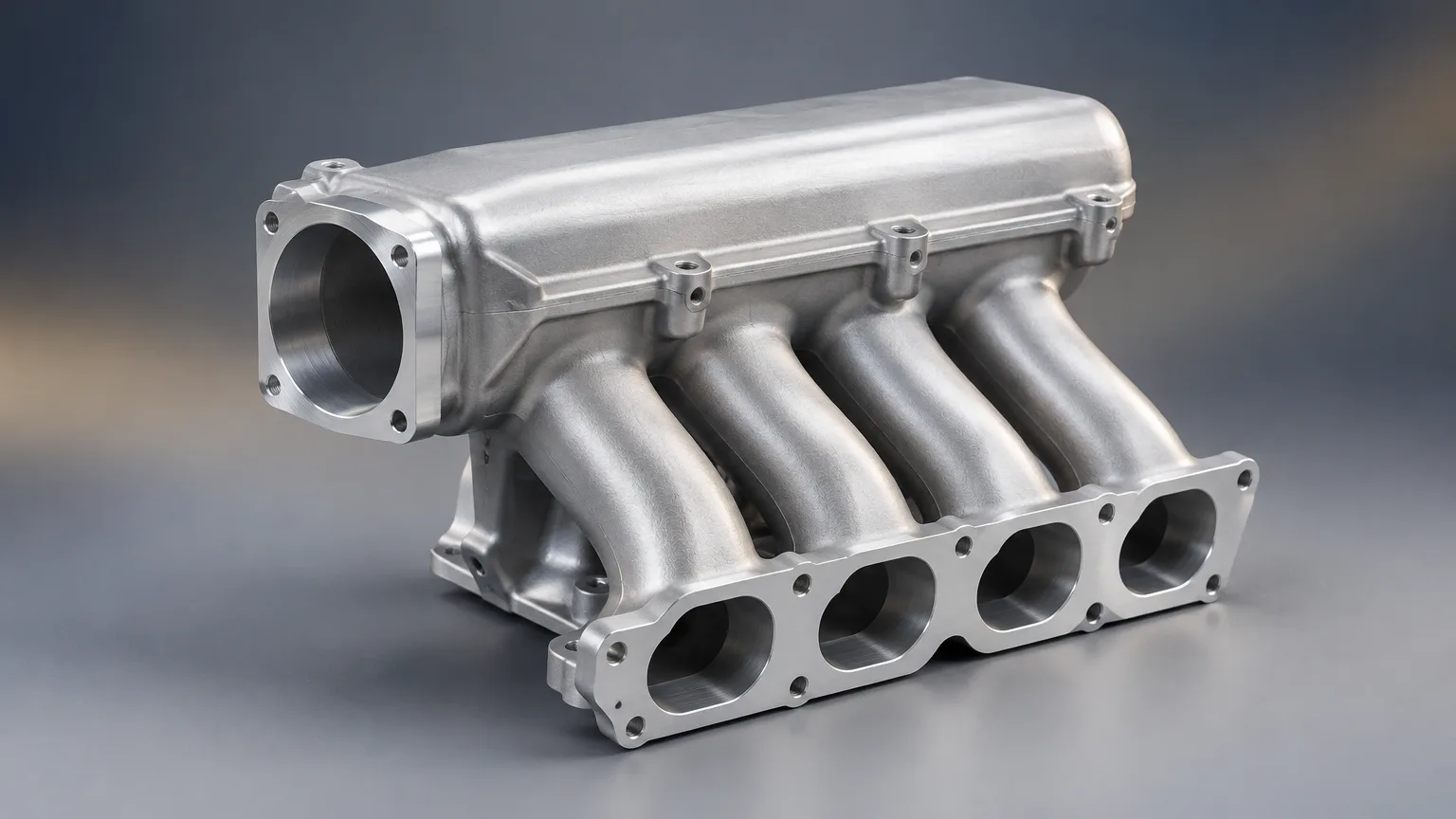
Intake manifold manufacturing is the production of the air-distribution component that feeds an engine's cylinders, usually by casting, forging or molding plus CNC machining. Turbocharger housings and exhaust components follow similar routes, with material, tolerance and PPAP requirements set by the drawing and the vehicle program.
Function and where intake, exhaust and turbo components are used
An intake manifold is the component that distributes incoming air, and often fuel or charge air, to each cylinder of an engine. It sets the path, volume and balance of airflow, so its internal geometry and sealing surfaces directly affect power delivery and emissions.
Turbocharger housings and exhaust components sit on the hot side of the same system. The turbine housing collects exhaust gas and guides it across the turbine wheel, while exhaust manifolds, pipes, flanges and brackets carry gas away from the engine and support the turbocharger assembly.
- Intake side: intake manifolds, plenum chambers, runners, throttle-body flanges, charge-air ducts and mounting brackets.
- Turbo side: turbine housings, compressor housings, bearing housings, wastegate and actuator brackets.
- Exhaust side: exhaust manifolds, downpipes, mid-pipes, flanges, heat shields and hanger brackets.
- Typical applications: passenger cars, light and heavy trucks, off-highway equipment and stationary engines.
Typical manufacturing processes for intake manifold manufacturing and turbo housings
Intake manifold manufacturing typically uses casting or molding, while turbocharger housings are usually cast and then machined.
Intake manifold manufacturing is the production of the housing that distributes air to each cylinder, typically by casting aluminum or molding plastic, then machining flange and sealing faces to the drawing. Process choice follows material, volume and geometry.
Exhaust components are often formed from tube or sheet and welded. The same routes apply across auto parts manufacturing, car parts manufacturing and wider vehicle parts manufacturing.
| Process | Typical use on these parts | Trade-off |
|---|---|---|
| Die casting | Aluminum intake manifolds and turbocharger housings in volume | Fast near-net shapes; porosity, tooling cost and alloy limits need control |
| CNC machining | Flange faces, bores, threads and sealing surfaces | Precise and flexible for low volumes; material waste and cycle time can be high |
| Forging | Flanges, adapters and high-fatigue brackets | Strong, fatigue-resistant parts; tooling and machining allowances add cost |
| Stamping | Heat shields, brackets and sheet-metal covers | Economical at high volume; needs dedicated dies, less suited to complex 3D forms |
| Injection molding | Plastic intake manifolds, ducts and covers | Efficient for repeatable parts; tooling cost and design lead time can be substantial |
| Assembly and joining | Welded exhaust assemblies, bonded or overmolded manifolds | Joint strength, distortion and traceability require validation |
How the route is chosen
- Prototype or low volume: CNC machining from billet or a printed pattern.
- Mid to high volume in aluminum: die casting, then CNC machining of critical faces.
- High-volume plastic: injection molding with a tool built to the final revision.
- Welded exhaust assemblies: tube and sheet forming, fixture welding, then leak and dimensional checks.
Materials used for intake manifolds, turbo housings and exhaust components
Material choice is driven by temperature, pressure, weight target and cost. Aluminum dominates cast intake and turbo housings, steel and stainless grades carry exhaust gas, and engineering plastics serve naturally aspirated intake systems.
| Material | Grade | Properties | Typical uses |
|---|---|---|---|
| Aluminum alloys | Alloy to be named on the drawing | Low density, corrosion resistance, machinability and castability | Brackets, housings, engine and transmission components |
| Carbon and alloy steel | Steel grade to be named on the drawing | High strength and fatigue resistance; hardness and weldability vary by grade | Stampings, shafts, fasteners and structural parts |
| Magnesium alloys | Alloy to be confirmed by the drawing | Very low density and good castability; corrosion protection is often required | Lightweight housings and brackets |
| Polypropylene | Resin grade set by the drawing | Low density, chemical resistance and good processability | Trim, ducts, covers and molded parts |
| Polyamide | Resin grade fixed on the drawing | Good strength, wear resistance and temperature capability; moisture affects dimensions | Clips, brackets, connectors and under-hood parts |
Quality requirements: PPAP, traceability and inspection
Quality requirements for these parts are PPAP approval, traceability and inspection, backed by documented process control. Automotive component manufacturers in this network are expected to work to IATF 16949 requirements and applicable customer-specific requirements, which also governs intake manifold manufacturing.
- PPAP: submission level and evidence vary by customer.
- Traceability: material certificates, heat or lot numbers and process records linked to shipped parts.
- Inspection: dimensional layout, GD&T verification, surface and hardness checks as called out on the drawing.
- Capability: Cp/Cpk targets are customer- and feature-specific and set in the control plan.
- Leak and pressure testing: common for intake manifolds, turbo housings and welded exhaust assemblies.
Specifications and tolerances for intake and exhaust components
Specifications and tolerances for intake and exhaust components depend on process, size, material and drawing, so the supplier must confirm capability for each critical feature. The table lists the parameters that matter most in intake manifold manufacturing and for other automotive components.
| Parameter | Typical range | Standard or source |
|---|---|---|
| Dimensional tolerance | Depends on process, size, material and drawing | Part drawing and supplier capability study |
| Geometric tolerancing | Specify datum scheme and GD&T callouts | ASME Y14.5 or applicable ISO GPS standard; edition to be confirmed |
| Surface roughness | Specify Ra or another required parameter | Drawing requirement |
| Hardness and strength | Set by material and heat-treatment specification | Material specification and test method |
| Capability | Cp/Cpk targets are customer- and feature-specific | IATF 16949, control plan, SPC |
| Part approval | Submission level varies by customer | AIAG PPAP and customer-specific requirements |
Volumes and lead times from prototype to production
Prototype work favors speed and flexibility; production work favors repeatability and cost per part. The route usually changes between the two, so plan the transition early rather than assuming the prototype process scales.
| Stage | Typical route | What drives timing |
|---|---|---|
| Prototype | CNC machining from billet or printed pattern, or additive manufacturing | Programming, material availability and inspection scope |
| Pilot or pre-production | Soft tooling, cast or molded samples, fixture welding | Tooling build, first-article inspection and PPAP evidence |
| Production | Die casting, injection molding, stamping or forging plus finish machining | Tooling lead time, cycle time, capability studies and logistics |
Quote turnaround through Sourcing Repository is 5-7 working days from a complete RFQ package. Manufacturing lead time is quoted per project because it depends on process, tooling, material and inspection requirements.
Design tips for intake manifold manufacturing and turbo housings
Good design for intake manifold manufacturing and turbo housings means uniform walls, clear datums and machining stock wherever a face must seal. These rules apply equally to other automotive parts manufacturing.
- Specify the tightest tolerance needed for function, not the tightest possible; confirm capability per critical feature.
- Give a clear datum scheme and GD&T callouts so inspection and machining share one reference.
- Keep wall sections uniform on cast and molded parts to reduce porosity, shrinkage and distortion.
- Add draft and generous fillets, and avoid sharp internal corners that concentrate stress.
- Provide machining stock on cast or forged surfaces that must be finished to a sealing face.
- Plan weld joints and fixture access on exhaust assemblies, and allow for distortion after welding.
- State material grade, heat treatment, finish and any leak or pressure test on the drawing.
Ordering intake, exhaust and turbo components through Sourcing Repository
Sourcing Repository is a manufacturing broker. It does not own factories or machines; it collects quotes from a vetted supplier network, manages quality and inspection, and delivers the parts.
- Send the RFQ package Provide CAD, drawing and revision, material, finish, tolerances, quantity, delivery location, inspection needs and the intended application.
- Receive quotes Quotes are collected from the vetted supplier network, with a turnaround of 5-7 working days.
- Confirm process and quality plan Process route, inspection scope and PPAP submission level are agreed before production starts.
- Production and inspection Parts are produced, inspected against the drawing and documented before shipment.
- Delivery Parts are delivered to the agreed location with the inspection records that apply to the order.
Questions on a project can be sent to killol@sourcingrepository.com. The company address is 201 SG Mall, Ahmedabad.
Have a drawing to quote?
Upload it with quantity and material to start a quote.
FAQ
Common questions
What is PPAP?
PPAP is an automotive submission process used to demonstrate that production processes can consistently meet approved requirements. The submission level and evidence package vary by customer, so confirm the expected level before tooling or first production.
Does IATF 16949 certification guarantee part quality?
No. IATF 16949 defines a quality-management system for automotive production, service and accessory parts. Part conformity still depends on the drawing, process controls, inspection and the customer-specific requirements that apply to the program.
Can a supplier make an intake manifold without a drawing?
A supplier may reverse-engineer a part or develop a model from a sample, but requirements, ownership, tolerances, material and approval responsibilities must be agreed in writing. A controlled drawing is the normal basis for PPAP and inspection.
What information is needed for a quote?
Provide CAD, drawing and revision, material, finish, tolerances, quantity, delivery location, inspection needs and the intended application. Complete packages are what allow quotes to be returned within 5-7 working days.
Related resources
Keep reading
Ready when you are
Request a quote for intake, exhaust or turbo components
Send your CAD, drawing and quantity. Sourcing Repository collects quotes from a vetted supplier network, manages quality and inspection, and delivers the parts.
Your files stay confidential. NDA available on request.