
Automotive Parts Manufacturing
Wheel Hub Manufacturing for Automotive Programs
Wheel hub manufacturing covers the hubs, bearings carriers and wheels that locate the wheel and carry vehicle load. SR collects quotes from a vetted supplier network, manages quality and inspection, and delivers parts.
- Forged wheels
- Cast wheels
- PPAP support
- Inspection managed
- Quote turnaround5-7 working days from a complete RFQ package
- Inspection managedDimensional and material checks coordinated by SR
- TraceabilityLot and heat records requested from suppliers
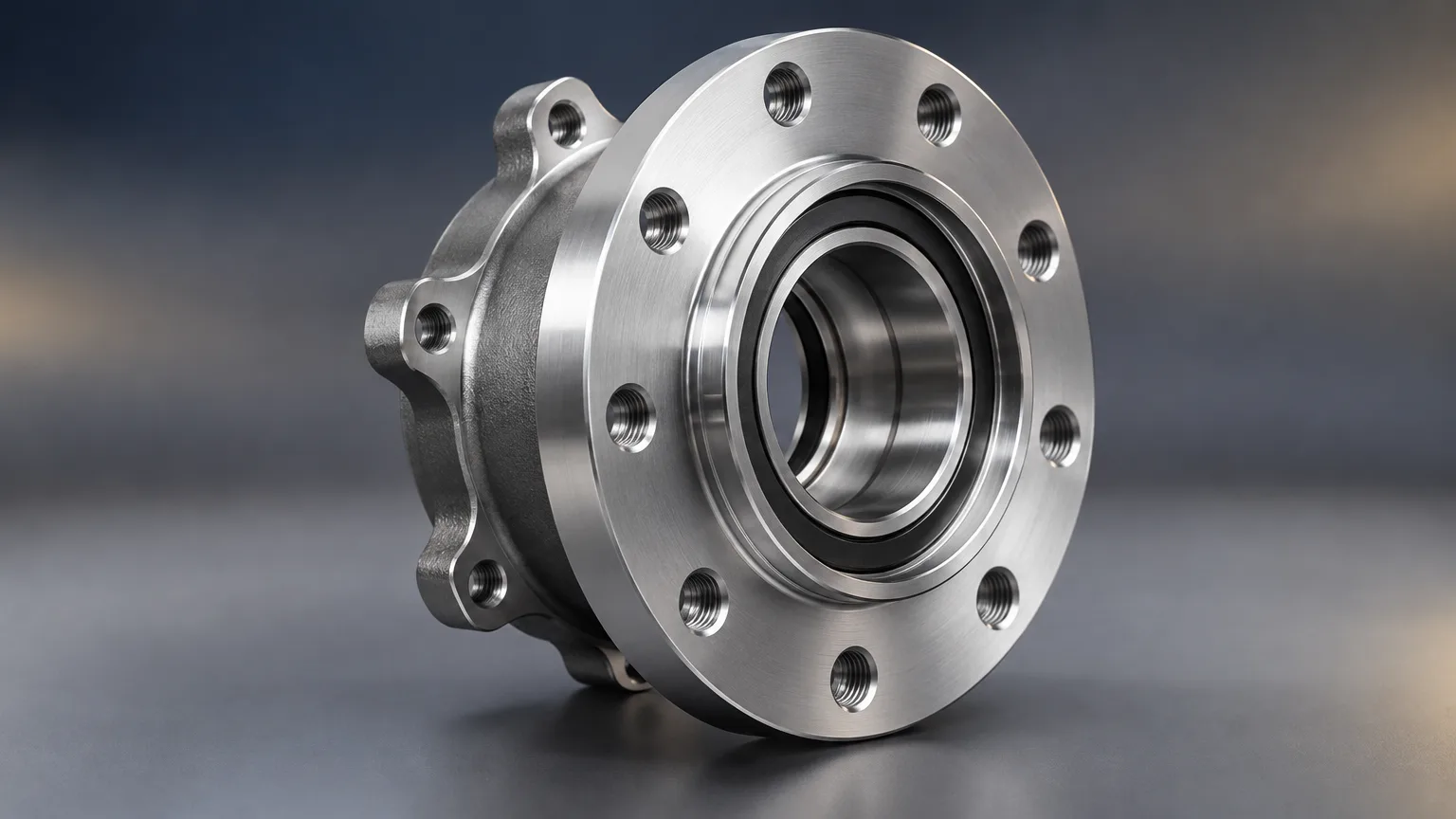
Wheel hub manufacturing is the production of the hub, bearing carrier and wheel that locate the wheel and carry vehicle loads. Routes include casting, forging, CNC machining and assembly. Suppliers work to a drawing with defined tolerances, material and heat treatment, and are commonly required to follow IATF 16949 and PPAP requirements.
What a wheel hub does in a vehicle
A wheel hub is the rotating assembly that mounts the wheel and transfers vertical, lateral and braking loads into the suspension and steering system. It locates the wheel on the axle or spindle, carries the wheel bearing, and provides the mounting face and stud pattern for the wheel.
Hubs and wheels are safety-relevant parts. They are subject to fatigue, corrosion, brake heat and road impact, so geometry, material and heat treatment must be controlled to the drawing. Automotive suppliers commonly operate under IATF 16949 and applicable customer-specific requirements.[1][2]
- Locates and centers the wheel on the axle or spindle.
- Carries radial and axial loads through the bearing interface.
- Transmits drive torque on driven axles.
- Provides the wheel mounting face, studs or bolt holes.
- Supports brake disc or drum mounting on many designs.
Typical wheel hub manufacturing processes
Wheel hub manufacturing is a branch of auto parts manufacturing (also called car parts, automotive parts or vehicle parts manufacturing). It typically combines a forming route (casting or forging) with CNC machining, heat treatment and finishing. The route depends on volume, material, geometry, and the fatigue and tolerance requirements on the drawing.
- Casting Die casting produces near-net-shape aluminum, zinc or magnesium parts quickly; porosity, tooling cost and alloy limits need control. Cast wheels start here.
- Forging Forging gives strong, fatigue-resistant metal parts; tooling, material flow and machining allowances add cost. Forged wheels and high-load hubs are common examples.
- CNC machining CNC machining is precise and flexible for prototypes or low volumes, but material waste and cycle time can be high. It produces the bearing bore, mounting face and stud holes.
- Heat treatment The material and heat-treatment specification define hardness and strength. The drawing must state the test method.
- Finishing Coatings, anodizing or paint protect against corrosion. The drawing specifies surface roughness as Ra or another parameter.
- Assembly and joining Welding, riveting, fastening, bonding or overmolding combine hubs, studs and bearing races; joint strength, distortion and traceability need validation.
- Inspection Dimensional, material and functional checks confirm the part meets the drawing before shipment.
Materials used in wheel hubs and wheels
Aluminum alloys and carbon and alloy steels are the most common materials for automotive components such as wheel hubs and wheels. The drawing must specify the grade; the table lists the main material families.
| Material | Grade | Properties | Typical uses |
|---|---|---|---|
| Aluminum alloys | Unverified; alloy and temper set by drawing | Low density, corrosion resistance, machinability and castability | Wheels, housings, brackets, engine and transmission components |
| Carbon and alloy steel | Unverified; grade and heat treatment set by drawing | High strength, fatigue resistance, hardness and weldability vary by grade | Shafts, suspension, fasteners and structural parts |
| Magnesium alloys | Unverified; alloy set by drawing | Very low density and good castability; corrosion protection is often required | Lightweight housings and brackets |
Incoming material verification and certification review belong in the supplier's control plan. Request material certificates and heat-treatment records for safety-relevant parts.
Quality requirements for wheel hub manufacturing
Wheel hub manufacturing quality is controlled through part approval, traceability and inspection. PPAP is an automotive submission process used to demonstrate that production processes can consistently meet approved requirements; exact customer submission rules vary.
- Part approval: AIAG PPAP and applicable customer-specific requirements; submission level and evidence vary by customer.[1][2]
- Capability: Cp/Cpk targets are customer- and feature-specific, supported by IATF 16949, control plan, SPC and customer-specific requirements.[1][2]
- Traceability: lot, heat and serial records linking material and process history to the delivered part.
- Incoming material verification and certification review.
- In-process inspection of critical features such as bearing bore, mounting face and stud pattern.
- Final inspection of dimensions, surface finish and markings.
- Machining time, setup count and material removal monitored as cost and capability drivers.
Wheel hub specifications and tolerances
The table below lists the specification parameters that should be defined on a wheel hub or wheel drawing. Numerical values depend on process, size, material and drawing, so the supplier must confirm capability for each critical feature.
| Parameter | Typical range | Standard or source |
|---|---|---|
| Dimensional tolerance | Unverified; depends on process, size, material and drawing | Part drawing and supplier capability study required |
| Geometric tolerancing | Unverified; specify datum scheme and GD&T callouts | ASME Y14.5 or applicable ISO GPS standard; exact edition unverified |
| Surface roughness | Unverified; specify Ra or other required parameter | Drawing requirement; applicable surface-texture standard unverified |
| Hardness and strength | Unverified; defined by material and heat-treatment specification | Material specification and test method required |
| Capability | Cp/Cpk targets are customer- and feature-specific | IATF 16949, control plan, SPC and customer-specific requirements.[1][2] |
| Part approval | Submission level and evidence vary by customer | AIAG PPAP and applicable customer-specific requirements.[1][2] |
Volumes and lead times from prototype to production
Prototype wheel hub work usually favors CNC machining or additive manufacturing because tooling is minimized. Production work favors casting, forging or stamping once volume justifies dedicated tooling.
Prototype and low volume
- CNC machining: precise and flexible; material waste and cycle time can be high.
- Additive manufacturing: useful for prototypes, tooling and complex low-volume parts; production rate, surface finish and material qualification may limit use.
- Minimal tooling and shorter design lead time.
Production volume
- Casting: near-net shape at speed; porosity, tooling cost and alloy limits require control.
- Forging: strong, fatigue-resistant parts; tooling, material flow and machining allowances increase cost.
- Stamping: economical for high-volume sheet-metal parts; requires dedicated dies.
- Injection molding: efficient for repeatable plastic parts; tooling cost and design lead time can be substantial.
Lead time depends on tooling, material availability, heat treatment, finishing and inspection. SR returns quotes in 5-7 working days from a complete RFQ package.
Design tips for wheel hub manufacturing
Design decisions made early determine which wheel hub manufacturing route is economical and capable. The tips below reduce cost and risk without weakening the part.
- Define the datum scheme and GD&T callouts so inspection is repeatable.
- Specify material grade and heat treatment on the drawing, not by reference alone.
- Keep wall sections uniform in castings to limit porosity and distortion.
- Allow machining stock on forged and cast surfaces that must be finished.
- Avoid deep, narrow features that increase machining time and tool wear.
- State surface roughness as Ra or another required parameter only where it matters.
- Design for the intended volume: machining for prototypes, casting or forging for production.
- Confirm bearing bore, mounting face and stud pattern tolerances with the supplier early.
Ordering wheel hubs and wheels through SR
Ordering wheel hubs and wheels through SR means sending one RFQ to a manufacturing broker that sources automotive components from vetted automotive component manufacturers. SR does not own factories or machines; it collects quotes, manages quality and inspection, and delivers parts.
- Send CAD, drawing, revision, material, finish, tolerances and quantity.
- State the intended application and any inspection or PPAP requirements.
- Include delivery location and required date.
- SR returns quotes in 5-7 working days.
- SR coordinates supplier selection, quality checks and delivery.
Have a drawing to quote?
Upload it with quantity and material to start a quote.
FAQ
Common questions
What is PPAP?
PPAP (Production Part Approval Process) is an automotive submission process a supplier uses to demonstrate that its production process can consistently meet approved requirements. Submission level and required evidence vary by customer, so confirm the customer-specific rules before production starts, especially for safety-relevant parts such as wheel hubs.
Does IATF 16949 certification guarantee part quality?
No. IATF 16949 is an automotive quality-management system standard, so it shows a supplier has defined process controls and defect prevention. Part conformity still depends on drawing specifications, in-process controls, inspection results and customer requirements, which is why buyers verify each part rather than relying on certification alone.[1][2]
What information is needed for a quote?
A useful RFQ includes CAD, a drawing with revision, material, finish, tolerances and quantity. Add the delivery location, inspection or PPAP needs and the intended application. Complete information lets suppliers confirm the forming route and capability and return comparable quotes without repeated clarification.
What tolerance should be requested?
Request the tightest tolerance needed for function rather than the tightest possible. Tighter tolerances add machining time, setup count and inspection effort, so cost rises. Ask the supplier to confirm capability for each critical feature, ideally with a capability study, before production starts.
Related resources
Keep reading
Ready when you are
Request a wheel hub manufacturing quote
Send your drawing, material, tolerances and quantity. SR collects quotes from a vetted supplier network and returns pricing in 5-7 working days.
Your files stay confidential. NDA available on request.