Automotive Suspension Components
Suspension Parts Manufacturing: Control Arms, Knuckles, Bushings
Sourcing Repository collects quotes from a vetted supplier network for custom control arms, steering knuckles and bushings, then manages quality and inspection through to delivered parts.
- Control arms
- Steering knuckles
- Bushings
- PPAP support
- Quote turnaround5-7 working days from a complete RFQ package
- Inspection managedDrawing-based checks and traceability records
- Process routes coveredMachining, casting, forging, stamping, molding
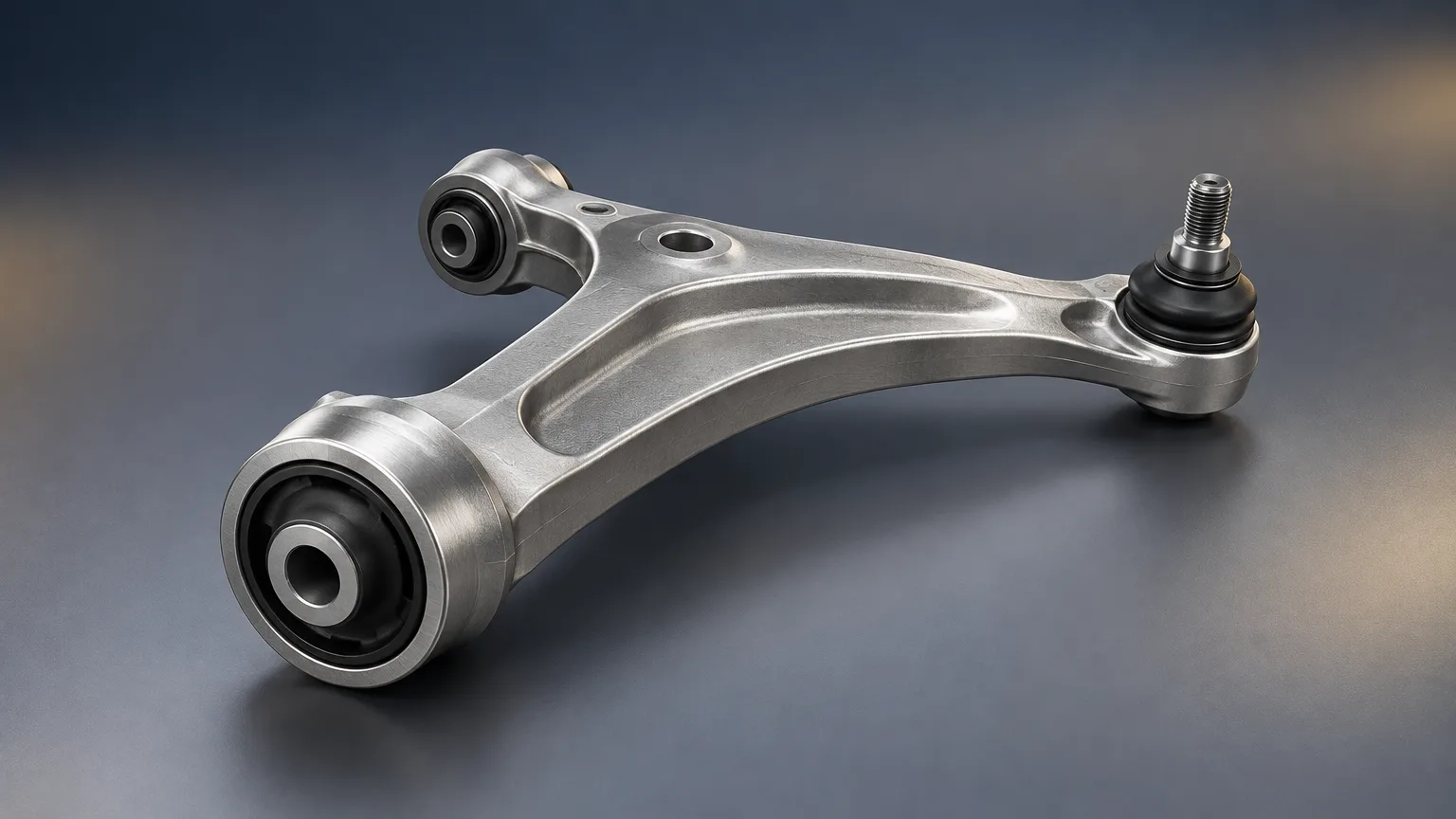
Suspension parts manufacturing covers control arms, steering knuckles and bushings that locate the wheel and manage road loads. Production routes include forging, casting, CNC machining, stamping, injection molding and assembly. Buyers should supply a drawing with tolerances, material, finish, quantity and inspection requirements, plus PPAP expectations, so suppliers can confirm capability.
Function and where suspension parts are used
Suspension parts connect the wheel assembly to the vehicle structure and control how the wheel moves under load. A control arm pivots between the frame or subframe and the wheel hub, a steering knuckle carries the hub, brake and steering attachment points, and a bushing isolates vibration and allows controlled movement at joints.
These parts sit in the braking, steering and suspension systems, where they carry corner loads, braking forces and steering inputs. Because they are safety-relevant, drawing requirements, material specification and inspection records matter as much as the manufacturing route itself.
- Control arm: locates the wheel, sets geometry through its pivot and ball-joint points, and carries corner loads.
- Steering knuckle: carries the wheel hub, brake caliper mounts and steering arm attachment; geometry affects steering feel and brake alignment.
- Bushing: allows controlled flex, reduces noise and vibration transfer, and extends joint life.
- Related components in the same assembly: ball joints, tie-rod ends, stabilizer links, subframes and brackets.
Typical suspension parts manufacturing processes
Typical suspension parts manufacturing processes combine a primary forming route with machining, joining and finishing. As in wider auto parts manufacturing, the choice depends on volume, geometry, material and how tight the critical features must be.
- CNC machining CNC machining is precise and flexible for prototypes or low volumes; material waste and cycle time can be high. It suits knuckle machining, bushing sleeves and post-forging finishing.
- Forging Forging provides strong, fatigue-resistant metal parts; tooling, material flow and machining allowances increase cost. It is common for control arms and knuckles under cyclic loading.
- Die casting Die casting produces near-net-shape aluminum, zinc or magnesium parts quickly; porosity, tooling cost and alloy limits require control. It fits brackets, housings and some knuckle designs.
- Stamping Stamping is economical for high-volume sheet-metal parts but needs dedicated dies and suits complex 3D forms poorly. Steel control-arm plates are typical examples.
- Injection molding Injection molding is efficient for repeatable plastic parts; tooling cost and design lead time can be substantial. It covers bushings, sleeves and covers where the load path allows polymer.
- Additive manufacturing Additive manufacturing suits prototypes, tooling and complex low-volume parts; production rate, surface finish and material qualification may limit use. Treat printed parts as development items unless the process is qualified.
- Assembly and joining Welding, riveting, fastening, bonding or overmolding combine components; joint strength, distortion and traceability require validation.
| Comparison | Key differences |
|---|---|
| Forging vs casting | Casting supports complex near-net shapes; forging generally provides stronger directional grain and fatigue performance. |
| Stamping vs machining | Stamping is faster and economical for sheet-metal volume; machining offers greater flexibility and localized precision. |
| CNC machining vs injection molding | Machining favors low volume, tight features, and metal parts; molding favors high-volume plastic production after tooling investment. |
| Prototype vs production part | Prototype routes minimize tooling and lead time; production routes optimize repeatability, cycle time, capability, and total cost. |
| OEM production vs aftermarket custom | OEM programs usually require validated processes, traceability, and customer approval; custom aftermarket work often prioritizes flexibility and low-volume economics. |
Materials used in control arms, knuckles and bushings
Steel and aluminum are the main materials in control arms and knuckles, while elastomers and engineering plastics cover bushings. Material choice follows the load path, corrosion exposure and weight target for these automotive components.
| Material | Grade | Properties | Typical uses |
|---|---|---|---|
| Aluminum alloys | Unverified; grade must be specified by drawing | Low density, corrosion resistance, machinability, and castability | Brackets, housings, wheels, engine and transmission components |
| Carbon and alloy steel | Steel grade unverified; drawing sets it | High strength, fatigue resistance, hardness, and weldability vary by grade | Stampings, shafts, gears, suspension, fasteners, and structural parts |
| Magnesium alloys | Magnesium alloy unverified; drawing sets it | Very low density and good castability; corrosion protection is often required | Lightweight housings, brackets, seat frames, and instrument-panel structures |
| Polyamide | Polymer grade unverified; drawing sets it | Good strength, wear resistance, and temperature capability; moisture affects dimensions | Gears, clips, brackets, connectors, and under-hood parts |
Bushing-specific materials
Bushings commonly use elastomers or polyurethane for the flexible element, with steel, aluminum or polymer sleeves. Specify hardness or durometer, temperature range and chemical exposure, because these drive bushing life more than geometry alone.
Quality requirements for suspension parts manufacturing
Quality requirements for suspension parts manufacturing center on part approval, process control and traceability. SR works with automotive component manufacturers that operate under recognized automotive quality frameworks, and inspection is planned from the drawing rather than added at shipment.
What PPAP covers
PPAP is an automotive submission process used to demonstrate that production processes can consistently meet approved requirements; exact customer rules vary. It links the drawing, process flow, control plan and dimensional and material evidence into one approval package.
Traceability and inspection
- Material certificates tied to heat or lot number.
- First article inspection reports covering drawing dimensions, GD&T and surface requirements.
- In-process checks of ball-joint bores, pivot bores, mounting faces and knuckle hub bores.
- Capability studies on critical features, with Cp/Cpk targets set by the customer or program.
- Non-destructive testing such as magnetic particle, dye penetrant or X-ray where porosity or crack risk exists.
- Final inspection and documentation so the delivered lot matches the approved part.
Specs and tolerances for suspension part production
There is no universal tolerance for a control arm, knuckle or bushing. Acceptable values depend on process, size, material and the drawing, so the supplier should confirm capability on each critical feature.
| Parameter | Typical range | Standard or source |
|---|---|---|
| Dimensional tolerance | Unverified; depends on process, size, material, and drawing | Part drawing and supplier capability study required |
| Geometric tolerancing | Unverified; specify datum scheme and GD&T callouts | ASME Y14.5 or applicable ISO GPS standard; exact edition unverified |
| Surface roughness | Unverified; specify Ra or other required parameter | Drawing requirement; applicable surface-texture standard unverified |
| Hardness and strength | Unverified; defined by material and heat-treatment specification | Material specification and test method required |
| Capability | Cp/Cpk targets are customer- and feature-specific | IATF 16949, control plan, SPC, and customer-specific requirements. |
| Part approval | Submission level and evidence vary by customer | AIAG PPAP and applicable customer-specific requirements. |
Practical tolerance guidance
Call out tolerances as typical ranges that reflect function, not the tightest value a machine can hit. Tightening an unused dimension adds cost without improving fit or safety. Reserve tight tolerances for load paths, bearing bores, ball-joint seats and mounting faces where alignment actually matters.
- Define datums that match how the part locates on the vehicle, not how it is easy to measure.
- Separate critical-to-function features from cosmetic or clearance features in the drawing notes.
- State units consistently and include both size and geometric requirements for bores and faces.
- Flag high-risk features such as cast or forged porosity zones and heat-affected weld regions.
Volumes and lead times from prototype to production
Suspension parts manufacturing spans one-piece development builds through high-volume production. Tooling choice sets the break point: machining and additive routes avoid tooling, while forging, casting and stamping need dedicated dies or molds that only pay back at volume.
Prototype and low volume
- CNC machining or additive for fit checks and development builds
- No dedicated tooling, so changes are cheaper between revisions
- Best when geometry is still moving or the program is not yet released
- Inspection can be first-article focused rather than full capability study
Production volume
- Forging, die casting, stamping or molding for repeatability and cycle time
- Tooling cost amortized across the program
- Process control plans, SPC and capability studies apply
- PPAP evidence and traceability are part of the release package
SR provides a quote turnaround of 5-7 working days once the RFQ package is complete. Actual production lead time varies with process, tooling and inspection scope, so treat any schedule as a project-specific commitment confirmed by the supplier.
DFM tips for control arms, knuckles and bushings
DFM tips for control arms, knuckles and bushings start with function-based tolerances, machining access and consistent wall thickness. Decisions made early usually cost less than changes after tooling, and these features most often drive cost, scrap or inspection disputes in suspension parts manufacturing and wider automotive parts manufacturing.
- Set tolerances from function, not habit. A typical tight callout such as 0.005 in (0.13 mm) belongs only on critical bores; over-tight tolerances raise cost and reduce yield.
- Give machining access to hub bores, pivot bores and ball-joint seats.
- Keep wall thickness and ribs consistent in cast or molded parts to reduce porosity, sink and distortion.
- Specify generous fillets at load transitions; sharp internal corners concentrate stress.
- Design drafts and parting lines that allow simple dies and avoid undercuts.
- Plan heat treatment and coating before final machining so distortion does not break finished tolerances.
- For bushings, define durometer, sleeve material and retention method.
- Consider a modular design: a common knuckle or arm with varied bushing or bracket options can reduce tooling across a model range.
Geometry, size, wall thickness and tolerance requirements all affect processing. When those inputs are stable, suppliers can propose a route rather than quote a wide cost range.
Ordering suspension parts manufacturing through SR
SR is a manufacturing broker. It does not own factories or machines. It collects quotes from a vetted supplier network, manages quality and inspection, and delivers parts, with the primary keyword search starting at the automotive parts hub.
- Send the RFQ package Provide CAD, drawing, revision, material, finish, tolerances, quantity, delivery location, inspection needs, and intended application.
- Scope the route SR reviews the part against the process routes and materials available in the network and flags missing information.
- Receive quotes Quotes are collected from vetted suppliers. Quote turnaround is 5-7 working days for a complete package.
- Approve, inspect and receive SR manages quality and inspection activities and coordinates delivery, with documentation matched to the approved part.
Have a drawing to quote?
Upload it with quantity and material to start a quote.
FAQ
Common questions
Does IATF 16949 certification guarantee part quality?
No. Certification confirms a supplier operates a recognized automotive quality-management system. Part conformity still depends on the drawing, material, process control, inspection and customer requirements, so review the PPAP evidence and inspection records for the actual part.
Can a supplier make a suspension part without a drawing?
A supplier may reverse-engineer a sample or build a model, but requirements, ownership, tolerances, materials and approval responsibilities should be agreed in writing first. Without a drawing, tolerance and traceability expectations are undefined, which is risky for safety-relevant parts.
What information is needed for a quote on control arms or knuckles?
Provide CAD, drawing, revision, material and grade, heat treatment, finish, tolerances, quantity, delivery location, inspection needs, and the intended application. State the vehicle program and whether PPAP or first-article documentation is required, so the quote reflects the correct route.
What tolerance should be requested for a steering knuckle?
Request the tightest tolerance needed for function, not the tightest possible tolerance. Concentrate tight callouts on hub bores, pivot bores, ball-joint seats and mounting faces, and ask the supplier to confirm capability for each critical feature before production.
Related resources
Keep reading
Ready when you are
Ready to quote your suspension parts?
Send your drawings, material, tolerances and volumes. SR collects quotes from its vetted supplier network, manages quality and inspection, and delivers parts. Quote turnaround is 5-7 working days.
Your files stay confidential. NDA available on request.