
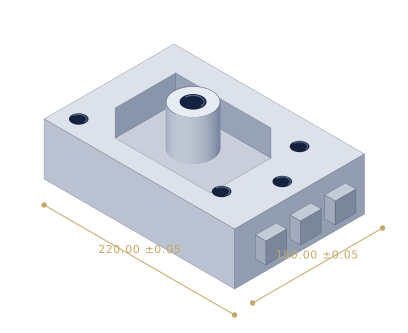
- STEP 01 · REVIEW TIME
1. Define requirements and issue an RFQ
Provide drawings, material and finish specifications, quantities, acceptance criteria and target dates. The customer issues specifications or an RFQ, and the manufacturer reviews manufacturability.
- STEP 02 · QUOTE IN
2. Supplier matching and quoting
Sourcing Repository routes the RFQ to suppliers in its vetted network whose processes fit the part. Quotes are returned in 5-7 working days. Compare price, process capability and quality evidence, not price alone.
- STEP 03 · LEAD TIME PER QUOTE
3. Manufacturability review and clarification
Suppliers flag features that are difficult to produce, propose alternatives, and confirm tooling or process needs. Resolve these points before tooling is cut.
- STEP 04 · TERMS
4. Prototype or first article approval
Where required, an initial part or production sample is verified against the drawing and requirements before wider production. FAI terminology and required report content may vary by contract, industry and customer specification.
5. Production with in-process controls
Production runs under documented process controls and in-process inspection. Establish validated limits for critical steps and record the results.
6. Final inspection and documentation
Parts are checked against the quality plan, purchase order and customer specification. Inspection level, sample size and acceptance criteria should be defined in advance.
7. Packaging, logistics and delivery
Packaging, labeling and shipment are coordinated to the agreed schedule. Sourcing Repository manages this stage and delivers the parts.
How It Works
How a Contract Manufacturer Works
Contract manufacturing is outsourcing part or all of a product's production to a third-party manufacturer under a formal agreement. This page shows how Sourcing Repository runs that process for custom parts.
Contract manufacturing is outsourcing part or all of a product's production to a third-party manufacturer under a formal agreement. The customer supplies designs, specifications, quantities and acceptance criteria; the contract manufacturer may provide sourcing, tooling, production, inspection, packaging and logistics.
Overview
What a Contract Manufacturer Does for a Buyer
A contract manufacturer produces parts or products to your specifications under a formal agreement. You keep control of the design and acceptance criteria; the manufacturer handles sourcing, tooling, production, inspection, packaging and logistics as agreed.
This matters to buyers for two reasons. It reduces internal capital expenditure and manufacturing overhead, and it lets you manufacture regulated products with documented quality systems. Sourcing Repository is a manufacturing broker: it does not own factories or machines. It collects quotes from a vetted supplier network, manages quality and inspection, and delivers parts.
Start an RFQDetails
How Contract Manufacturing Works: Scope, Materials and Processes
How contract manufacturing works depends on how much scope you transfer. A narrow scope covers one process, such as machining. A broad scope covers sourcing, production, inspection, assembly, packaging and delivery. Exact scope is agreement-dependent, so define it in writing before production.
Common production routes
| Route | Pros | Cons |
|---|---|---|
| Machining | Good for prototypes, low-to-medium volumes, and tight drawing-controlled features. | Material waste, tooling wear, and higher unit cost at high volume. |
| Injection molding | Repeatable, fast production of polymer parts after tooling is complete. | Mold cost and lead time; design changes can require mold modification. |
| Sheet-metal fabrication | Suitable for enclosures, brackets, panels, and moderate production volumes. | Bend allowances, springback, distortion, and tooling constraints require control. |
| Casting | Produces complex shapes and can reduce machining at scale. | Requires patterns or dies; porosity, shrinkage, and dimensional variation are risks. |
| Additive manufacturing | Rapid prototypes and complex low-volume geometries without conventional tooling. | Build anisotropy, surface finish, material limits, and slower unit economics. |
| Assembly and packaging | Consolidates component integration, testing, labeling, and shipment. | Line balancing, traceability, supplied-part quality, and change control add complexity. |
Materials you can specify
| Material | Grade | Properties | Typical uses |
|---|---|---|---|
| Aluminum | Unverified; specify an applicable alloy such as 6061-T6 only when required by the drawing. | Grade-dependent strength, corrosion behavior, machinability, and heat treatment. | Machined parts, brackets, housings, panels, and lightweight assemblies. |
| Stainless steel | Unverified; specify the exact grade, condition, and applicable material standard. | Grade-dependent corrosion resistance, strength, weldability, and machinability. | Process equipment, medical components, enclosures, fasteners, and food-contact hardware. |
| Carbon steel | Unverified; specify grade, chemistry, condition, and coating requirements. | Generally high stiffness and strength; corrosion protection may be required. | Frames, brackets, shafts, fabricated structures, and general industrial components. |
| Engineering polymers | Unverified; identify resin family, reinforced content, color, and applicable specification. | Grade-dependent strength, temperature resistance, chemical resistance, creep, and shrinkage. | Molded housings, seals, covers, insulators, wear parts, and consumer products. |
| Elastomers | Unverified; specify polymer, hardness, compound, and compatibility requirements. | Elasticity, sealing behavior, compression set, temperature range, and chemical resistance vary by compound. | Gaskets, seals, vibration isolators, grips, and flexible components. |
Specifications to control
| Parameter | Typical range | Standard or source |
|---|---|---|
| Dimensional tolerance | Unverified; tolerance is drawing-, process-, material-, and feature-dependent. | Customer drawing and controlled specification; process tolerances may be defined in drawings, work instructions, or material specifications. |
| Material condition | Unverified; define alloy or resin grade, temper or condition, and certification. | Approved material specification and purchase requirements. |
| Surface finish | Unverified; specify roughness, coating, plating, or cosmetic acceptance criteria. | Engineering drawing, finish specification, and approved sample where applicable. |
| Inspection sampling | Unverified; define inspection level, sample size, and acceptance criteria. | Quality plan, purchase order, customer specification, or applicable industry standard. |
| Process parameters | Unverified; establish validated limits for critical steps. | Process specification, control plan, work instructions, or quality manual. |
| Lead time and quantity | Unverified; negotiated by product, volume, tooling, and capacity. | Manufacturing services agreement, purchase order, and production schedule. |
Process
The Contract Manufacturing Process, Step by Step
The process runs from specification to inspected delivery. Each step produces a document you can check, which is what makes the agreement enforceable.
Have a drawing ready?
Upload your files and quantity. You get DFM notes and quotes from matched suppliers.
Standards and proof
Standards and Proof in Contract Manufacturing
Standards set the baseline; proof is the documented evidence that the baseline was met on your order. Ask for both. Certification alone does not replace process audits, product inspection, capability evidence or industry-specific requirements.
ISO 9001
Suppliers we work with hold ISO 9001 quality management certification.
IATF 16949
Automotive suppliers we work with hold IATF 16949 certification for production part quality.
AS9100
Aerospace suppliers we work with hold AS9100 certification.
PPAP
Suppliers we work with submit Production Part Approval Process evidence when a program requires it.
Next steps
Next Steps: Send Your RFQ to Sourcing Repository
Send your drawings, specifications, quantities and acceptance criteria to start. Sourcing Repository collects quotes from its vetted supplier network, manages quality and inspection, and delivers the parts. Quotes are returned in 5-7 working days.
Questions before you submit? Email killol@sourcingrepository.com. Sourcing Repository, 201 SG Mall, Ahmedabad.
- Prepare a complete RFQ: drawings, material and finish specs, quantities, acceptance criteria, target dates.
- State which standards or inspection evidence you require.
- Confirm who owns the design and tooling, and how engineering changes are handled.
- Submit the RFQ and review returned quotes on capability and evidence, not price alone.
FAQ
Questions about how sourcing works
Not covered here? Talk to an engineer before you send a drawing.
Talk to an engineerHow does contract manufacturing work?
The customer issues specifications or an RFQ; the manufacturer reviews manufacturability, quotes, prototypes or tools as needed, produces approved parts, inspects them, and ships under agreed requirements. Sourcing Repository adds a broker layer: it collects quotes from a vetted supplier network, manages quality and inspection, and delivers the parts.
What is first article inspection?
First article inspection is documented verification of an initial part or production sample against the drawing and requirements before wider production. It confirms the process can meet the specification. FAI terminology and required report content may vary by contract, industry and customer specification, so agree the format up front.
Can a contract manufacturer source materials?
Yes. Many providers can source raw materials and coordinate production, packaging and delivery, but responsibilities and approval requirements should be contractual. Specify the grade, condition and certification you need, and state whether material substitution requires your written approval before the order runs.
Who owns the design and tooling?
Ownership is contract-dependent. Define intellectual property, tooling title, maintenance, access, relocation, confidentiality and engineering-change rights in the manufacturing services agreement. If you pay for tooling, state explicitly whether title transfers to you and under what conditions it can be moved to another supplier.
Ready when you are
Ready to source custom parts?
Send drawings, specifications and quantities. Sourcing Repository collects quotes from a vetted supplier network, manages quality and inspection, and delivers parts. Quotes in 5-7 working days.
Your files stay confidential. NDA available on request.