
Sheet metal process overview
How cutting, forming, joining, and finishing fit together in one production route.
Sourcing Repository guide
A practical sheet metal fabrication guide for engineers and procurement teams: processes, materials, tolerances, cost drivers and supplier selection for custom and precision parts.
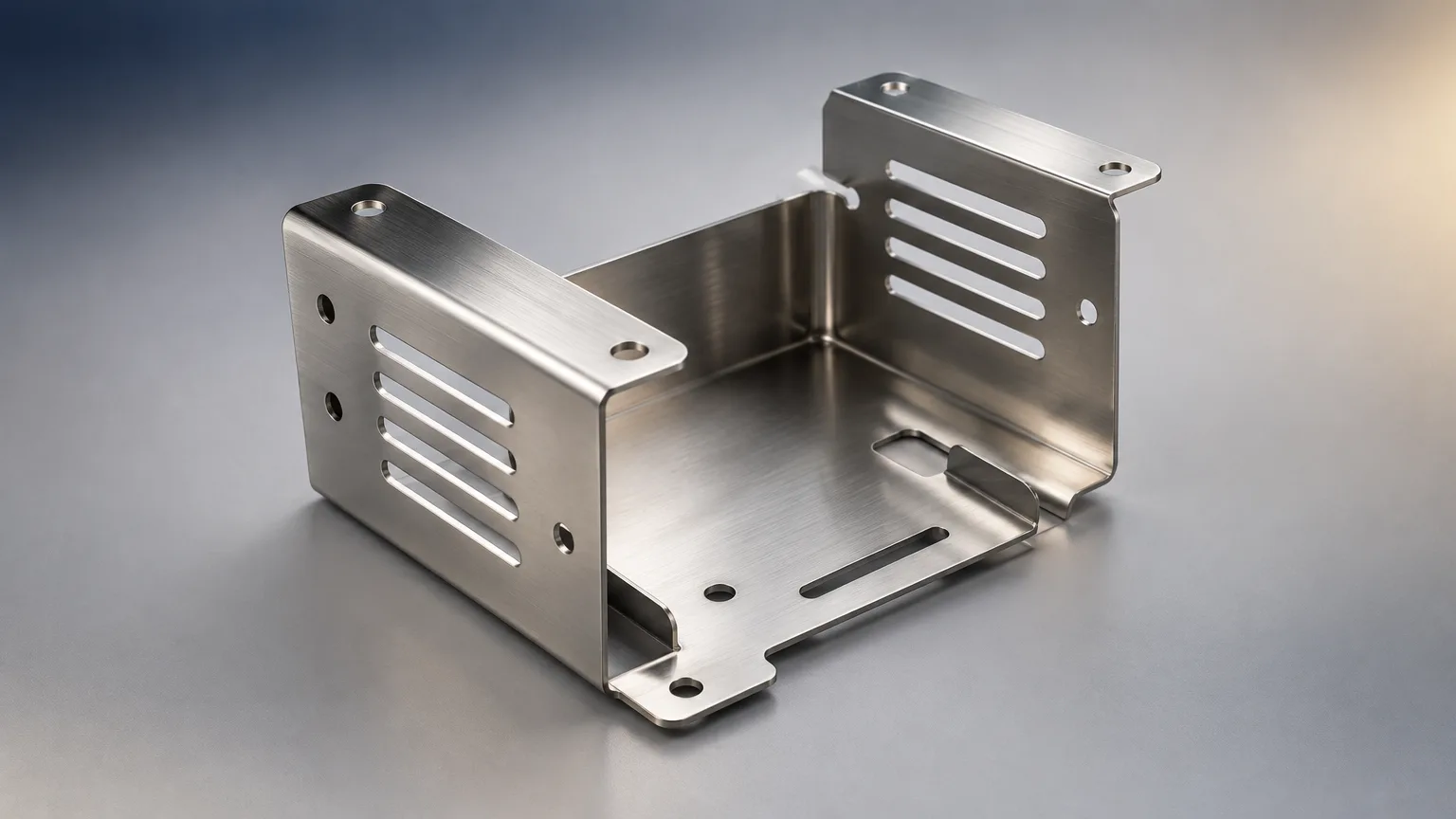
How cutting, forming, joining, and finishing fit together in one production route.
Laser cutting capability, edge quality, heat effects, and when to choose it over punching.
Bend radii, bend relief, hole-to-bend distance, and forming limits.
Material grades, thickness and gauge choice, availability, and purchased-sheet size.
Weld processes, distortion control, PEM insertion, and assembly strategy.
Coating, plating, and surface treatment selection and their effect on fit and cost.
Sheet metal fabrication is the conversion of flat metal sheet into finished parts or assemblies through cutting, forming, joining and finishing. This sheet metal fabrication guide covers the main processes, material selection, design rules and typical tolerances, cost drivers, and a supplier checklist, so buyers can specify parts and compare quotes with confidence.
Fabricators turn flat metal sheet into finished parts or assemblies by cutting, forming, joining, and finishing it. This overview explains how those steps fit together and what buyers must specify to get comparable quotes.
This sheet metal fabrication guide is a practical reference for engineers and buyers sourcing custom sheet metal parts. It explains the main processes, materials, tolerances, cost drivers, and supplier checks, so quotes can be compared against the same specification.
Custom and precision fabrication differ mainly in required repeatability, dimensional control, inspection, and secondary processing. The chapters below move from process selection through materials, design rules, tolerances, cost, and supplier evaluation. Read them in order for a new part, or jump to the chapter that matches your open question.
The guide is organized as a set of chapters, each answering one sourcing question. Read them in order for a full picture, or jump to the chapter that matches your current decision.
| Chapter | What it covers | Link |
|---|---|---|
| Sheet metal process overview | How cutting, forming, joining, and finishing fit together in one production route. | /resources/guides/sheet-metal-fabrication-guide/sheet-metal-process-overview/ |
| Laser cutting guide | Laser cutting capability, edge quality, heat effects, and when to choose it over punching. | /resources/guides/sheet-metal-fabrication-guide/laser-cutting-guide/ |
| Bending and forming design rules | Bend radii, bend relief, hole-to-bend distance, and forming limits. | /resources/guides/sheet-metal-fabrication-guide/bending-and-forming-design-rules/ |
| Sheet metal materials and gauge selection | Material grades, thickness and gauge choice, availability, and purchased-sheet size. | /resources/guides/sheet-metal-fabrication-guide/sheet-metal-materials-and-gauge-selection/ |
| Welding and assembly options | Weld processes, distortion control, PEM insertion, and assembly strategy. | /resources/guides/sheet-metal-fabrication-guide/welding-and-assembly-options/ |
| Finishes for sheet metal parts | Coating, plating, and surface treatment selection and their effect on fit and cost. | /resources/guides/sheet-metal-fabrication-guide/finishes-for-sheet-metal-parts/ |
Each chapter states its topic directly, gives typical values where published guidelines exist, and flags where supplier capability must be confirmed.
Sheet metal fabrication processes fall into five common routes, each trading tooling investment against volume, geometry, and repeatability. The right route depends on quantity, part complexity, and how often the design will change.
| Route | Typical sequence | Pros | Cons |
|---|---|---|---|
| Laser or plasma cutting | Laser or plasma cutting, press-brake forming, deburring | Flexible, economical for prototypes and varied geometries | Heat-affected edges; forming requires bend compensation |
| Turret punching | Turret punching, forming, and deburring | Fast repetitive production; efficient holes and louvers | Tooling constraints; punch marks and distortion may occur |
| Shearing and welding | Shearing, bending, and welding | Suitable for simple parts and heavy-gauge work | Lower geometric flexibility; weld distortion requires control |
| Stamping | Stamping with dedicated dies | Very low unit cost at high volumes; repeatable | High tooling investment; poor fit for frequent design changes |
| Full assembly | Cutting, forming, PEM insertion, welding, and coating | Delivers complete assemblies from a single supply chain | Additional setup, coordination, and inspection requirements |
Laser handles varied profiles without dedicated tooling; punching is often faster for repeated holes, forms, and high-volume patterns. For low-to-medium volumes with design changes still in play, laser cutting plus press-brake forming is usually the more flexible route.
Press brakes require less tooling and suit low-to-medium volumes; stamping requires dies but can reduce unit cost at high volume. Move to stamping only when the design is stable and annual volume justifies the die.
Material grade, thickness, availability, and purchased-sheet size drive both formability and price. The table below summarizes the sheet materials most often specified for custom and precision parts.
| Material | Grade | Properties | Typical uses |
|---|---|---|---|
| Low-carbon steel | AISI 1010 or 1018; verify mill specification | Good formability, weldability, and relatively low material cost | Brackets, cabinets, machine guards, and structural panels |
| Cold-rolled steel | ASTM A1008; grade must be specified | Smooth finish, consistent thickness, good forming capability | Enclosures, panels, appliance parts, and precision blanks |
| Stainless steel | 304 or 316; ASTM specification required | Corrosion resistance; 316 generally offers better chloride resistance | Food, chemical, medical, outdoor, and marine equipment |
| Aluminum | 5052-H32 or 6061-T6; ASTM B209 applies to sheet | Low density, corrosion resistance, and good machinability; 5052 forms better | Lightweight enclosures, transportation, electronics, and covers |
| Galvanized steel | ASTM A653; coating designation must be specified | Zinc coating provides corrosion protection; welding requires process controls | HVAC, outdoor enclosures, ductwork, and utility hardware |
5052-H32 generally forms better; 6061-T6 generally offers higher strength but reduced bendability. If a part needs tight bends, 5052 is usually the safer starting point.
Both resist corrosion; 316 is generally preferred for stronger chloride exposure, at higher material cost. Specify the ASTM product specification on the drawing so the mill certificate can be checked against it.
Specify only functional tolerances. Use a stated general-tolerance standard or confirmed supplier capability, then identify critical features individually. Over-tolerancing adds inspection and rework cost without improving function.
| Parameter | Typical range | Standard or source |
|---|---|---|
| Flat cut feature location | ±0.005 in (±0.13 mm), process and supplier dependent | Protolabs design guidelines |
| Bend-to-hole or bend-to-feature | ±0.015 to ±0.025 in (±0.38 to ±0.64 mm) | Protolabs design guidelines |
| Dimensions across three or more bends | ±0.030 to ±0.040 in (±0.76 to ±1.02 mm) | Protolabs design guidelines |
| Forming and bending | ±0.020 in (±0.51 mm) | Brighton design guide; supplier capability must be confirmed |
| Angular tolerance | ±2° | Brighton design guide; unverified as universal default |
| General tolerance | Specify individually; ISO 2768 may provide defaults | ISO 2768; class and applicability must be stated |
| Blank surface roughness | Ra 125 µin (3.2 µm) maximum | Brighton design guide; supplier-specific |
Sheet metal fabrication cost drivers are the specification and process choices that set a quote: material, nesting, cutting, forming, tooling, labor, joining, finishing, inspection, packaging, quantity, and schedule. Cost is therefore driven as much by specification choices as by part size.
Ask suppliers to separate material, processing, finishing, and inspection into distinct lines. That breakdown shows which driver dominates and where a design or specification change would have the most effect.
Supplier selection should be based on demonstrated capability for your specific material, thickness, tolerance, and finish, not on a general claim of experience. Use the checklist below before releasing production.
Upload it with quantity and material to start a quote.
FAQ
Suppliers generally evaluate material, nesting, cutting, forming, tooling, labor, joining, finishing, inspection, packaging, quantity, and schedule. Ask for a breakdown by these elements so quotes can be compared on scope rather than on a single total price.
Precision sheet metal fabrication is fabrication requiring controlled repeatability and tighter dimensional or geometric requirements, normally supported by defined inspection and process controls. It typically adds tighter tolerances, controlled processes, specialized inspection, and more secondary operations than standard custom work.
Provide a native CAD file, a drawing with datums and tolerances, material and thickness, finish, quantity, revision, inspection requirements, and packaging instructions. Missing any of these usually produces a quote with assumptions that later change price or schedule.
Specify only functional tolerances. Use a stated general-tolerance standard or confirmed supplier capability, then identify critical features individually. Typical published values include ±0.005 in (±0.13 mm) for flat cut feature location and ±0.015 to ±0.025 in (±0.38 to ±0.64 mm) for bend-to-hole dimensions.
Related resources
Ready when you are
Send your drawing package and SR will collect quotes from vetted suppliers, manage quality and inspection, and deliver the finished parts. Typical quote turnaround is 5-7 working days.
Your files stay confidential. NDA available on request.